
Introduction
For over half a century, the computer industry has thrived on Moore’s Law—the prediction that transistor density doubles roughly every two years. This has enabled exponential improvements in computing power, fueling everything from personal computers to cloud-scale AI.
But as transistor sizes approach atomic limits, silicon’s scalability is hitting a wall. Heat dissipation, quantum tunneling, and astronomical fabrication costs are slowing progress. The world now faces the most fundamental question in computer science:
What comes after silicon?
This blog explores the emerging landscape of post-silicon computing—from quantum to neuromorphic, from DNA to photonics. For software engineers and leaders, understanding these shifts is essential to anticipate the new programming paradigms, system designs, and leadership challenges of the next era.
The Limits of Silicon
The Shrinking Transistor
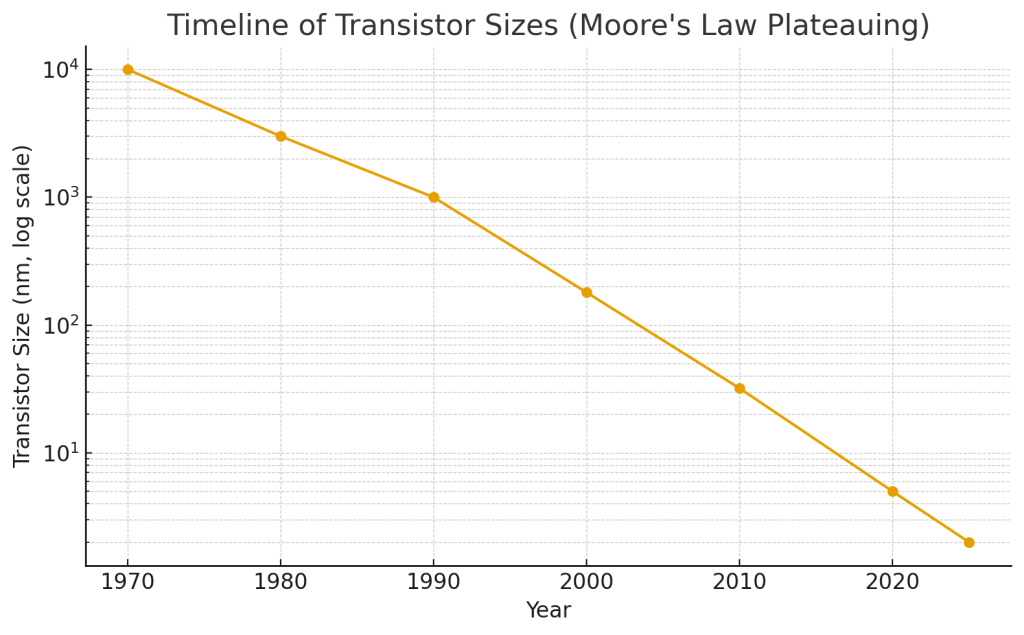
Transistors, once measured in micrometers, are now at the 2–3 nm scale. At this point:
- Quantum tunneling causes electrons to “leak” through barriers.
- Heat generation becomes difficult to manage.
- Fabrication costs for new fabs exceed tens of billions of dollars.
Diagram:
A timeline of transistor sizes (1970s → 2020s), showing Moore’s Law plateauing around 2025.
Quantum Computing
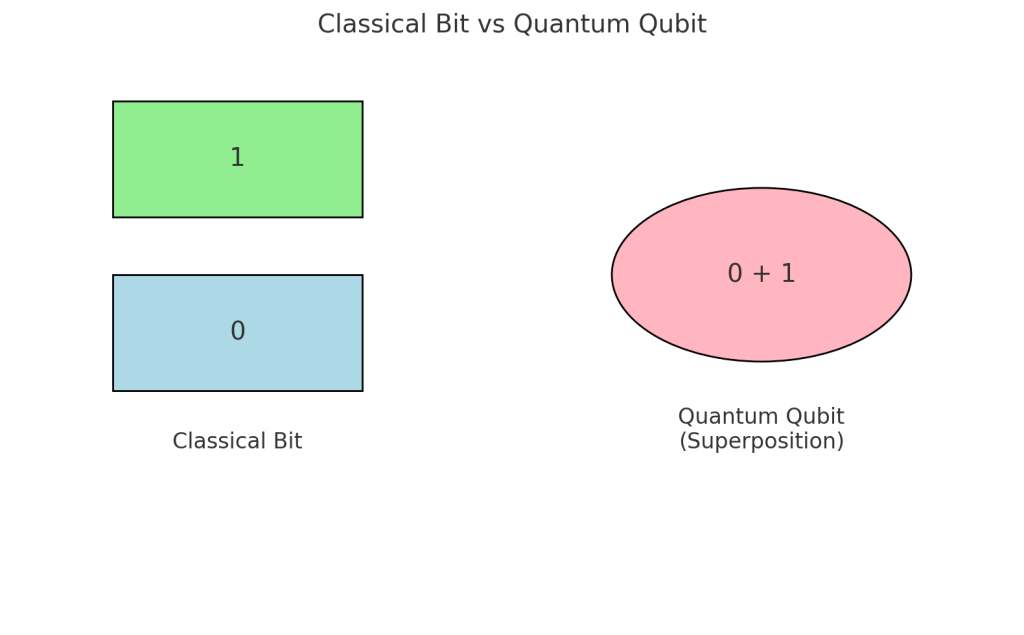
Quantum computing is the most hyped candidate for post-silicon computing. Unlike classical bits (0 or 1), qubits can exist in superposition, enabling massive parallelism.
Applications
- Cryptography – Shor’s algorithm threatens RSA encryption.
- Optimization – Logistics, finance, and drug discovery.
- AI & ML – Faster training of deep neural networks.
Challenges
- Error correction is resource-intensive.
- Qubits decohere easily due to environmental noise.
- Scaling beyond 1000 qubits remains difficult.
Diagram:
Side-by-side comparison of Classical Bit vs Quantum Qubit, showing superposition and entanglement.
Neuromorphic Computing
Neuromorphic computing mimics the architecture of the human brain with spiking neural networks. Instead of binary logic, it uses event-driven models that are massively parallel and energy-efficient.
Applications
- Real-time pattern recognition (e.g., vision, speech).
- Edge AI – Low-power devices like IoT sensors.
- Adaptive robotics – Systems that learn continuously.
Challenges
- Programming neuromorphic chips requires new paradigms. Traditional imperative languages won’t fit.
- Lack of standard frameworks and tools.
Diagram:
Brain-inspired Neuromorphic Chip Architecture vs Classical CPU/GPU.

DNA & Biocomputing
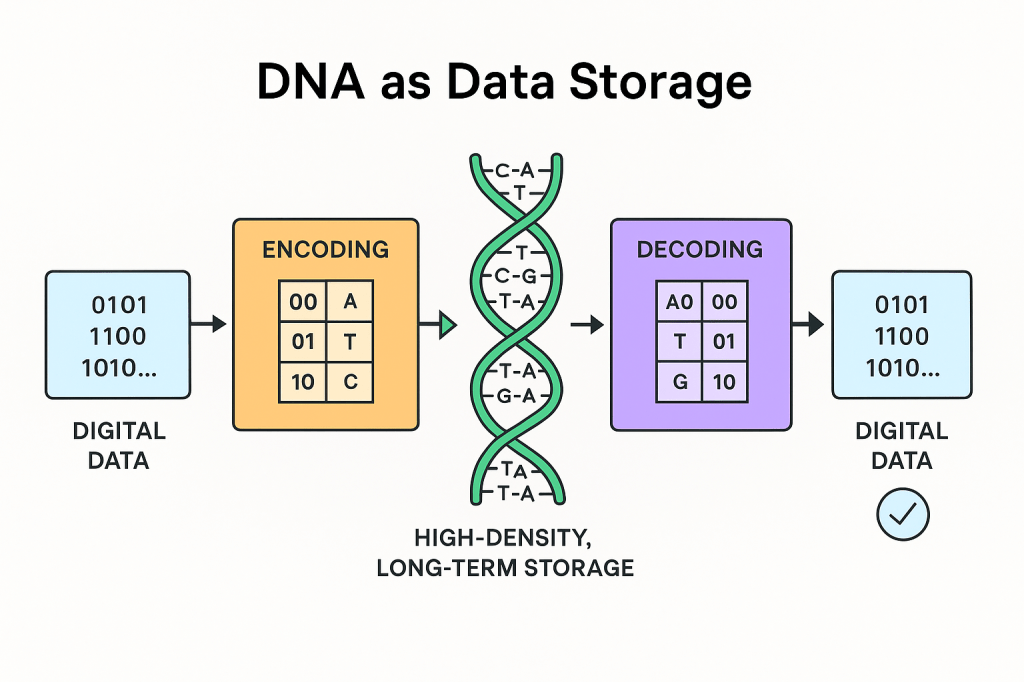
DNA isn’t just the code of life—it’s also a high-density storage medium. A single gram of DNA can theoretically hold 215 petabytes of data. Beyond storage, DNA can also be used for parallel molecular computation.
Applications
- Long-term archival storage – Data lasting thousands of years.
- Medical computing – Processing biochemical data inside cells.
- Massive parallel search problems.
Challenges
- Slow read/write times compared to silicon.
- High cost of DNA synthesis.
Diagram:
Visual of DNA strands as data storage with encoding/decoding pipeline.
Photonics & Carbon Nanotubes
Photonic Computing
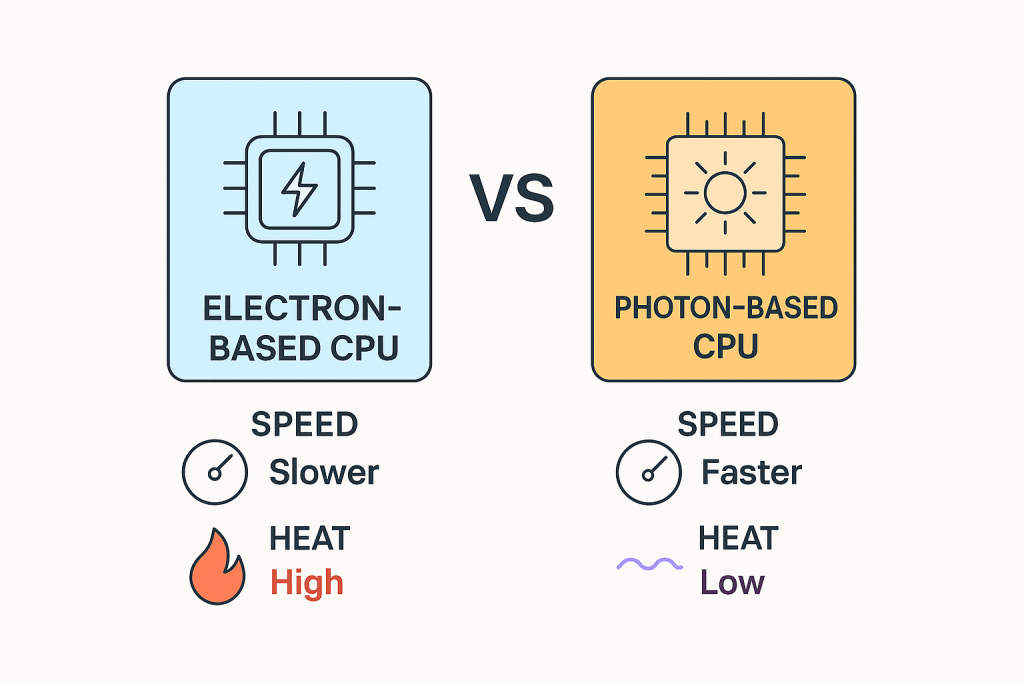
Instead of electrons, photonic chips use photons (light) for computation and data transfer.
- Advantages: Near speed of light processing, low heat, massive bandwidth.
- Applications: Data centers, AI accelerators, high-frequency trading.
Carbon Nanotubes
Carbon nanotube transistors (CNTFETs) promise faster, smaller, and more energy-efficient chips than silicon. They could replace silicon transistors without requiring a full paradigm shift.
Diagram:
Comparison: Electron-based CPU vs Photon-based CPU highlighting speed & heat differences.
Implications for Software Engineers & Leaders
The rise of post-silicon computing isn’t just hardware—it’s a software revolution.
- New Programming Models
- Quantum computing requires learning quantum algorithms and languages like Q# or Qiskit.
- Neuromorphic systems need event-driven, brain-like programming models.
- DNA computing may involve bioinformatics-inspired coding.
- Leadership Challenges
- Deciding when and where to invest in emerging technologies.
- Building cross-disciplinary teams (software + physics + biology).
- Navigating ethics and security in new computational domains.
- The Transition Period
- Just like we moved from mainframes → PCs → cloud → edge, the shift from silicon → beyond will be gradual and hybrid.
- Software leaders should prepare for hybrid architectures combining CPUs, GPUs, TPUs, and quantum accelerators.
Conclusion
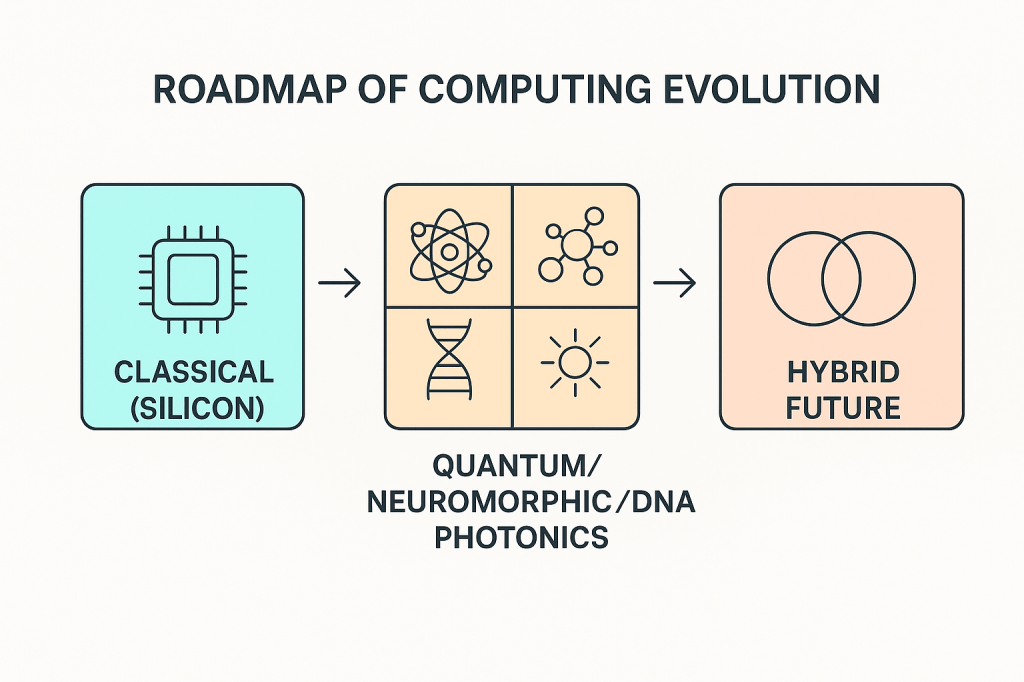
The age of silicon dominance is nearing its natural limits. What comes next may not be a single technology, but a convergence of quantum, neuromorphic, DNA, photonic, and carbon-based architectures.
For software engineers, this means:
- Expanding skill sets beyond traditional programming.
- Embracing new abstractions and paradigms.
- Staying ahead of an inevitable computing renaissance.
For leaders, this means:
- Strategic foresight in R&D investments.
- Cultivating teams that can bridge disciplines.
- Preparing organizations for the post-silicon future.
Diagram:
A roadmap of computing evolution:
- Classical (Silicon) →
- Quantum/Neuromorphic/DNA/Photonics →
- Hybrid Future









Leave a comment