

For decades, the software engineering career ladder was predictable.
Junior developers wrote boilerplate. Mid-level engineers shipped features. Senior engineers made decisions.
That ladder is collapsing.
Not because software engineering is dying — but because execution is becoming free.
AI agents don’t complain. They don’t procrastinate. They don’t need onboarding. And they can generate, refactor, and test more code in an hour than many teams ship in a week.
This doesn’t eliminate software engineers.
It redefines who creates value.
And here’s the uncomfortable truth most blogs won’t tell you:
Junior developers are the first role to structurally break in an agent-first world — unless the industry changes how engineers are trained, evaluated, and promoted.
This article is not fear-mongering. It’s not a hot take. And it’s not about replacing people with AI.
It’s a deep, practical analysis of how AI agents are reshaping:
- Software engineering workflows
- Career progression
- Hiring signals
- Skill valuation
If you’re a junior developer, this article matters. If you mentor juniors, it matters more. If you lead engineering teams, ignoring this will cost you talent, velocity, and credibility.
Let’s break it down — from first principles.
🧠 What Changed: Execution Is No Longer the Bottleneck
📊 Diagram 1: What Used to Be Scarce vs What Is Scarce Now
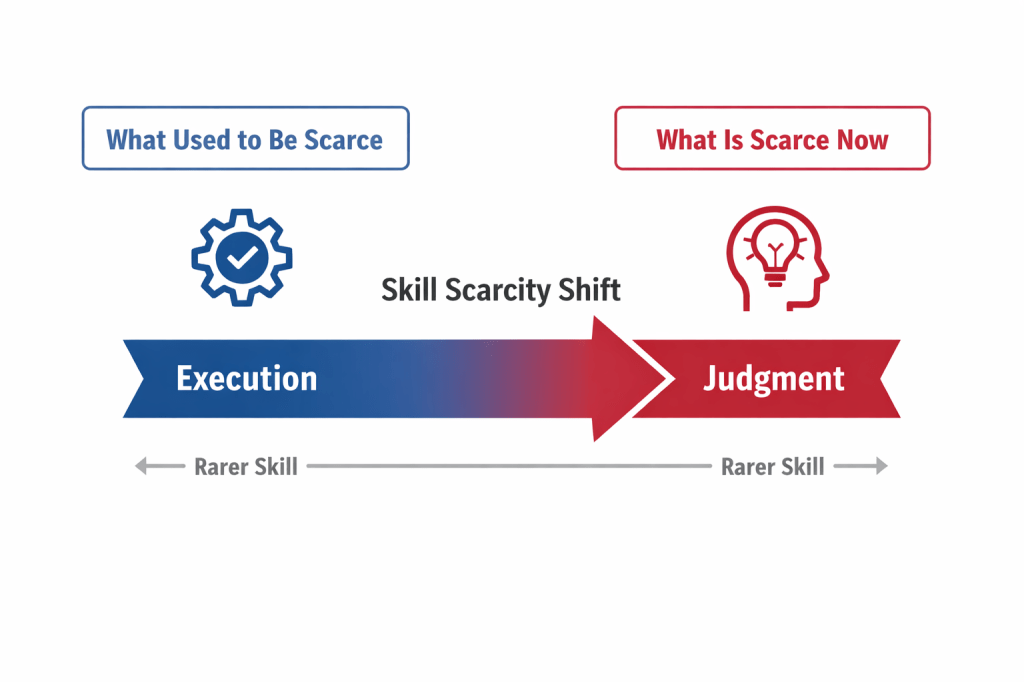
Humans executed. AI executes.
Humans decided. Humans decide.
The bottleneck didn’t disappear. It moved upward.
Historically, software engineering teams were constrained by execution capacity.
Questions leaders asked:
- How fast can we write code?
- How many tickets can we close?
- How many engineers do we need?
Junior developers existed to expand execution bandwidth.
They:
- Implemented specs
- Wrote repetitive code
- Fixed low-risk bugs
- Followed instructions
That model worked because humans were the only execution engine.
AI Agents Break This Assumption
AI agents:
- Read entire codebases
- Generate production-ready code
- Run tests and simulations
- Iterate without fatigue
Execution is no longer scarce.
Judgment is.
This single shift changes everything.
🧩 The Old Career Ladder (And Why It Worked)
📊 Diagram 2: Traditional Software Engineering Career Ladder
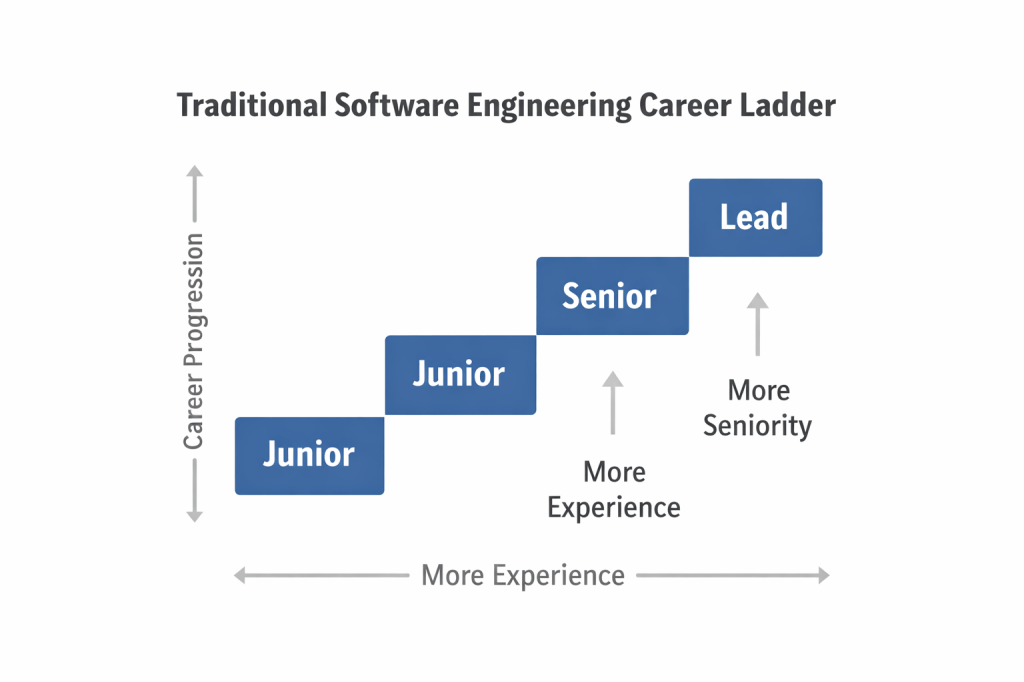
This ladder depended on execution being scarce.
Let’s be honest about the traditional model.
Junior Developer
- Learns syntax
- Follows tickets
- Writes boilerplate
- Gains experience through repetition
Mid-Level Engineer
- Owns features
- Handles edge cases
- Understands systems
Senior Engineer
- Designs architectures
- Makes trade-offs
- Mentors others
This ladder assumed:
- Time-on-task equals learning
- Repetition builds intuition
- Execution precedes judgment
AI breaks that sequence.
💥 Why Junior Developers Are the First to Break
📊 Diagram 3: Task Replacement Pressure
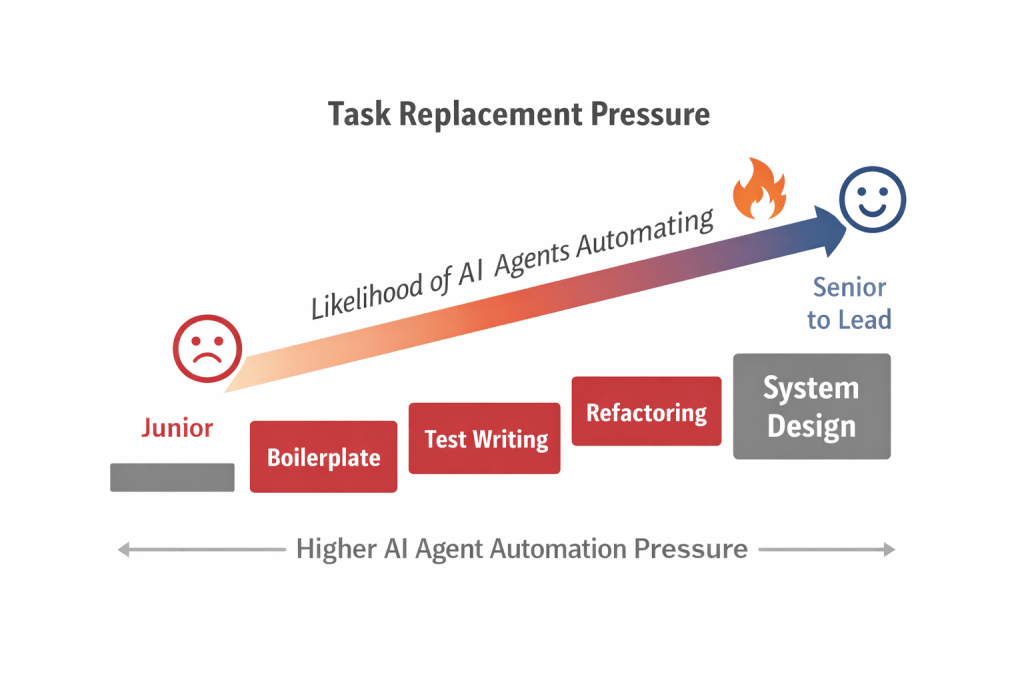
The pressure hits the bottom of the ladder first.
This is not about intelligence. It’s about where value is created.
AI agents now outperform juniors at:
- CRUD APIs
- Data transformations
- Test generation
- Refactoring
- Documentation
These tasks were the training ground for junior engineers.
When that ground disappears, two things happen:
- Teams stop needing juniors for execution
- Juniors lose their traditional learning path
This is the real crisis.
⚠️ The Myth of “AI Will Replace All Developers”
That framing is lazy.
What’s actually happening is role compression.
AI removes low-leverage work. Humans are pushed up the abstraction stack faster.
The problem?
Most juniors aren’t trained for abstraction.
🧠 What AI Cannot Replace (Yet)
AI agents struggle with:
- Ambiguous requirements
- Ethical judgment
- Business trade-offs
- Political constraints
- Long-term ownership
These are senior skills.
Junior developers must now acquire them earlier — or stagnate.
🔄 From Experience-Based Progression to Capability-Based Progression
📊 Diagram 4: Career Progression Model Shift
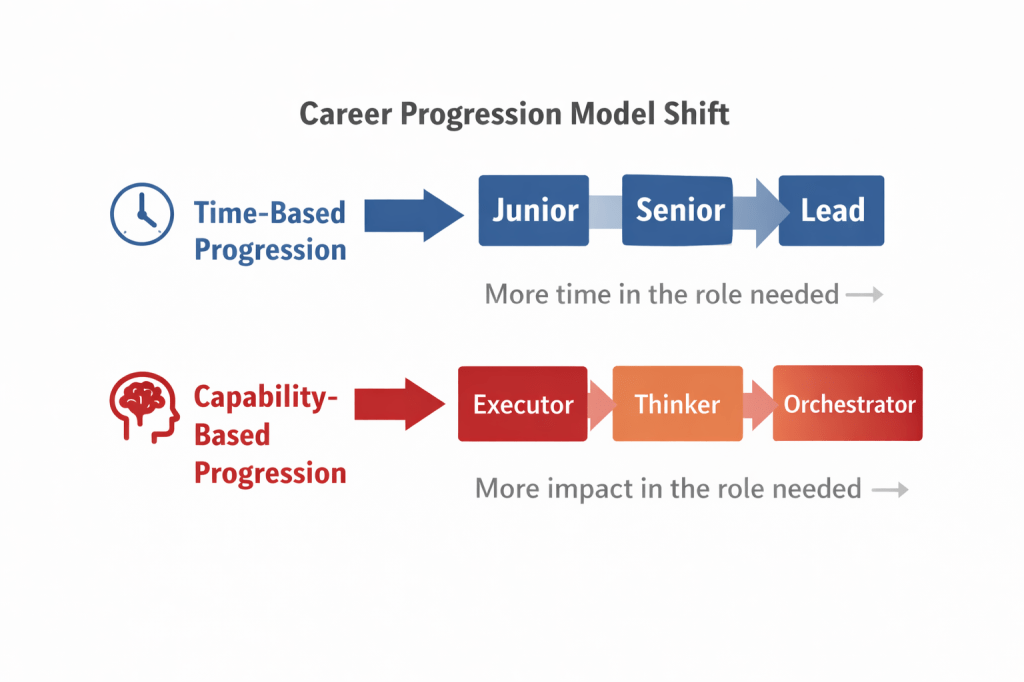
Promotion = Time Promotion = Trust
Capability replaces tenure as the signal.
The old model:
“You’ll understand systems after 5 years.”
The new model:
“Show me you can reason about systems today.”
Time served is no longer a signal.
Capability is.
🧑💻 The New Junior Developer Archetype
Surviving juniors will look very different.
They will:
- Ask why before how
- Read architectures, not just tickets
- Review AI-generated code critically
- Learn system design early
- Treat AI as a collaborator, not a crutch
They won’t compete with AI on speed.
They’ll compete on thinking.
🏗️ How Teams Must Redesign Junior Roles
Keeping juniors busy with tasks is malpractice.
Instead, teams must:
1. Teach Intent, Not Tasks
Give juniors problems, not tickets.
2. Pair Juniors With AI + Seniors
Learning accelerates when juniors:
- Observe AI execution
- Observe senior judgment
3. Make Trade-Offs Explicit
Ask juniors to explain:
- Why this design
- What alternatives exist
- What risks are accepted
📉 What Happens If Teams Don’t Adapt
If organizations cling to old ladders:
- Juniors stagnate
- Seniors burn out
- AI is misused
- Knowledge gaps widen
The result?
A hollowed-out engineering org.
📈 New Metrics for Career Growth
📊 Diagram 5: Measuring Engineer Value in an Agent-First World
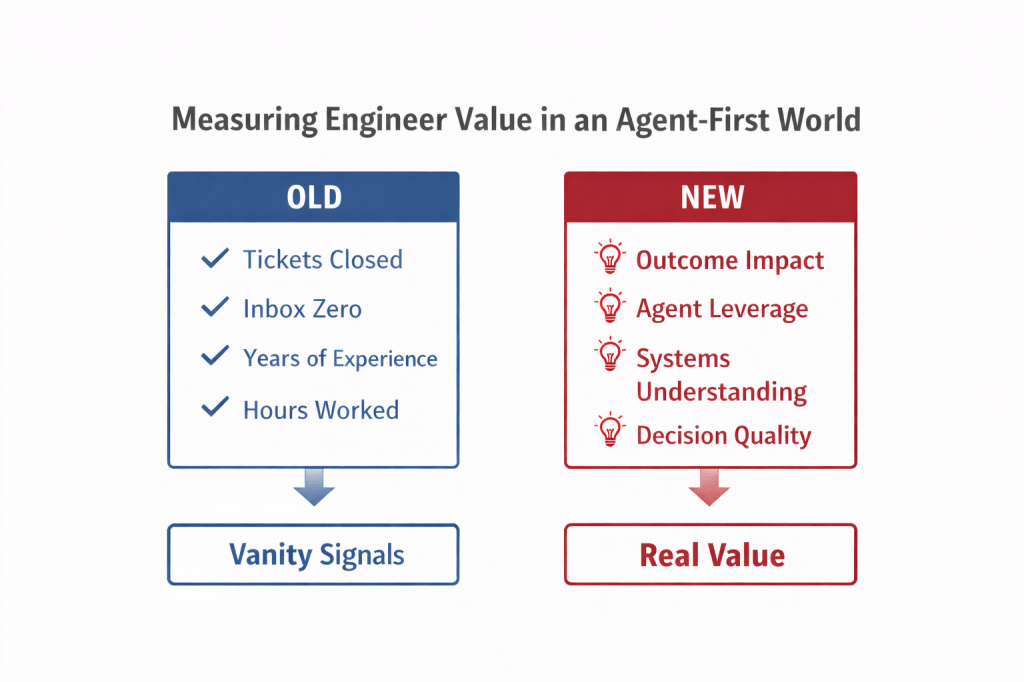
Execution Metrics Judgment Metrics
As execution scales, judgment becomes the currency.
Forget:
- Lines of code
- Tickets closed
- Hours logged
Measure:
- Quality of decisions
- Speed of understanding
- Risk awareness
- System reasoning
This applies to individuals and teams.
🎓 Practical Advice for Junior Developers (No Fluff)
Stop Optimizing for Syntax
AI already knows it.
Learn System Design Early
Even badly.
Review AI Code Aggressively
Treat it like a junior peer.
Ask Better Questions
Questions signal seniority faster than answers.
🧭 Practical Advice for Engineering Leaders
If you hire juniors today:
- You are responsible for reshaping the ladder
- You must reward thinking, not typing
- You must protect learning paths
AI doesn’t remove leadership.
It demands better leadership.
🔮 The Long-Term Outcome (If We Get This Right)
If teams adapt:
- Juniors grow faster
- Seniors focus on leverage
- Systems improve
- Burnout drops
If teams don’t:
- Talent pipelines collapse
- Inequality widens
- Engineering credibility erodes
This is a choice.

















Leave a comment