

Most engineers design systems to work.
Very few design systems to survive.
There’s a massive difference.
If failure is “acceptable,” you optimize for:
- Speed of delivery
- Cost
- Simplicity
But if failure is not allowed — financial systems, healthcare platforms, emergency services, aviation, large-scale infrastructure — your mindset changes completely.
You stop designing software.
You start designing resilience under chaos.
This is how I would design a system where failure is not an option.
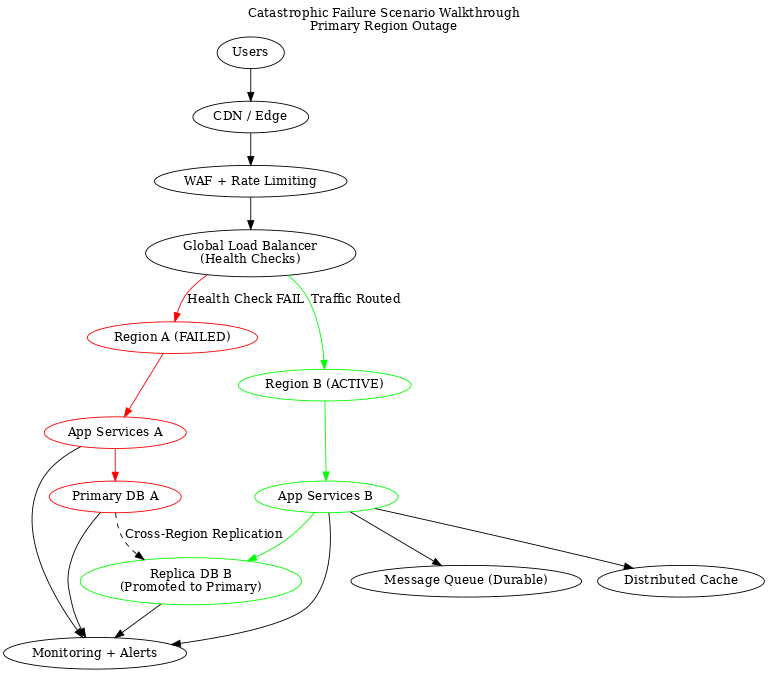
Diagram: Catastrophic failure scenario walk-through: Primary region outage
🚨 First Truth: “No Failure” Does NOT Mean “No Outage”
This is where junior thinking collapses.
Failure is inevitable.
What’s unacceptable is uncontrolled failure.
So the real goal becomes:
The system must fail safely, predictably, and recover automatically.
That’s the philosophy behind everything that follows.
🧠 Step 1 — I Design for Failure Before I Design Features
Most teams start with:
“What should the system do?”
I start with:
“How will this system break?”
I list failure categories first:
| Failure Type | Example |
|---|---|
| Infrastructure failure | Server dies, AZ goes down |
| Network failure | Packet loss, latency spikes |
| Dependency failure | Third-party API timeout |
| Data failure | Corruption, replication lag |
| Human failure | Bad deployment, bad config |
| Traffic failure | Sudden 10× load spike |
| Security failure | DDoS, malicious traffic |
If your architecture doesn’t answer these, it’s not production-grade — it’s a demo.
🧱 Step 2 — Architecture Pattern: Redundancy Everywhere
If a component exists only once, it is a liability.
Core Design Principle:
Every critical component must have a backup that can take over without humans.
Infrastructure Layer
- Multi–Availability Zone deployment (minimum)
- Multi-region for critical workloads
- Stateless services behind load balancers
- Auto-scaling groups, not fixed servers
If one region dies, traffic shifts automatically. No war room.
🗄 Step 3 — Data Is the Real Single Point of Failure
Most architectures look resilient… until the database fails.
That’s when reality hits.
My Data Strategy
✅ Replication
- Multi-AZ replication
- Cross-region replication
- Read replicas for load distribution
✅ Backups
- Automated snapshots
- Point-in-time recovery
- Immutable backup storage
✅ Data Corruption Protection
- Write-ahead logging
- Versioned storage
- Soft deletes for critical entities
Because in high-stakes systems:
Losing data is worse than downtime.
🔌 Step 4 — I Assume Every Dependency Will Fail
This is where most production outages come from.
Defensive Design Patterns
| Pattern | Why |
|---|---|
| Timeouts everywhere | No request waits forever |
| Retries with backoff | Handle transient failures |
| Circuit breakers | Prevent cascading collapse |
| Bulkheads | Isolate failures to one subsystem |
| Graceful degradation | Partial functionality > total outage |
If your system crashes because a non-critical service is slow, your design is fragile.
🌊 Step 5 — Traffic Surges Should Be Boring
A system where failure isn’t allowed must treat spikes as normal.
How:
- Auto-scaling based on CPU + queue depth
- Rate limiting at the edge
- Caching at multiple layers (CDN, app cache, DB cache)
- Async processing for non-critical flows
If your system collapses under growth, your architecture was lying to you.
🧍 Step 6 — Design Against Human Mistakes
Most outages are not caused by hardware.
They’re caused by people.
So I reduce the blast radius of humans.
How I Do It:
- Blue/Green deployments
- Canary releases
- Feature flags for risky features
- Automated rollbacks
- Infrastructure as Code (no manual server changes)
If a developer can break production with one command, your process is broken.
🧪 Step 7 — Observability Is Not Optional
You cannot prevent failure if you can’t see it forming.
Mandatory Stack:
- Centralized logging
- Metrics (CPU, memory, latency, error rates)
- Distributed tracing
- Real-time alerting
- Synthetic monitoring
If users discover the outage before your monitoring does, your system is blind.
🧯 Step 8 — Failure Containment Over Failure Prevention
You cannot stop all failures.
But you can contain them.
Example:
Bad design:
One service crashes → whole platform down
Resilient design:
One service crashes → that feature disabled → rest of platform works
That’s maturity.
🧩 Step 9 — Simplicity Becomes a Reliability Strategy
Complex systems fail in complex ways.
If failure is unacceptable:
- Avoid unnecessary microservices
- Prefer modular monoliths when scale doesn’t demand distribution
- Fewer moving parts = fewer failure paths
Over-engineering is a hidden reliability risk.
🧑💼 Step 10 — Leadership Matters More Than Technology
Here’s the part tutorials don’t talk about.
Highly reliable systems come from:
- Blameless postmortems
- Incident response training
- Clear on-call ownership
- Runbooks for emergencies
- Culture of reporting near-misses
Reliability is not an architecture diagram.
It’s an organizational discipline.
🤖 AI Changes the Game — But Not This Part
AI can help:
- Predict anomalies
- Analyze logs
- Suggest scaling
But AI cannot replace:
- System trade-off decisions
- Risk modeling
- Failure prioritization
This is where senior engineers stay valuable.
🎯 Final Reality Check
Designing systems where failure isn’t allowed means:
- Slower development
- Higher infrastructure cost
- More process
- More testing
But in certain domains, the alternative is:
- Financial loss
- Legal consequences
- Human harm
And suddenly, “move fast and break things” sounds childish.
🧠 The Mindset Shift
Average engineers ask:
“How do we make this work?”
Senior engineers ask:
“How does this behave when everything goes wrong?”
That’s the difference between building software…
and building systems that survive reality.














Leave a comment