

🔥 The Core Thesis
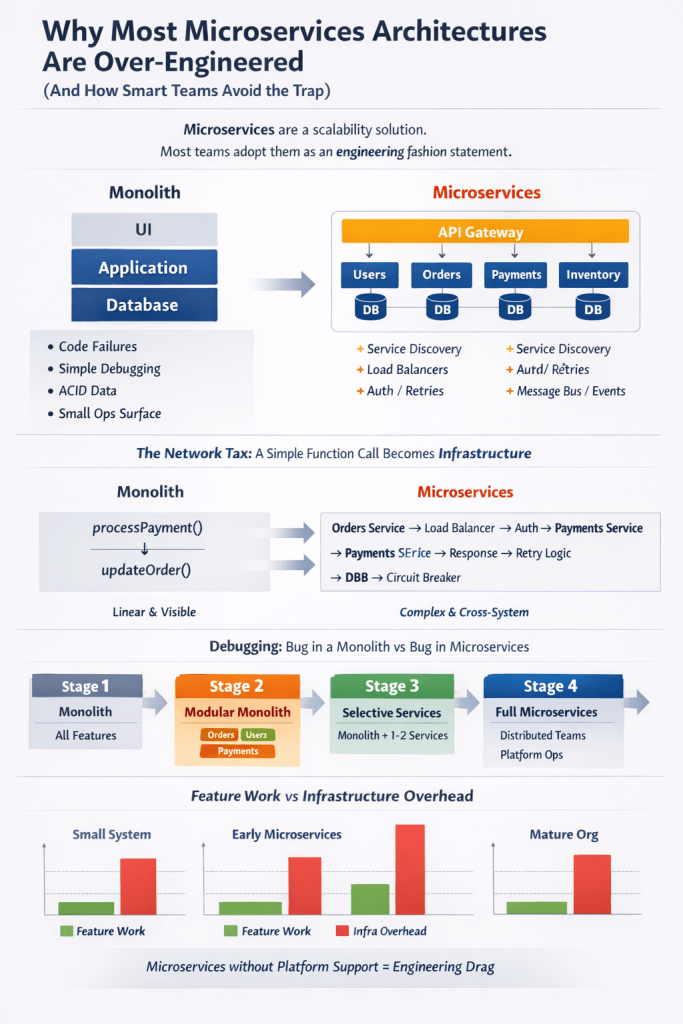
Microservices are a scalability solution.
Most teams adopt them as an engineering fashion statement.
The result?
You get:
- 12 services
- 4 databases
- 2 message brokers
- 1 service mesh
- 0 actual business problems solved
🧠 Why Microservices Sound Like the Right Choice
Microservices promise:
| Promise | What People Hear | Reality |
|---|---|---|
| Independent scaling | “We’ll handle millions of users” | Your app has 5k users |
| Team autonomy | “Teams move faster” | Coordination actually increases |
| Fault isolation | “One service fails, system survives” | Cascading failures via dependencies |
| Technology freedom | “Use the best tool for each job” | Now you maintain 7 stacks |
Microservices solve organizational scale, not just system scale.
If you don’t have:
- Multiple autonomous teams
- Independent product domains
- High traffic bottlenecks
You are pre-paying complexity interest.
⚠️ The Hidden Cost Most Architects Underestimate
1️⃣ Network Is Now Your Biggest Dependency
A method call becomes:
’Function call → HTTP → Load balancer → Service → Auth → DB → Response’
Failures multiply:
- Timeouts
- Retries
- Partial failures
- Circuit breakers
You didn’t reduce complexity.
You moved it into the network.
2️⃣ Data Becomes a Nightmare
Monolith:
One DB → ACID → Simple transactions
Microservices:
Service A DB Service B DB Service C DB ↓ ↓ ↓ Eventual consistency + Sagas + Sync bugs
Now you must design:
- Distributed transactions
- Idempotency
- Event ordering
- Data reconciliation jobs
This is not “modern architecture.”
This is distributed systems research.
3️⃣ Debugging Becomes Forensics
Monolith bug:
Stack trace → Fix.
Microservices bug:
Logs across 9 services → trace IDs → message queues → retries → stale events → race conditions.
You didn’t build a system.
You built a mystery novel.
4️⃣ DevOps Overhead Explodes
Before:
- 1 deployment pipeline
- 1 container
- 1 monitoring target
After:
- CI/CD per service
- Version compatibility management
- API contracts
- Distributed tracing
- Central logging
- Service mesh config
Your team size stayed the same.
Your operational surface area tripled.
🚩 The Real Reason Teams Over-Engineer
It’s rarely technical. It’s psychological.
| Driver | What’s Actually Happening |
|---|---|
| Resume-driven design | Engineers want “microservices experience” |
| Fear of future scale | Designing for 100x load that may never come |
| Conference influence | Copying FAANG architectures blindly |
| Tooling hype | Kubernetes makes complexity look manageable |
Big companies use microservices because they are already complex.
Startups copy them and become complex.
🧩 When Microservices Do Make Sense
Use them when ALL are true:
✔ Teams > 4–5 autonomous squads
✔ Clear domain boundaries (DDD-level)
✔ Independent scaling needs
✔ Mature DevOps + Observability
✔ Platform engineering support
✔ High change velocity
If not, you’re not “modern.”
You’re prematurely distributed.
💡 What Smart Teams Do Instead
✅ Start With a Modular Monolith
This is the architecture nobody talks about — because it’s not flashy.
Structure:
Monolith ├── Orders Module ├── Payments Module ├── Users Module └── Notifications Module
Rules:
- Strict module boundaries
- No shared DB access between modules
- Internal APIs
- Separate packages/repos if needed
You get:
- Local calls (fast)
- Single deployment
- Easier debugging
- Future extraction path
This is microservices without the network tax.
✅ Extract Services Only When Pressure Appears
Trigger signals:
- One module scaling independently
- Deployment bottlenecks
- Team ownership conflicts
- DB contention
Then extract surgically, not ideologically.
🧠 The Architecture Maturity Model
| Stage | Architecture | Complexity | Who Should Use It |
|---|---|---|---|
| 1 | Monolith | Low | Startups, new products |
| 2 | Modular Monolith | Medium | Growing teams |
| 3 | Selective Services | Medium–High | Scale-up phase |
| 4 | Full Microservices | Very High | Large orgs |
Most teams jump from Stage 1 → Stage 4.
That’s like learning to drive in a Formula 1 car.
🎯 The Leadership Takeaway
Great architects don’t ask:
“What architecture is most scalable?”
They ask:
“What architecture introduces the least complexity for the problems we have today?”
Because complexity is not free.
It compounds like debt.
🔚 Closing Line
The best architecture is not the most advanced one.
It’s the one that lets your team sleep at night.

















Leave a comment