

1. Introduction: The Industry’s Favorite Architecture Lie
Event-Driven Architecture (EDA) has quietly become the default answer to modern system design.
- Microservices? → Use events
- Scalability issues? → Use events
- Decoupling problems? → Use events
But here’s the uncomfortable truth:
Most teams adopt event-driven architecture before they understand distributed systems.
And that’s where things go wrong.
Because EDA doesn’t just change how services communicate—it fundamentally changes:
- How failures behave
- How systems evolve
- How engineers think
This is not an architectural style.
This is a system behavior transformation.
2. What Event-Driven Architecture Really Is
Let’s strip away the hype.
EDA is not Kafka.
EDA is not async messaging.
EDA is not microservices.
EDA is this:
A system where state changes are communicated indirectly via events instead of direct control flow.
Diagram 1
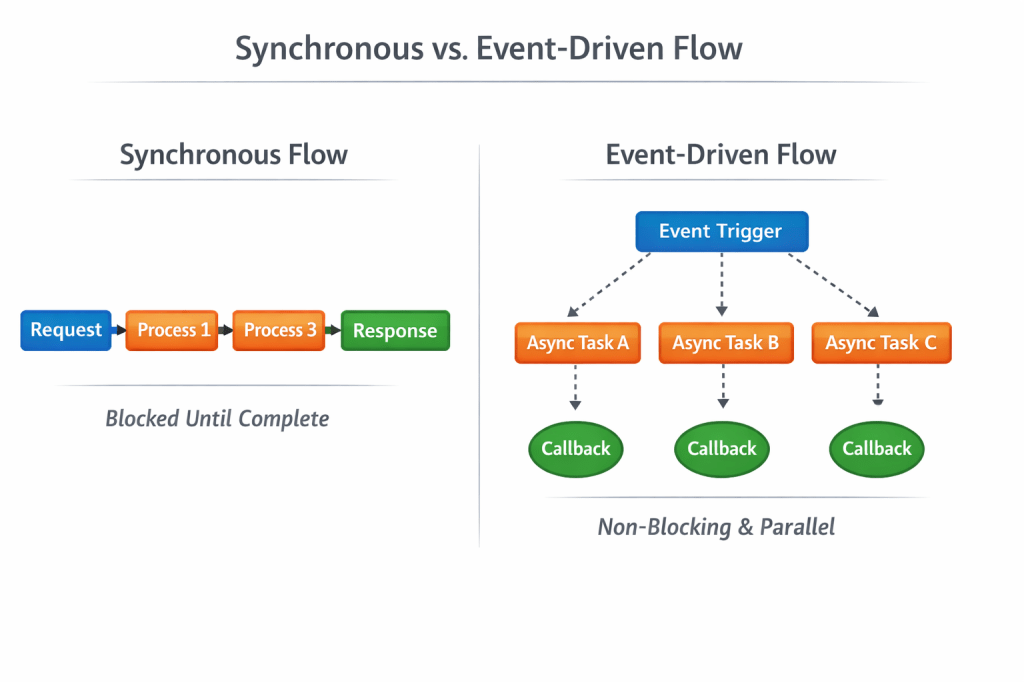
Key Insight:
- Synchronous = predictable flow
- Event-driven = emergent behavior
That distinction is everything.
3. The Illusion of Decoupling
EDA is often sold as “loosely coupled.”
That’s partially true—but dangerously misleading.
What actually happens:
You remove structural coupling
…but introduce temporal + behavioral coupling
Example
Service A emits:
{ "orderId": "123", "status": "CREATED"}
Now:
- Service B depends on it
- Service C depends on it
- Service D depends on it
But A has no idea.
You didn’t remove coupling. You hid it.
4. The First Real Cost: Loss of Control
In a traditional system:
A → B → C
You know:
- What runs
- When it runs
- What fails
In EDA:
A → Event → Unknown chain of reactions
You don’t know:
- Who consumes the event
- In what order
- Whether the flow completes
Diagram 2
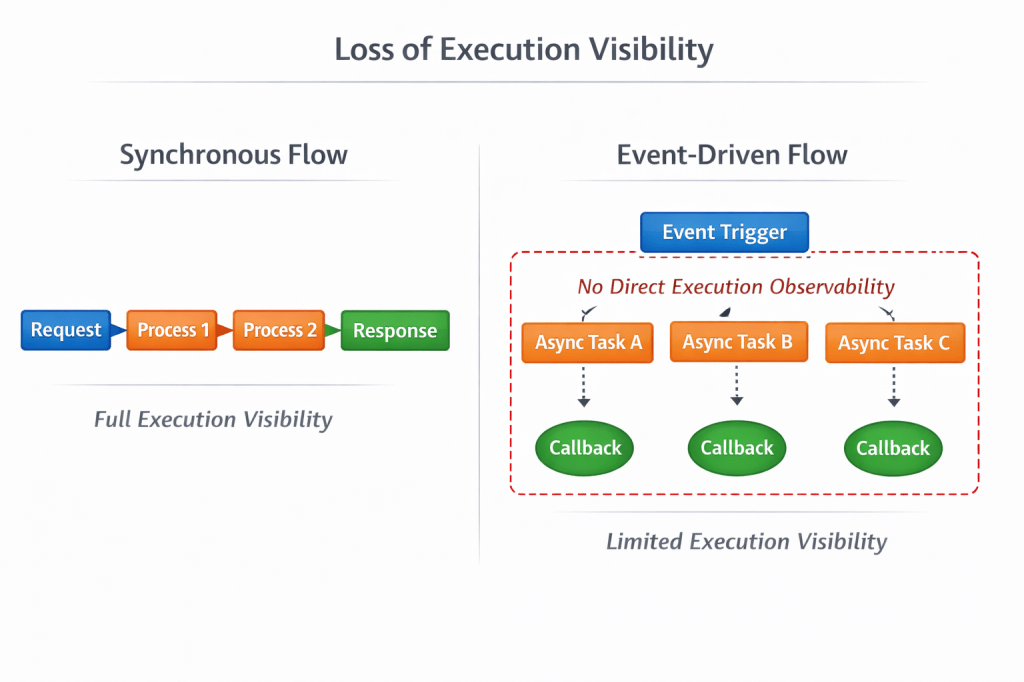
The gap:
What you think happens vs what actually happens diverges over time.
5. Eventual Consistency: The Silent Killer
EDA systems are almost always:
Eventually consistent
That sounds harmless—until you attach business requirements.
Diagram 3
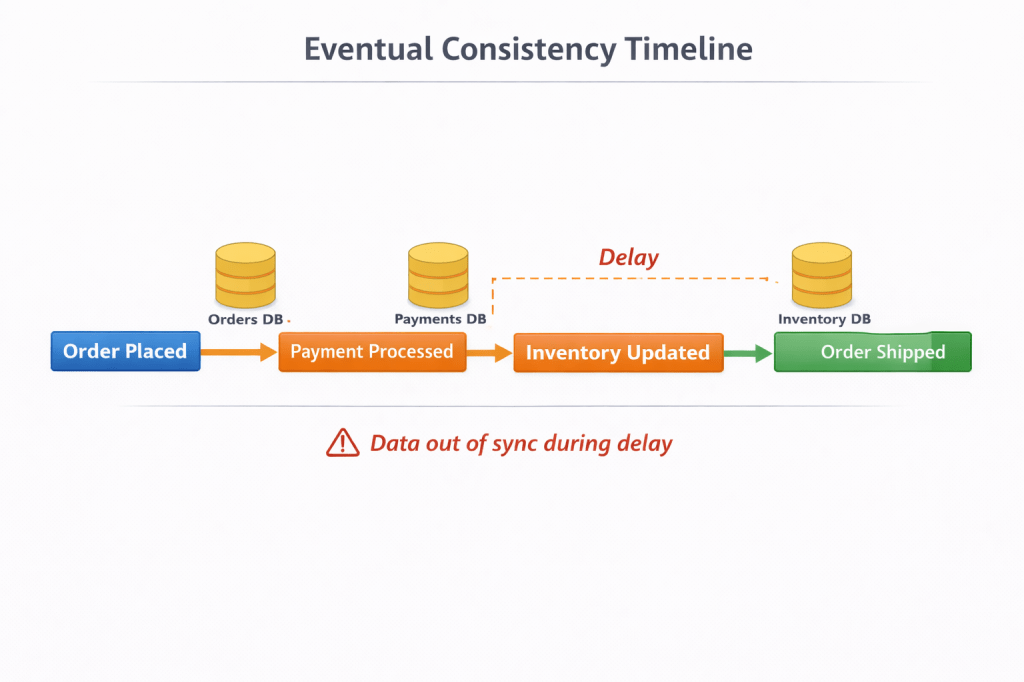
What this forces you to build:
- Retry mechanisms
- Idempotency layers
- Compensation logic (Saga pattern)
- Dead-letter queues
At this point:
You are implementing a distributed transaction system manually
6. Debugging: Where Systems Go to Die
In a monolith:
Error → Stack trace → Fix
In EDA:
Error → Logs → More logs → Guessing → More guessing
Why debugging fails:
- No single execution path
- No central control flow
- Asynchronous timing issues
- Partial failures everywhere
Diagram 4
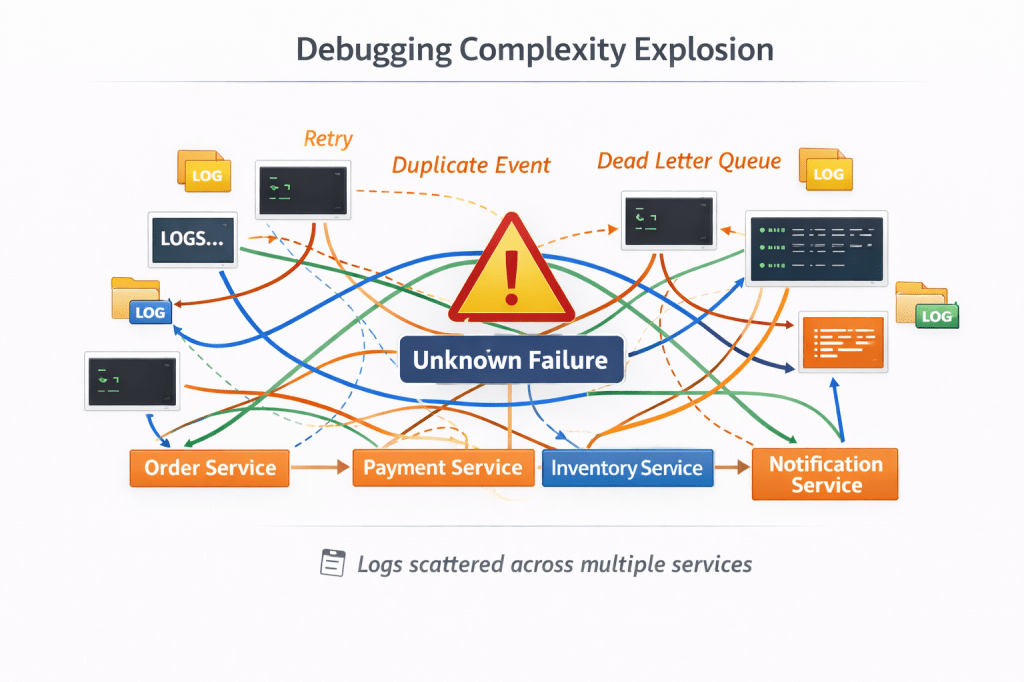
Required (Non-Optional) Tools
If you use EDA, you MUST have:
- Distributed tracing (e.g., OpenTelemetry)
- Correlation IDs
- Centralized logging
- Event replay capability
Without these:
Your system is effectively undebuggable at scale
7. Data Contracts: The Hidden Time Bomb
Events are not just messages.
They are:
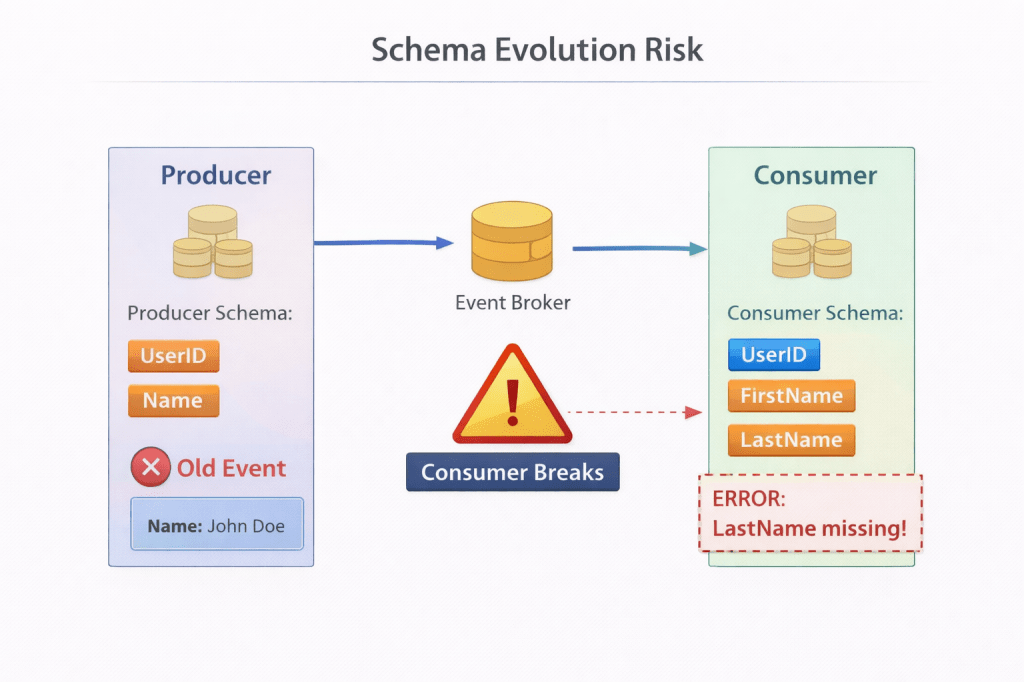
Immutable contracts across time
The problem:
You deploy Service A v2:
{ "orderId": "123", "status": "CREATED", "currency": "USD"}
But Service B still expects:
{ "orderId": "123", "status": "CREATED"}
What breaks:
- Consumers crash
- Silent data corruption
- Partial processing
Diagram 5
Required solutions:
- Schema registry
- Backward compatibility rules
- Versioning strategy
This is:
API versioning × distributed systems × time
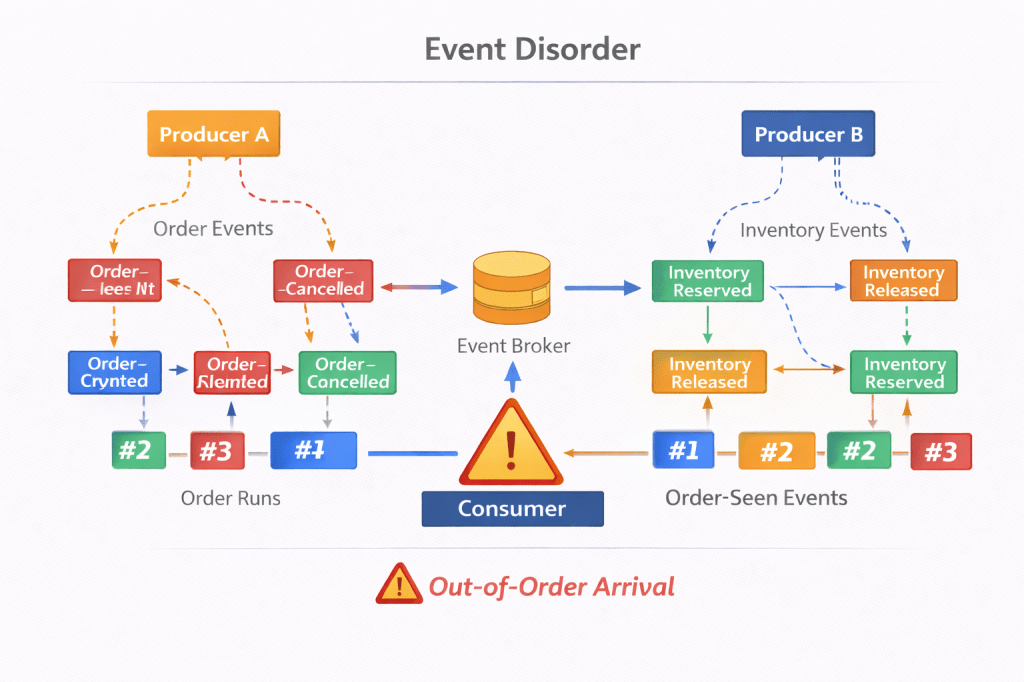
8. Duplicate and Out-of-Order Events
This is not a bug.
This is guaranteed behavior.
You WILL see:
- Duplicate events
- Out-of-order delivery
- Partial processing
Diagram 6
What you must implement:
- Idempotency keys
- Deduplication logic
- Ordering constraints (if possible)
If you skip this:
You will corrupt your own system.
9. Operational Complexity: The Real Price
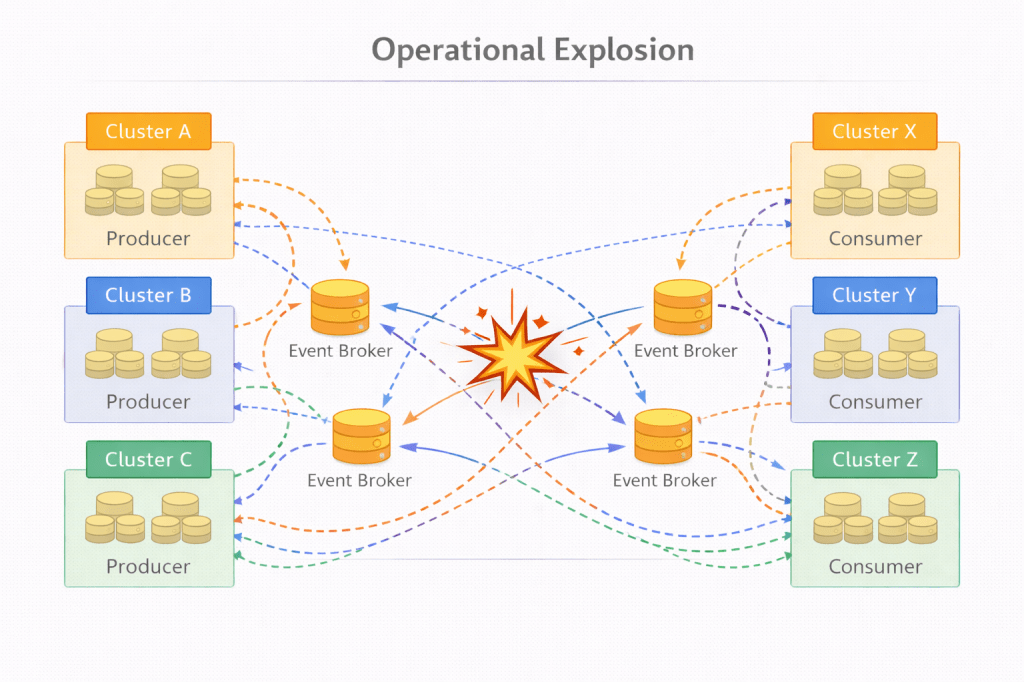
EDA turns your system into a platform.
Your architecture now includes:
- Message brokers (Kafka, RabbitMQ)
- Retry pipelines
- Dead-letter queues
- Monitoring systems
- Schema registry
- Event replay systems
Diagram 7
This is not “architecture elegance.”
This is operational overhead at scale
10. Cognitive Load: The Most Ignored Cost
This is where most systems fail—not technically, but organizationally.
Ask a developer:
“What happens when an order is placed?”
In synchronous systems:
Clear answer.
In EDA:
“It depends…”
- Which services are up
- Which events are delayed
- Which retries succeed
Diagram 8 — Cognitive Load Gap
TEAM UNDERSTANDINGSimple Flow → Order → Payment → Done----------------------------------------REAL SYSTEMEvents → Retries → Failures → Partial State → Recovery
If engineers can’t reason about the system, they can’t safely change it.
11. When NOT to Use Event-Driven Architecture
Let’s cut through the noise.
❌ 1. CRUD Applications
- Simple request-response
- Low complexity
→ EDA adds zero value
❌ 2. Strong Consistency Systems
- Banking
- Trading
- Critical workflows
→ You need correctness NOW, not eventually
❌ 3. Small Teams
EDA requires maturity:
- Observability
- Debugging discipline
- Operational ownership
❌ 4. Low Scale Systems
If you’re not dealing with:
- High throughput
- Async workloads
→ EDA is premature optimization
12. When EDA Actually Works
EDA shines in specific conditions.
✅ 1. High-Scale Systems
- Millions of events
- Parallel consumers
✅ 2. Decoupled Domains
Different teams, independent systems
✅ 3. Event Sourcing
- Audit trails
- Replayability
✅ 4. Real-Time Systems
- Streaming
- Notifications
- IoT
13. The Hybrid Architecture (The Real Answer)
The best systems are not pure EDA.
They are:
Hybrid systems with controlled complexity
Diagram 9 — Hybrid Architecture
CRITICAL PATH (SYNC)User → Order Service → Payment → Confirmation---------------------------------------------ASYNC SIDE EFFECTS (EVENTS)OrderPlaced Event → → Email Service → Analytics → Notification System
Why this works:
- Critical flow = reliable
- Side effects = scalable
14. Orchestration vs Choreography
This is where senior engineers separate from average ones.
Choreography (default EDA)
- Services react blindly
- No central control
→ Scales poorly in complexity
Orchestration (recommended)
- Central workflow controller
- Explicit flow definition
Diagram 10 — Orchestration vs Choreography
CHOREOGRAPHYEvent → Service A → Event → Service B → Event → Service C(No central control)----------------------------------------ORCHESTRATIONOrchestrator ↓Service A → Service B → Service C
If your workflows matter, don’t leave them to chaos.
15. A Practical Decision Framework
Before choosing EDA, ask:
1. Do you need async processing?
No → don’t use it
2. Can your system tolerate inconsistency?
No → avoid it
3. Do you have observability maturity?
No → you’re not ready
4. Is scale a real problem?
No → keep it simple
16. Final Truth
Event-Driven Architecture is powerful.
But here’s the reality:
It amplifies both good engineering and bad decisions
Used correctly:
- Scalable
- Flexible
- Resilient
Used blindly:
- Unpredictable
- Fragile
- Undebuggable
🔥 Closing Thought
“The goal is not to build modern systems.
The goal is to build systems your team can understand, debug, and evolve.”















Leave a comment