

The Senior Engineer Isn’t Dying.
The economic model that created them is.
For the last 25 years, becoming a “Senior Software Engineer” meant mastering complexity.
You:
- Understood threading when others didn’t.
- Debugged production issues under pressure.
- Designed scalable systems.
- Knew frameworks deeply.
- Mentored juniors.
- Survived outages.
Your edge came from experience compounded over time.
But something changed.
And most engineers are misdiagnosing it.
They think AI is replacing engineers.
That’s not what’s happening.
AI is compressing implementation value.
And when implementation becomes cheap, hierarchy reorganizes.
Let’s unpack that properly.
Part 1 — What Seniority Used To Mean
To understand the shift, we need to define the old system.
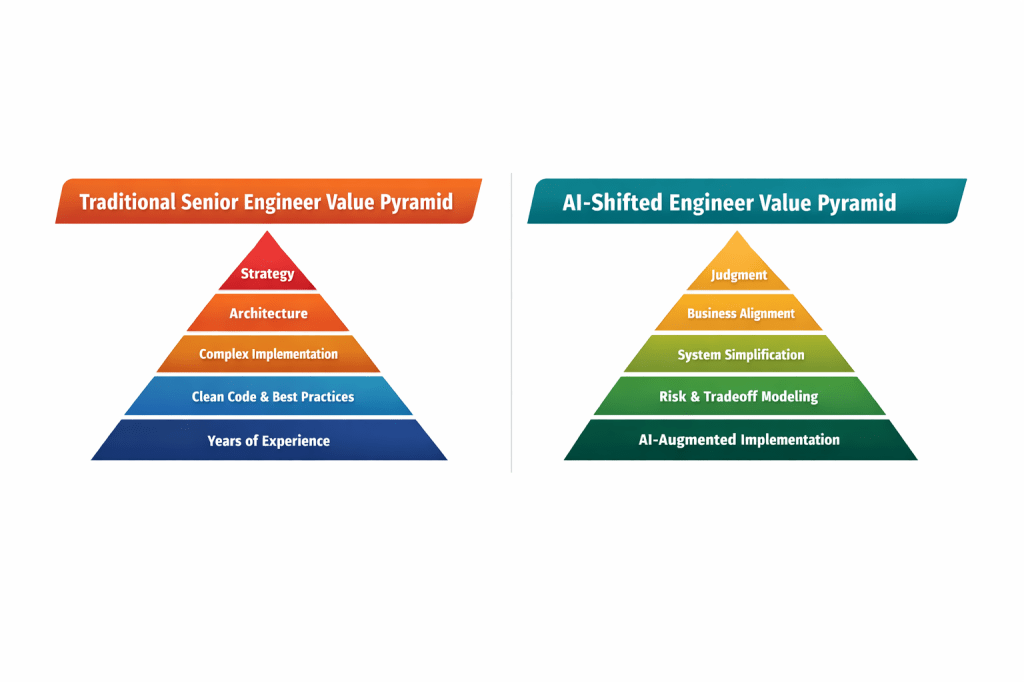
In the 2000–2020 era, the engineering value pyramid looked like this:
              Strategy
           Architecture
       Complex Implementation
     Clean Code & Best Practices
   Years of Experience
The majority of value sat in:
- Technical depth
- Pattern recognition
- Debugging experience
- Architecture ownership
Why?
Because knowledge was scarce.
You had to:
- Read books
- Dig through StackOverflow threads
- Experiment manually
- Learn through painful failure
Experience created asymmetry.
A 10-year engineer could do what a 2-year engineer simply couldn’t.
That asymmetry justified:
- Higher salary
- Senior titles
- Architectural control
- Decision authority
This model made sense.
Until implementation stopped being scarce.
Part 2 — The Real AI Disruption (It’s Not What You Think)
AI tools from companies like:
- OpenAI
- Anthropic
- GitHub (Copilot)
- Google (Gemini)
have changed something fundamental:
They made implementation fast, cheap, and scalable.
Let’s be precise.
AI can now:
- Generate CRUD APIs in minutes
- Scaffold React frontends
- Write unit tests
- Suggest refactors
- Translate legacy code
- Draft documentation
- Assist debugging
What used to take:
- 3 days → 3 hours
- 5 hours → 15 minutes
That is not incremental.
That is economic compression.
And whenever economics compresses one layer, value shifts upward.
Part 3 — Economic Compression and Value Migration
In every industry, when execution becomes cheap:
- Decision-making becomes valuable.
- Allocation becomes valuable.
- Risk management becomes valuable.
Software engineering is not special.
When writing code becomes easy, the scarce skill is:
Deciding what code should exist at all.
This changes seniority entirely.
Part 4 — The New Engineering Value Pyramid
The pyramid reorganizes:
               Judgment
         Business Alignment
      System Simplification
   Risk & Tradeoff Modeling
 AI-Augmented Implementation
Notice what moved to the bottom.
Implementation.
This does not mean coding is irrelevant.
It means coding is no longer the differentiator.
Part 5 — Replaceable vs Irreplaceable Engineers
Let’s be brutally honest.
Replaceable Senior Engineer
- Measures productivity by PR count.
- Obsessively debates code style.
- Optimizes for local performance.
- Masters frameworks but ignores business.
- Accumulates complexity.
- Feels threatened by AI.
Irreplaceable Senior Engineer
- Deletes more code than they write.
- Reduces system entropy.
- Makes high-quality tradeoffs under ambiguity.
- Aligns architecture to revenue strategy.
- Designs optionality.
- Uses AI as leverage.
Which one survives long term?
Part 6 — Complexity Is the Silent Killer
Most senior engineers increase complexity unintentionally.
Why?
Because complexity signals intelligence.
Microservices.
Event-driven architecture.
CQRS.
Service meshes.
Over-abstraction.
You’ve written about over-engineered microservices before — this connects directly.
Complexity used to justify seniority.
Now complexity destroys leverage.
Because:
- AI reduces implementation friction.
- But complexity increases coordination cost.
- And coordination cost is what kills velocity.
The new senior engineer is a complexity reducer.
Not a complexity amplifier.
Part 7 — From Engineer to Capital Allocator
Here is the real shift.
The next evolution is not:
Junior → Mid → Senior → Staff → Principal → Director.
It is:
Coder → Architect → Systems Thinker → Engineering Capital Allocator
An Engineering Capital Allocator:
- Treats developer time as capital.
- Calculates ROI of technical decisions.
- Minimizes long-term maintenance cost.
- Kills projects early.
- Designs with margin.
- Avoids fragile dependencies.
This role thinks like:
- A product strategist
- A financial operator
- A risk manager
- A systems designer
Not just a coder.
Part 8 — A Concrete Example
Old Senior Decision:
“We should break this into 7 microservices for scalability.”
New Senior Decision:
“Current traffic is 5K users/month.
Operational overhead of 7 services > projected scaling risk.
Monolith now. Modular boundaries inside. Extract later if needed.”
That’s leverage.
Not cleverness.
Part 9 — AI Will Not Replace Engineers. It Will Stratify Them.
We are heading toward stratification.
Tier 1 — High-Leverage Engineers
- Use AI to 10x output.
- Focus on system-level decisions.
- Reduce organizational entropy.
Tier 2 — Implementation Engineers
- Execute well.
- Depend on assigned tasks.
- Vulnerable to cost pressure.
AI widens the gap.
It does not flatten it.
Part 10 — What Senior Engineers Must Develop Now
If you want to stay ahead:
1. Business Literacy
Understand:
- Revenue streams
- Margins
- CAC vs LTV
- Operational cost
Engineering divorced from economics is fragile.
2. Risk Modeling
Ask:
- What fails first?
- What is the blast radius?
- What is reversible?
- Where is optionality?
3. System Simplification
Practice:
- Removing layers.
- Consolidating services.
- Killing unused abstractions.
- Measuring cognitive load.
4. AI Fluency
Do not resist AI.
Instrument it.
Build internal GPT workflows.
Automate documentation.
Accelerate onboarding.
Generate test suites.
Prototype faster.
AI is not competition.
It is capital.
Part 11 — Measuring the New Seniority
Stop measuring:
- Lines of code
- Velocity points
- PR merges
Start measuring:
- Cycle time reduction
- Mean time to recovery
- Complexity reduction
- Revenue per engineer
- Deployment confidence
That is modern leverage.
Part 12 — The Psychological Trap
Many experienced engineers tie identity to:
“I am the one who solves hard technical problems.”
When AI solves many of those faster, ego resists.
But survival requires adaptation.
You are not paid for solving problems.
You are paid for solving the right problems.
Part 13 — The 5-Year Forecast
Within 5 years:
- AI-assisted coding will be default.
- Architecture debates will shift toward simplicity.
- Senior roles will require business fluency.
- Technical judgment will command premium compensation.
- Pure implementers will face wage compression.
This is not fear.
This is economic logic.
Final Thought
Senior engineers are not dying.
Low-leverage seniority is.
The market no longer pays for code.
It pays for judgment under uncertainty.
And judgment compounds faster than syntax ever did.


















Leave a comment