
Table of Contents
- Introduction: The Leadership Illusion
- The Execution Gap Defined
- Why Strong Engineers Struggle as Leaders
- The Three Pillars of Technical Execution
- Architecture vs Execution: The Hidden Disconnect
- The Operating Model of High-Performing Teams
- Decision-Making at Scale
- Ownership and Accountability Systems
- Metrics That Actually Matter
- Communication Architecture (Not Just Meetings)
- Handling Failure Without Killing Velocity
- Scaling Teams Without Losing Control
- Real-World Execution Playbook
- Final Thoughts: Becoming a High-Leverage Leader
1. Introduction: The Leadership Illusion
Most engineering leaders believe they’re doing their job well because:
- Systems are being designed
- Teams are working
- Sprints are running
But here’s the uncomfortable truth:
Execution—not intelligence—is the real bottleneck in engineering organizations.
You’ve seen it:
- Beautiful architectures that never stabilize
- Teams that ship… but don’t deliver impact
- Roadmaps that constantly slip
That’s the Execution Gap.
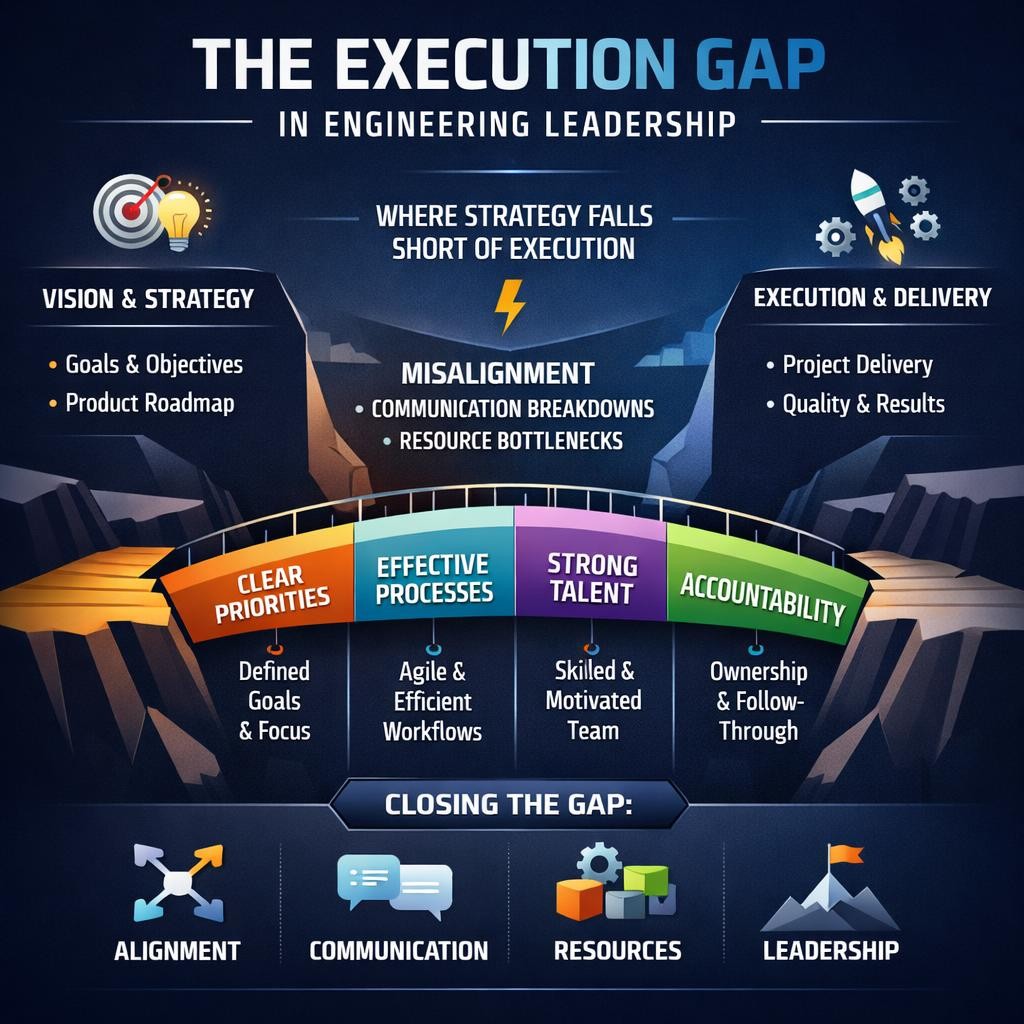
2. The Execution Gap Defined
The Execution Gap is the difference between:
What the organization intends to deliver vs what actually reaches production with impact.
Visual: The Execution Gap


Where it shows up:
| Stage | Problem |
|---|---|
| Planning | Over-optimistic scope |
| Design | Over-engineering |
| Development | Lack of ownership |
| Testing | Bottlenecks |
| Deployment | Fear of release |
| Post-release | No feedback loop |
3. Why Strong Engineers Struggle as Leaders
Let’s be blunt.
Being a great engineer does not prepare you to lead systems of people.
Common traps:
- Solution bias → Jumping to design instead of framing problems
- Control mindset → Not delegating effectively
- Perfectionism → Slowing delivery
- Technical tunnel vision → Ignoring business outcomes
Reality shift:
| Engineer Thinking | Leader Thinking |
|---|---|
| “Is this correct?” | “Is this effective?” |
| “Can we build it?” | “Should we build it?” |
| “Is this elegant?” | “Will this deliver value?” |
4. The Three Pillars of Technical Execution
If you remember nothing else from this article, remember this:
Execution = Architecture + Ownership + Feedback Loops
Visual: Execution Pillars


1. Architecture (Direction)
- Defines constraints
- Enables scalability
- Reduces ambiguity
2. Ownership (Accountability)
- Someone owns outcomes, not tasks
- No diffusion of responsibility
3. Feedback Loops (Learning)
- Observability
- Metrics
- Continuous improvement
5. Architecture vs Execution: The Hidden Disconnect
Most leaders over-invest in architecture and under-invest in execution systems.
Visual: Architecture vs Execution Imbalance


Symptoms of imbalance:
- Endless design discussions
- Delayed releases
- Frequent rewrites
- Low team morale
Hard truth:
A mediocre architecture executed well beats a perfect architecture that never ships.
6. The Operating Model of High-Performing Teams
Execution doesn’t happen by accident.
It is designed.
Visual: High-Performance Team Operating Model


Key components:
- Clear ownership boundaries
- Autonomy with guardrails
- Aligned goals
- Fast decision loops
Anti-pattern:
- Shared ownership across everything
→ Leads to no ownership of anything
7. Decision-Making at Scale
Execution dies when decisions slow down.
Types of decisions:
| Type | Approach |
|---|---|
| Reversible | Fast, decentralized |
| Irreversible | Slow, deliberate |
Leader’s role:
- Push decisions downward
- Only escalate when necessary
If every decision comes to you, you are the bottleneck.
8. Ownership and Accountability Systems
Ownership is not a slogan. It’s a system.
Visual: Ownership Model


Strong ownership looks like:
- One team owns one service end-to-end
- Metrics tied to ownership
- Clear escalation paths
Weak ownership looks like:
- “We all own it”
- Blame during failures
- No accountability
9. Metrics That Actually Matter
Most teams track the wrong things.
Useless metrics:
- Lines of code
- Story points completed
- Hours worked
High-impact metrics:
| Metric | Why it matters |
|---|---|
| Lead time | Speed of delivery |
| Deployment frequency | Agility |
| Change failure rate | Quality |
| MTTR | Resilience |
These are inspired by DORA metrics — and they work.
10. Communication Architecture (Not Just Meetings)
Leaders think communication = meetings.
That’s wrong.
Visual: Communication Architecture


Components:
- Async communication (default)
- Documentation-first culture
- Decision logs
- Minimal meetings
Rule:
If it’s not written down, it doesn’t scale.
11. Handling Failure Without Killing Velocity
Failure is inevitable.
What matters is how your system reacts.
Bad systems:
- Blame individuals
- Add bureaucracy
- Slow everything down
High-performing systems:
- Focus on root cause
- Improve systems, not punish people
- Maintain velocity
You don’t build resilient systems by avoiding failure.
You build them by learning fast from failure.
12. Scaling Teams Without Losing Control
Growth introduces chaos.
Visual: Scaling Complexity Curve


Key challenges:
- Communication overhead
- Dependency explosion
- Loss of ownership
Solutions:
- Modular architecture
- Independent teams
- Strong interfaces
13. Real-World Execution Playbook
Let’s make this practical.
Step 1: Define ownership
- Map services → teams
- Assign clear accountability
Step 2: Simplify architecture
- Reduce unnecessary complexity
- Focus on delivery speed
Step 3: Implement metrics
- Track DORA metrics
- Review weekly
Step 4: Redesign communication
- Async-first
- Document everything
Step 5: Shorten feedback loops
- Faster deployments
- Real-time monitoring
14. Final Thoughts: Becoming a High-Leverage Leader
Here’s the shift you need to make:
From → To
| From | To |
|---|---|
| Problem solver | System builder |
| Decision maker | Decision enabler |
| Architect | Execution driver |
Your job is not to write code.
Your job is to build systems where great execution happens naturally.
Closing Insight
Most leaders focus on:
- Tools
- Technologies
- Frameworks
But the real leverage comes from:
Designing systems of execution.
What You Should Do Next (Actionable)
If you’re serious about leveling up:
- Audit your team’s execution gaps
- Identify ownership confusion
- Simplify one over-engineered system
- Introduce real metrics
- Reduce meeting load by 30%



















Leave a comment