
Introduction: The Problem Nobody Talks About
Most engineering leaders don’t fail because they lack technical skill.
They fail because:
- Their teams don’t scale with growth
- Their systems become fragile under pressure
- Their engineers burn out silently
- Their org becomes a coordination bottleneck
You’ve probably seen this:
More engineers → slower delivery
More process → less ownership
More tools → less clarity
This is not a tooling problem.
This is not a hiring problem.
This is an organizational design problem.
And strong technical leadership means:
👉 Designing systems where people, architecture, and execution scale together
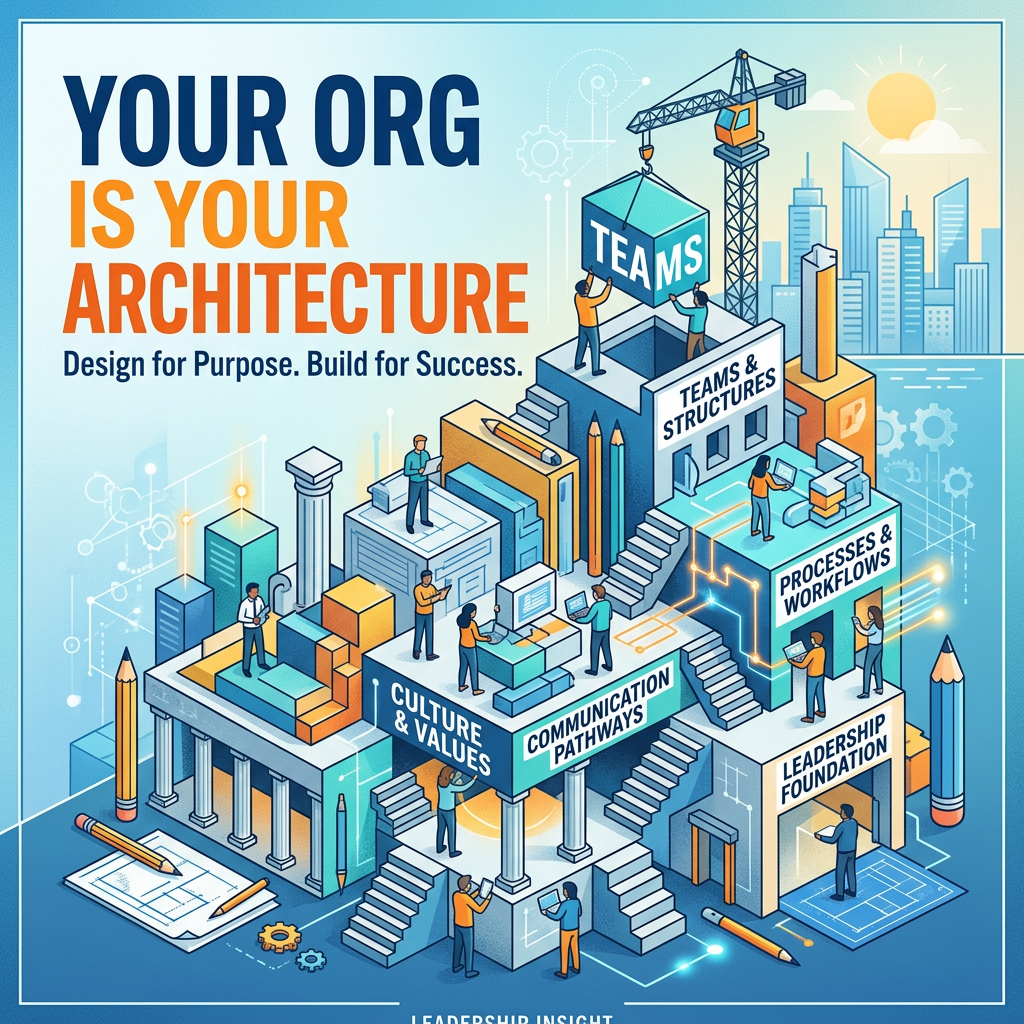
Section 1: The Hidden Truth — Your Org Structure Is Your Architecture
Melvin Conway figured this out decades ago, but most leaders still ignore it.
“Organizations design systems that mirror their communication structure.”
What this actually means in practice:
- If your teams are siloed → your systems are tightly coupled
- If your org has bottlenecks → your architecture has bottlenecks
- If decision-making is centralized → your system evolution slows down
🔷 Diagram 1 — Conway’s Law in Action


Leadership Insight
You cannot fix architecture without fixing org design first.
Bad approach:
- “Let’s refactor the system”
Correct approach:
- “Let’s restructure ownership boundaries”
Section 2: The 4 Core Pillars of Scalable Engineering Organizations
Every high-performing engineering org is built on four non-negotiables:
1. Clear Ownership Boundaries
- Every system has a single accountable team
- No “shared ownership” ambiguity
2. Autonomy with Guardrails
- Teams move fast
- But within defined constraints
3. Aligned Execution Model
- Everyone understands how work flows
4. Operational Discipline
- Reliability is engineered—not hoped for
🔷 Diagram 2 — The Scalable Engineering Organization Model


Leadership Reality Check
If even one pillar is weak:
- Ownership unclear → blame culture
- No guardrails → chaos
- Misaligned execution → delays
- Weak ops → outages
Section 3: Team Topologies That Actually Work
Let’s cut through theory.
There are only a few team structures that consistently scale:
1. Stream-Aligned Teams
- Own a business capability
- End-to-end responsibility
2. Platform Teams
- Provide internal developer platforms
- Reduce cognitive load
3. Enabling Teams
- Help others adopt new capabilities
4. Complicated Subsystem Teams
- Handle deep technical complexity
🔷 Diagram 3 — Team Topologies in Practice


Leadership Mistake to Avoid
Most orgs:
- Either over-centralize (platform bottleneck)
- Or over-fragment (coordination chaos)
Your job is to balance:
👉 Independence vs alignment
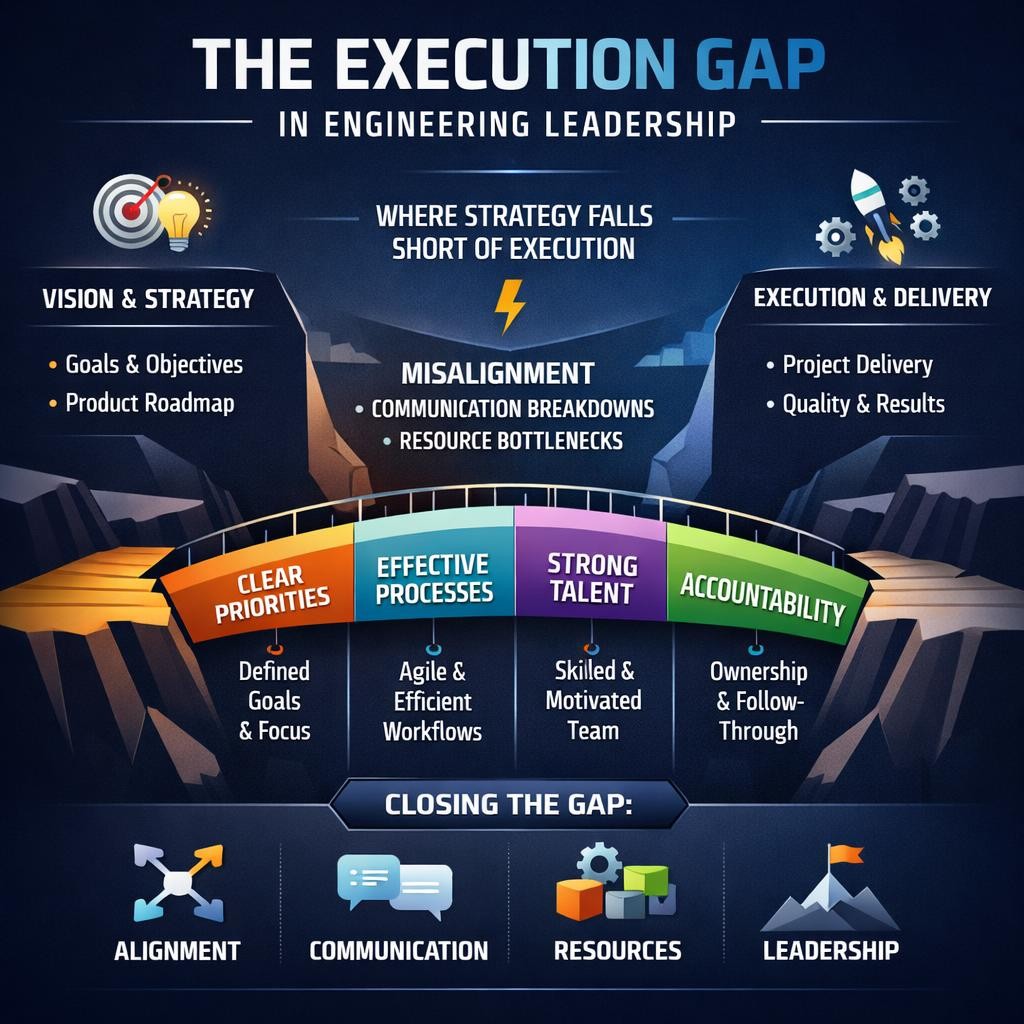
Section 4: The Execution Engine — How Work Actually Gets Done
This is where most leaders lose control.
Not because they’re weak—but because execution becomes invisible.
The 3 Layers of Execution
1. Strategic Layer
- Quarterly goals
- Business alignment
2. Tactical Layer
- Sprint planning
- Backlog prioritization
3. Operational Layer
- Incident handling
- Deployment pipelines
🔷 Diagram 4 — Engineering Execution Stack


Leadership Insight
If these layers are disconnected:
- Strategy becomes PowerPoint theater
- Teams optimize locally
- Delivery becomes unpredictable
Section 5: Autonomy vs Alignment — The Leadership Balancing Act
This is the hardest part of your job.
Too much autonomy:
- Teams diverge
- Duplication everywhere
Too much alignment:
- Everything slows down
- Innovation dies
🔷 Diagram 5 — Autonomy vs Alignment Tradeoff


The Right Model
You don’t choose one—you design both:
| Area | Approach |
|---|---|
| Architecture | Guardrails |
| Tools | Standardized |
| Delivery | Autonomous |
| Decision-making | Context-driven |
Section 6: The Platform Strategy — The Multiplier Most Leaders Miss
Here’s where great leaders separate themselves.
A strong internal platform:
- Removes friction
- Standardizes best practices
- Accelerates delivery
🔷 Diagram 6 — Internal Developer Platform


Leadership Insight
Without a platform:
- Every team reinvents everything
- Productivity collapses at scale
With a platform:
- You create leverage
Section 7: Reliability as a Leadership Responsibility
Most leaders treat reliability as:
“An engineering problem”
That’s wrong.
Reliability is a leadership decision.
What Leaders Control
- Investment in observability
- Incident response culture
- SLAs and SLOs
- Technical debt prioritization
🔷 Diagram 7 — Reliability Operating Model


Hard Truth
If your system is unreliable:
👉 It’s not your engineers’ fault
👉 It’s your prioritization decisions
Section 8: The Leadership Operating System
At this level, your job changes.
You’re no longer:
- Writing code
- Designing APIs
You are:
- Designing systems of execution
Your Core Responsibilities
- Define clear boundaries
- Enable fast decision-making
- Remove organizational friction
- Build accountability systems
🔷 Diagram 8 — Leadership Operating System


Section 9: Common Failure Patterns (And How to Avoid Them)
❌ Pattern 1: The Hero Culture
- Few engineers carry everything
- System collapses when they leave
❌ Pattern 2: Process Overload
- Too many meetings
- No real progress
❌ Pattern 3: Platform Bottleneck
- Platform team becomes gatekeeper
❌ Pattern 4: Misaligned Incentives
- Teams optimize locally, not globally
Leadership Fix
You don’t fix these with motivation.
You fix them with:
👉 Structural changes
👉 Clear incentives
👉 Better system design
Section 10: The Playbook — What You Should Actually Do Next
Let’s make this practical.
Step 1: Map Your Current State
- Team boundaries
- System ownership
- Bottlenecks
Step 2: Redesign Ownership
- One team → one system
Step 3: Introduce Platform Thinking
- Build internal developer experience
Step 4: Align Execution
- Strategy → delivery → operations
Step 5: Measure What Matters
- Lead time
- Deployment frequency
- Reliability
Final Thought: Leadership Is System Design
At senior levels, your impact is not measured by:
- Code written
- Features shipped
It’s measured by:
👉 How well your organization scales without you
Closing Perspective
Most engineers try to grow by:
- Learning new frameworks
- Following trends
But real growth comes from:
👉 Understanding how systems of people + technology + process interact
That’s what separates:
- A good engineer
- From a great technical leader


















Leave a comment