
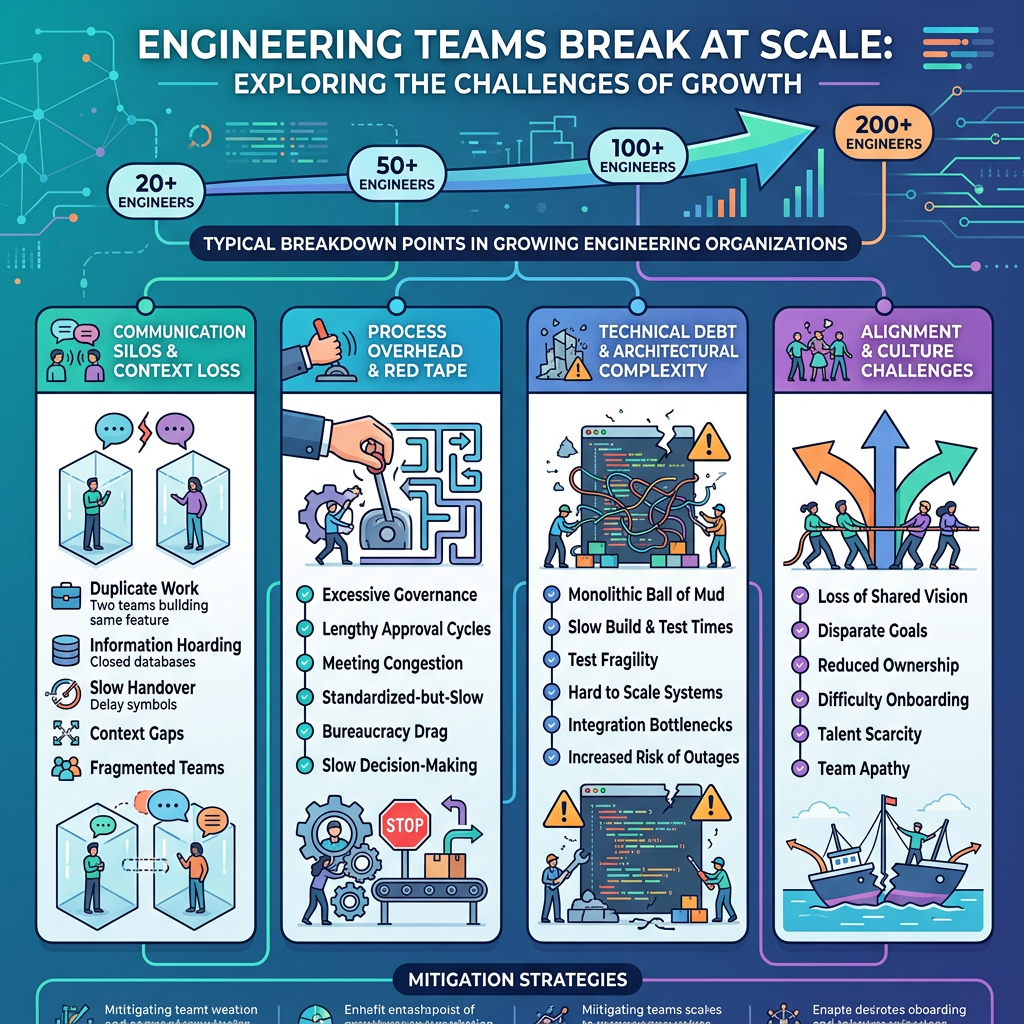
Focus Areas:
Technical Leadership • Organizational Architecture • Platform Engineering • Delivery Systems • Team Topologies • Software Governance
Introduction
There is a dangerous point in every engineering organization’s lifecycle.
It usually happens when the company grows beyond 20 engineers.
At 5 engineers, communication is easy.
At 10 engineers, architecture is still manageable.
At 20 engineers, coordination begins to strain.
Then something subtle happens.
Velocity starts dropping.
Deployments slow.
Ownership becomes blurry.
Architecture quality degrades.
Meetings multiply.
Engineers complain about process.
Leadership responds by adding more process.
Everything gets slower.
By the time the organization reaches 50–100 engineers, many companies find themselves trapped inside what I call:
The Engineering Scaling Trap
This is the stage where organizations discover a brutal truth:
Scaling software delivery is not about adding engineers.
It is about redesigning how engineering itself operates.
The technical leaders who understand this redesign their organizations before dysfunction appears.
The leaders who don’t become buried under:
- Coordination overhead
- Architectural entropy
- Delivery bottlenecks
- Ownership confusion
- Platform sprawl
- Organizational misalignment
This article is about how elite technical leaders avoid this trap.
We’ll go deep into:
- Why engineering organizations collapse while growing
- The structural mistakes leaders make
- How to design scalable engineering systems
- Team topology models that work
- Platform strategies
- Governance without bureaucracy
- Technical leadership operating systems
This is not theory.
This is the operating manual for engineering leaders building organizations that scale.
Part 1: Why Engineering Teams Break During Growth
The Illusion of Linear Scaling
Many leaders assume:
More engineers = more output
This is rarely true.
Software organizations scale nonlinearly.
The relationship often looks like this:
Diagram 1 — The Scaling Efficiency Curve


After a certain size:
- Communication paths explode
- Decision latency rises
- Cognitive load increases
- Dependency chains multiply
This phenomenon comes directly from Brooks’ Law:
Adding manpower to a late software project makes it later.
But the deeper issue is organizational architecture.
Communication Complexity
For N engineers, communication pathways scale approximately as:
N(N-1)/2
Examples:
- 5 engineers → 10 pathways
- 10 engineers → 45 pathways
- 20 engineers → 190 pathways
- 50 engineers → 1,225 pathways
- 100 engineers → 4,950 pathways
This becomes organizational chaos.
Part 2: Conway’s Law — The Hidden Force Behind Organizational Failure
Technical leaders often underestimate Conway’s Law.
Coined by Melvin Conway:
Organizations design systems that mirror their communication structures.
This means:
Bad org design creates bad architecture.
Always.
Diagram 2 — Conway’s Law in Action


When organizations scale poorly:
The software reflects:
- Fragmented ownership
- Redundant services
- Tight coupling
- Broken interfaces
Technical leadership is therefore organizational design.
Not merely technical decision-making.
Part 3: The Five Organizational Failure Modes
Failure Mode 1: Functional Silos
This is the classic model:
- Frontend Team
- Backend Team
- QA Team
- DevOps Team
- Database Team
It feels organized.
It is not.
It creates handoffs.
And handoffs destroy flow.
Why Functional Silos Fail
A feature request often travels:
Product → Frontend → Backend → DB → QA → DevOps
Each transfer introduces:
- Queue time
- Context loss
- Rework
- Accountability gaps
Diagram 3 — Silo Delivery Anti-Pattern


This is waterfall disguised as Agile.
Elite technical leaders eliminate it.
Failure Mode 2: Shared Ownership
When everyone owns everything:
No one owns anything.
Symptoms:
- “Who owns this service?”
- “I thought Platform handled that.”
- “Infra should fix it.”
- “Backend team wrote this.”
Shared ownership sounds collaborative.
In practice, it creates ambiguity.
Failure Mode 3: Platform Sprawl
As teams scale, many independently create:
- CI/CD pipelines
- Logging systems
- Monitoring setups
- Deployment tooling
- Security integrations
Soon:
10 teams maintain 10 incompatible delivery systems.
This is operational debt.
Failure Mode 4: Architecture by Committee
As organizations grow, decisions become meeting-driven.
Symptoms:
- Endless RFC review cycles
- Design paralysis
- Excessive stakeholder approvals
- Consensus dependency
Speed collapses.
Failure Mode 5: Leadership Distance from Systems
This is the most dangerous.
Leaders move too far from technical reality.
They begin optimizing dashboards instead of systems.
Elite leaders stay close to architectural truth.
Part 4: The Team Topologies Model That Actually Scales
One of the most influential organizational design models comes from the book
Team Topologies by Matthew Skelton and Manuel Pais.
It defines four team types.
1. Stream-Aligned Teams
These own business capabilities end-to-end.
Examples:
- Payments
- Claims Processing
- Customer Onboarding
- Billing
They own:
- Code
- Deployments
- Operations
- Reliability
This is where delivery happens.
2. Platform Teams
They build internal developer platforms.
They provide:
- Deployment systems
- Observability
- Security controls
- Runtime environments
Their goal:
Reduce cognitive load for stream-aligned teams.
3. Enabling Teams
They provide expertise.
Examples:
- Security coaching
- Performance optimization
- Database optimization
They teach.
They do not become permanent dependencies.
4. Complicated Subsystem Teams
These own domains requiring deep specialization.
Examples:
- Search relevance
- ML ranking systems
- Optimization engines
Diagram 4 — Team Topologies Architecture


This structure scales far better than functional silos.
Part 5: Platform Engineering as a Leadership Function
Many organizations misunderstand platform engineering.
They think it means:
“Create a DevOps team.”
Wrong.
Platform engineering is organizational infrastructure.
Its mission:
Accelerate product engineering safely.
The Internal Developer Platform
A strong platform provides:
Self-Service Infrastructure
Engineers provision environments instantly.
No ticket queues.
Standardized Deployment Pipelines
Every team deploys consistently.
Built-In Security Controls
Security is embedded.
Not bolted on.
Observability by Default
Metrics, tracing, logging included automatically.
Diagram 5 — Internal Developer Platform


Great technical leaders invest early here.
Because platform maturity determines scaling ceiling.
Part 6: The Cognitive Load Principle
This is one of the most underappreciated concepts in technical leadership.
Every engineering team has limited cognitive bandwidth.
When overloaded, quality drops.
Delivery slows.
Errors rise.
Sources of Cognitive Overload
Tooling Complexity
Too many systems.
Domain Breadth
Too much business complexity.
Operational Responsibility
Too many production concerns.
Dependency Surface Area
Too many cross-team interactions.
Leadership Responsibility
Reduce unnecessary complexity.
Not add process.
Part 7: Architecture Governance Without Bureaucracy
As engineering grows, architecture drift becomes inevitable.
Many leaders respond with:
- Architecture review boards
- Approval chains
- Governance committees
These often become bottlenecks.
Better approach:
Guardrails, Not Gates
Define Golden Paths
Provide default best practices.
Examples:
- Approved service templates
- Deployment standards
- Security defaults
Use Automated Policy Enforcement
Examples:
- Static analysis
- Policy-as-code
- Security scanning
Machines enforce.
Humans guide.
Lightweight ADRs
Architecture Decision Records.
Short.
Focused.
Searchable.
Diagram 6 — Governance Evolution


Part 8: The Technical Leadership Operating System
Elite technical leaders build operating systems for engineering.
Not just teams.
A technical leadership OS has five components.
1. Organizational Design
Structure for flow.
2. Platform Strategy
Enable autonomy.
3. Architectural Principles
Provide consistency.
4. Delivery Metrics
Measure reality.
5. Leadership Mechanisms
Create alignment.
Diagram 7 — Engineering Leadership OS


Part 9: Metrics That Actually Matter
Most engineering organizations track vanity metrics.
Bad examples:
- Story points
- Lines of code
- Sprint velocity
These are easily gamed.
Better Metrics
Use DORA metrics:
- Deployment Frequency
- Lead Time for Changes
- Change Failure Rate
- Mean Time to Recovery
- Cognitive Load Index
- Platform Adoption
- Dependency Latency
Part 10: Scaling Leadership Itself
The hardest part of engineering growth:
Leaders must evolve.
The leadership style that works at 10 engineers fails at 100.
Stage 1: Builder Leader (1–15 Engineers)
Hands-on.
Direct.
Technical depth.
Stage 2: System Designer (15–40 Engineers)
Defines architecture.
Shapes process.
Mentors deeply.
Stage 3: Organizational Architect (40–100 Engineers)
Designs systems of teams.
Focuses on topology.
Platform strategy.
Governance.
Stage 4: Executive Technical Strategist (100+ Engineers)
Shapes long-term technical capability.
Aligns engineering with business strategy.
Diagram 8 — Leadership Evolution


Part 11: Practical Playbook for Scaling from 20 to 100 Engineers
Phase 1 (20–30 Engineers)
Focus:
Clarify ownership.
Actions:
- Define service boundaries
- Assign explicit owners
- Remove functional silos
Phase 2 (30–50 Engineers)
Focus:
Build platform foundations
Actions:
- Establish platform team
- Standardize CI/CD
- Introduce observability standards
Phase 3 (50–75 Engineers)
Focus:
Governance evolution
Actions:
- Architecture principles
- ADR system
- Golden paths
Phase 4 (75–100 Engineers)
Focus:
Organizational optimization
Actions:
- Reduce cross-team dependencies
- Rebalance domains
- Measure cognitive load
Part 12: The Hard Truth About Technical Leadership
The biggest mistake engineering leaders make:
They think scaling is solved with:
- More hiring
- More process
- More meetings
- More tools
It isn’t.
Scaling is solved by better systems design.
And the most important system you will ever design is:
The engineering organization itself.
Final Takeaway
Software architecture matters.
Platform engineering matters.
Delivery systems matter.
But ultimately:
The highest-leverage technical artifact any engineering leader creates is organizational architecture.
Because every technical outcome emerges from it.
Great technical leaders understand this.
Average leaders discover it too late.
Leave a Reply