
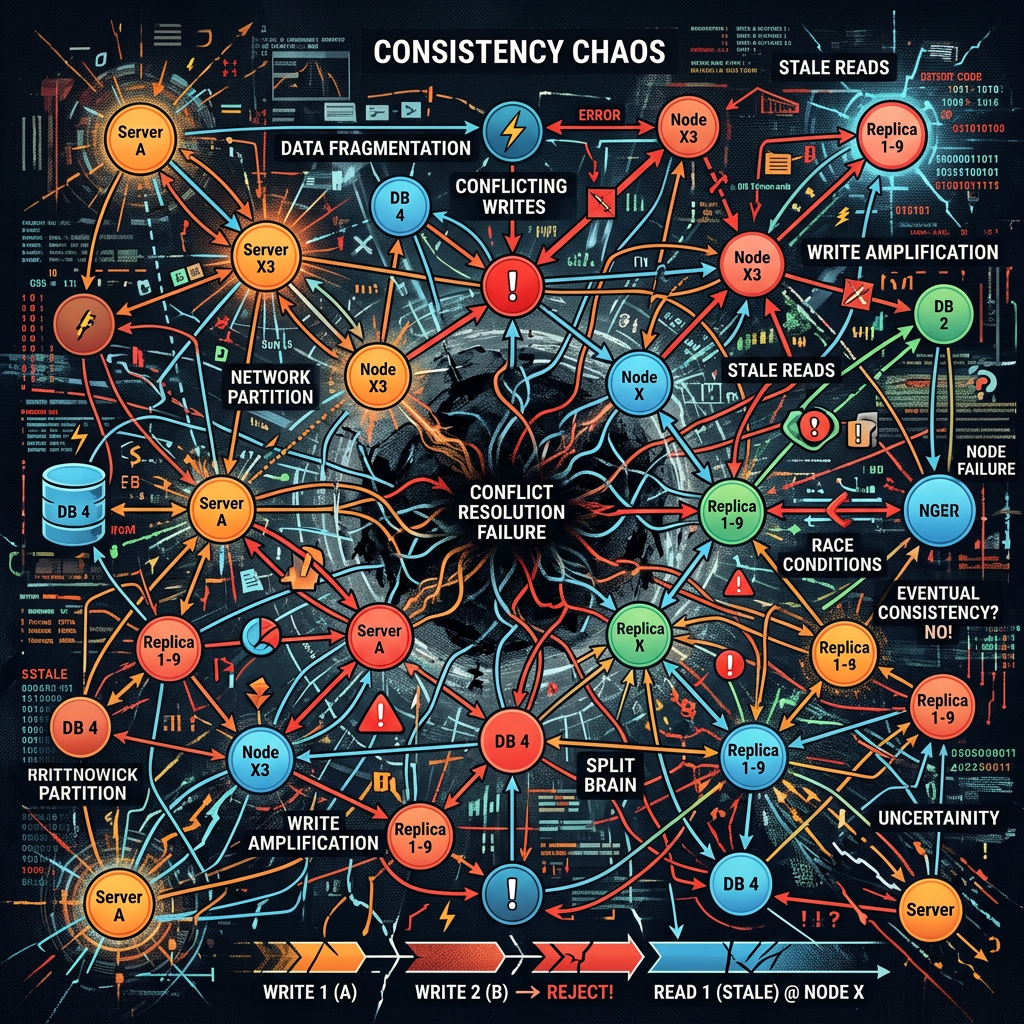
Hero Diagram
┌──────────────┐│ Customer App │└──────┬───────┘ │ ▼┌──────────────┐│ Order Service│└──────┬───────┘ │ ▼┌──────────────┐│ Payment Svc │└──────┬───────┘ │ ▼┌──────────────┐│ Inventory ││ Service │└──────┬───────┘ │ ▼┌──────────────┐│ Shipping Svc │└──────────────┘Question:What happens when one step fails?
Part 1 — The Most Expensive Bug Is Not a Crash
Software engineers fear:
- Outages
- Downtime
- Latency spikes
- Security incidents
But the most expensive failures rarely appear on dashboards.
The real disasters are:
Silent Data Corruption
Examples:
- Customer charged twice
- Inventory deducted three times
- Shipment created without payment
- Refund issued but balance unchanged
- Loyalty points duplicated
System appears healthy.
Data is wrong.
That is infinitely more dangerous.
Diagram — Availability vs Correctness
                HIGH
                  ▲
                  │
                  │
                  │
                  │
CORRECTNESS       │
                  │
                  │
                  │
                  │
                  └────────────────►
                       AVAILABILITY
Many organizations optimize availability.
Elite organizations optimize correctness.
Part 2 — Why Distributed Systems Create Consistency Problems
In a monolith:
Application │ ▼ Single Database
Single transaction.
Single source of truth.
ACID guarantees.
Life is simple.
Modern architectures look like:
Service A │ ├────► Database AService B │ ├────► Database BService C │ ├────► Database CKafkaRedisExternal APIsThird-Party Systems
Now:
- Network can fail
- Services can timeout
- Messages can duplicate
- Clocks disagree
- Databases diverge
Consistency becomes architecture’s hardest problem.
Part 3 — The Fallacy of Distributed Transactions
Many teams believe:
“We’ll just use a transaction.”
Works inside one database.
Fails across multiple services.
Classic Order Flow
1. Create Order2. Charge Card3. Reserve Inventory4. Create Shipment5. Send Email
Question:
What happens if:
Step 3 failsafterStep 2 succeeds?
Customer paid.
No inventory.
Now what?
Diagram — Distributed Transaction Failure
Order Service │ ▼Payment Service │ SUCCESS ▼Inventory Service │ FAILED ▼Shipping Service
Result:
Money TakenInventory MissingShipment Not Created
Data inconsistency.
Part 4 — Why Two-Phase Commit Is Mostly Dead
Theoretical solution:
2PC (Two-Phase Commit)
PrepareCommit
Coordinator asks every participant:
Can you commit?
If everyone agrees:
Commit
Sounds perfect.
Production reality:
- Slow
- Blocking
- Coordinator failures
- Scalability issues
- Operational complexity
Most cloud-native systems avoid it.
Part 5 — Enter the Saga Pattern
Modern systems typically use:
Saga Architecture
Instead of:
One giant transaction
We use:
Many local transactions
with compensating actions.
Saga Flow
Create Order │ ▼Charge Payment │ ▼Reserve Inventory │ ▼Create Shipment
Failure?
Execute compensation.
Refund PaymentRelease InventoryCancel Shipment
Diagram — Saga Orchestration
          Saga Coordinator
                 │
                 ▼
     ┌─────────────────────┐
     │ Create Order        │
     └─────────────────────┘
                 │
                 ▼
     ┌─────────────────────┐
     │ Charge Payment      │
     └─────────────────────┘
                 │
                 ▼
     ┌─────────────────────┐
     │ Reserve Inventory   │
     └─────────────────────┘
                 │
                 ▼
     ┌─────────────────────┐
     │ Create Shipment     │
     └─────────────────────┘
Part 6 — The Hidden Problem Nobody Talks About
Compensation is not reversal.
Example:
Refunding payment does not erase:
- Fraud detection triggers
- Accounting entries
- Currency conversions
- Audit trails
- Customer notifications
Many actions are irreversible.
This is where most simplistic Saga articles fail.
Part 7 — Eventual Consistency Explained Properly
Most architects say:
Eventual consistency means data becomes consistent later.
Technically true.
Practically useless.
The real definition:
Different parts of the system temporarily disagree.
Diagram — Eventual Consistency
Time T0Order DBStatus = PAIDInventory DBStatus = PENDINGShipping DBStatus = UNKNOWN
Eventually:
Time T1Order DBStatus = PAIDInventory DBStatus = RESERVEDShipping DBStatus = CREATED
The disagreement period is the danger zone.
Part 8 — The Duplicate Message Nightmare
Every production system eventually experiences:
Message Delivered Twice
Reasons:
- Retries
- Network failures
- Broker recovery
- Consumer restarts
Example
Reserve Inventory
delivered twice.
Inventory:
10 units
After duplicate:
8 units
Instead of:
9 units
This bug may remain hidden for months.
Diagram — Duplicate Event Disaster
Event │ ▼Reserve Item │ ├──► Consumer A │ └──► Consumer A (Retry)Inventory decremented twice
Part 9 — Idempotency: The Billion-Dollar Pattern
Every distributed operation should be:
Idempotent
Meaning:
1 execution = 100 executions
Same outcome.
Example:
Bad:
balance += payment
Good:
if paymentId not processed apply payment
Idempotency keys save companies millions.
Part 10 — The Outbox Pattern
One of the most important architecture patterns in existence.
Problem:
Save OrderPublish Event
Database succeeds.
Event fails.
Now services disagree forever.
Solution:
Transactional Outbox
Database TransactionSave OrderSave Event
Commit together.
Then publish asynchronously.
Diagram — Outbox Architecture
Application │ ▼┌─────────────┐│ Orders │├─────────────┤│ Outbox │└─────────────┘ │ ▼Publisher │ ▼Kafka
Part 11 — Why Exactly-Once Processing Is Mostly Marketing
Many vendors advertise:
Exactly Once
Reality:
Distributed systems fundamentally provide:
At Least Once
or
At Most Once
Exactly-once semantics usually require:
- Idempotency
- Deduplication
- Transaction coordination
Architecture creates correctness.
Not messaging platforms.
Part 12 — The Elite Engineering Playbook
Organizations operating at extreme scale adopt:
Principle 1
Design for duplication.
Principle 2
Design for reordering.
Principle 3
Design for replay.
Principle 4
Design for partial failure.
Principle 5
Design for recovery.
Principle 6
Favor correctness over convenience.
Principle 7
Track causality everywhere.
Ultimate Production Blueprint
Users │ ▼API Gateway │ ▼Order Service │ ▼Outbox Pattern │ ▼Kafka │ ├──► Payment │ ├──► Inventory │ ├──► Shipping │ └──► Analytics │ ▼Observability PlatformOpenTelemetryTracingAudit LogsEvent ReplayDead Letter Queues
Final Thought
The biggest misconception in software architecture is that scalability is about handling more traffic.
It isn’t.
True scalability is maintaining correctness while handling more traffic.
The systems that fail at scale are rarely the ones that cannot process requests.
They are the ones that can process millions of requests while quietly corrupting millions of records.
The future of software architecture is not faster systems.
It is trustworthy systems.
And the engineers who master distributed consistency will become some of the most valuable architects in the industry.
Leave a Reply