
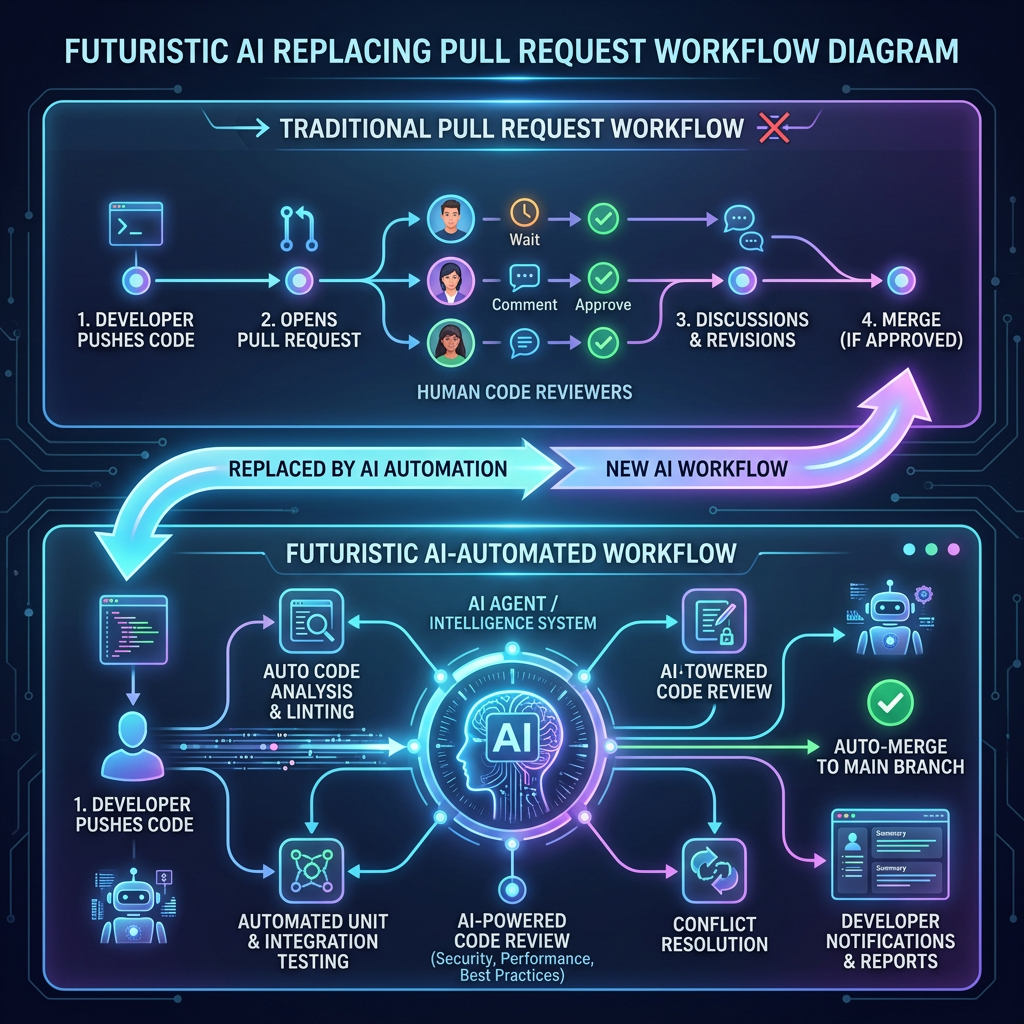
For the past fifteen years, the trunk-and-branch model, governed by the Pull Request (PR), has been the unquestioned constitutional foundation of elite software engineering teams. It democratized code review, instituted safety guardrails, and provided a structured learning mechanism for junior developers. The PR was the ultimate quality gate.
But the underlying assumption of the PR model—that code is authored by a finite, constrained human resource at a rate slow enough for another human to review asynchronously—has collapsed.
We have entered the era of the AI-Native Software Development Lifecycle (SDLC). AI is no longer a localized autocomplete utility sitting within an IDE; it has evolved into a network of autonomous, context-aware agents capable of executing massive, multi-file refactors, synthesizing complex migrations, and generating thousands of lines of syntactically valid code in seconds.
When code generation velocity scales by 100x while human review capacity remains fixed, the human review step becomes a catastrophic structural bottleneck. If your senior engineers spend four hours a day reading, verifying, and debating AI-generated pull requests, you aren’t running an agile engineering organization; you are running an expensive human compilation and validation queue.
To unlock the true potential of the 10x engineering team, technical leaders must systematically dismantle the traditional PR-based workflow. This guide provides the complete architectural, algorithmic, and organizational blueprint required to design, deploy, and lead an AI-Native SDLC utilizing Continuous Evaluation Pipelines and Trunk-Based Agent Integration.
1. The Anatomy of the Bottleneck: Why the Traditional PR Fails in the AI Era
To understand why the PR model breaks under the weight of generative AI, we must analyze it through the lens of queue theory and cognitive load. The traditional git-flow pipeline relies on asynchronous human intervention:
[Write Code] ──> [Open PR] ──> [CI/CD Checks] ──> [Human Review Request] ──> [Asynchronous Wait] ──> [Context Stitching] ──> [Approval] ──> [Merge]
This model works when a human developer spends six hours crafting a 150-line delta. The reviewer must dedicate 15–20 minutes to reconstruct the mental context of the change, spot edge cases, and ensure alignment with design patterns.
When an autonomous AI agent or an engineer paired with a highly specialized multi-agent system tackles the same problem, the dynamics shift completely. The agent scans the entire codebase, processes the issue description, updates 14 files across 3 microservices, and submits a 1,200-line PR within 45 seconds.
This introduces three critical failure modes for an engineering organization:
A. The Code Tsunami and Context Bankruptcy
Human cognitive throughput is fundamentally linear. A senior architect cannot review code at the speed an LLM can emit it. When an agent submits a massive multi-file change, the human reviewer experiences Context Bankruptcy. The time required to safely trace data flows, evaluate side effects, and verify architectural alignment across thousands of lines of generated code exceeds the time it would have taken to write the feature from scratch. Teams quickly face a choice: rubber-stamp the AI’s pull request (inviting catastrophic technical debt) or let PRs sit in a queue, killing organizational velocity.
B. The Asynchronous Stagnation Loop
The greatest waste metric in software manufacturing is inventory—code that has been written but not deployed to production. PR queues are the software equivalent of a warehouse filled with unsold goods. As AI increases the arrival rate of PRs into the queue, the wait time scales exponentially according to Kingman’s formula for queuing systems. Human engineers become trapped in an endless loop of context switching, alternating between their active coding tasks and reviewing an ever-mounting stack of agent-generated deltas.
C. The Diffusion of Responsibility
When code generation is cheap, the emotional ownership of code decreases. If an engineer triggers an agent to generate a feature, they are less intimately acquainted with the edge cases than if they had written every line line-by-line. When this code lands in a traditional PR, the reviewer assumes the author verified it; the author assumes the agent got it right and the reviewer will catch errors. This diffusion of responsibility leads to catastrophic architectural degradation, security vulnerabilities, and subtle runtime regressions escaping into production.
2. Paradigm Shift: From Gatekeeper to Architect of Context
To survive the code tsunami, technical leadership must pivot. Your role is no longer to ensure your team writes clean code line-by-line. Your role is to build a deterministic system that validates code behavior at scale.
The goal of the AI-Native SDLC is to transition from Human-Verified Code Production to System-Verified Automated Integration.
| Metric / Dimension | Traditional Human-Centric SDLC | AI-Native Automated SDLC |
| Primary Velocity Bottleneck | Code Generation (Human typing/thinking speed) | Code Verification (System testing & context injection) |
| Primary Quality Gate | Asynchronous Human Peer Review (PR) | Real-time Continuous Evaluation (CE) Pipeline |
| Branching Strategy | Long-Lived Feature Branches / Git-Flow | Trunk-Based Agent Integration with Automated Rollbacks |
| Leader’s Core Responsibility | Managing Headcount, Assigning Tickets, Code Reviews | Engineering Context Windows, Designing System Invariants |
| Unit of Execution | The Individual Pull Request | The Autonomous Evolution Loop |
In this new paradigm, instead of reviewing the code itself, human leaders and senior engineers build the Architectural Invariants, Semantic Guards, and Continuous Evaluation Engines that govern the environment in which AI agents operate. If the environment is sufficiently rigorous, code can flow directly into the trunk without manual human inspection.
3. The Multi-Agent Autonomous Engineering Architecture
To replace the traditional human IDE-to-PR pipeline, we must construct an enterprise-grade multi-agent software engineering framework. We cannot rely on a single monolith LLM call to write software; single models lack the memory, planning capacity, and localized tool access required to manage large-scale systems.
Instead, we implement a decoupled, event-driven multi-agent architecture where agents communicate via a centralized orchestration bus, executing specialized functions within isolated, sandboxed environments.
Architectural Blueprint of the Multi-Agent Factory
- The Product Synthesis Agent (PSA): Ingests ambiguous user requirements, customer feedback, or product specs (from tools like Jira or Linear). It deconstructs these into deterministic functional requirements, user stories, and acceptance criteria. It exposes these criteria as structured JSON schemas.
- The Context Resolution Agent (CRA): Before a single line of code is written, the CRA analyzes the codebase. It uses semantic code search, Abstract Syntax Tree (AST) parsing, and dependency graphing to extract the precise minimal context window required to execute the change. It filters out irrelevant modules, drastically reducing LLM token costs and minimizing hallucination risks.
- The Architectural Critic Agent (ACA): Acts as the guardian of the system design. It evaluates the CRA’s context and the PSA’s requirements against the organization’s predefined architectural guardrails (e.g., “Domain-driven design rules: Service A must never import Service B’s internal models; all communications must utilize event-driven payloads”). It produces a strict implementation contract.
- The Code Generation Agent (CGA): Operates inside a secure, containerized sandbox environment (e.g., an ephemeral Docker container or an isolated MicroVM). Armed with localized tools (compilers, linters, LSP servers), it generates the deltas across the code base. It iteratively executes internal linting and unit compilation steps until it compiles cleanly.
- The Continuous Evaluation Agent (CEA): The core engine replacing the PR. It subjects the compiled code to an aggressive battery of automated verification suites, dynamic analysis, and security verification tools.
4. The Continuous Evaluation (CE) Pipeline: Replacing the Human Gate
If we remove the human code review gate, how do we guarantee code quality, maintainability, and security? We replace the passive code review with an active, multi-layered Continuous Evaluation (CE) Pipeline.
The CE pipeline treats code as a black box whose behavior must be rigorously proven, rather than an artifact whose syntax must be visually admired.
[Agent Emits Delta] │ ▼┌────────────────────────────────────────────────────────┐│ Phase 1: Static Structural Guardrails ││ (AST Constraints, Architecture Compliance, Linters) │└───────────────────────┬────────────────────────────────┘ │ Pass ▼┌────────────────────────────────────────────────────────┐│ Phase 2: Dynamic Behavioral Verification ││ (Differential Testing, Automated Mutation Testing) │└───────────────────────┬────────────────────────────────┘ │ Pass ▼┌────────────────────────────────────────────────────────┐│ Phase 3: Semantic Guardrails ││ (LLM-Based Intent Alignment, Security Analysis) │└───────────────────────┬────────────────────────────────┘ │ Pass ▼[Automated Merge to Main Branch via Trunk-Based Pipeline]
Phase 1: Static Structural Guardrails (AST & Architecture-as-Code)
We do not use humans to check if code adheres to naming conventions, linting guidelines, or structural patterns. We enforce these programmatically using Abstract Syntax Tree (AST) analysis and Architecture-as-Code tooling (such as ArchUnit for JVM languages or TsArch for TypeScript).
If an agent attempts to introduce a tight coupling between two bounded contexts or bypasses an established database abstraction layer, the structural validation layer detects the AST violation instantly and rejects the change with a clear error payload back to the Code Generation Agent for self-correction.
TypeScript
// Example: Programmatic Architecture Invariant Definitionimport { Architecture } from 'tsarch';describe('Architectural Invariants', () => { it('Billing domain must never directly import from Inventory domain', async () => { const rule = Architecture.define() .where() .resideInAPath('src/modules/billing') .shouldNot() .dependOnModules() .matching('src/modules/inventory'); const result = await rule.check(); expect(result.hasViolations()).toBe(false); });});
Phase 2: Dynamic Behavioral Verification & Differential Testing
The gold standard of software verification is behavioral assertion. To allow AI agents to commit directly to the main trunk, your automated test suite must be incredibly robust.
- Differential Testing: When an agent updates a complex, legacy algorithm, the CE pipeline spins up two isolated worker environments: one running the stable production baseline (version $V_n$) and one running the agent’s modified candidate version ($V_{n+1}$). The pipeline feeds thousands of fuzz-generated, production-representative payloads into both instances concurrently, comparing the outputs, side-effects, and performance footprints. If any deviation occurs that wasn’t explicitly outlined in the product requirements spec, the execution is halted.
- Automated Mutation Testing: To prevent agents from circumventing code coverage metrics by writing hollow tests without genuine assertions, the CE pipeline runs mutation testing (using tools like Stryker or Pitest). The engine injects intentional faults into the agent’s generated code (e.g., changing a
>to a<or flipping a boolean toggle) and runs the test suite. If the test suite fails to detect the mutation, the tests are flagged as insufficient, and the code is rejected.
Phase 3: Semantic Guardrails (The Automated Critic Layer)
Not all software qualities can be extracted via static code parsing or dynamic test execution. Structural readability, intent alignment, and compliance with high-level design philosophies require semantic processing.
This is where the Automated Critic Layer operates. An independent, specialized LLM agent—highly prompted and armed with access to the company’s comprehensive engineering wiki, past post-mortems, and design patterns—reviews the code delta. It does not ask “Does this look good?” Instead, it executes an interrogation based on hard, deterministic prompts:
- “Evaluate this delta for potential race conditions given our event-driven infrastructure. Verify that all distributed consumer actions are strictly idempotent.”
- “Check for OWASP Top 10 vulnerabilities, explicitly scanning for unsafe deserialization or SQL injection vectors introduced via dynamic string manipulations.”
- “Verify that log levels conform to our observability standards, ensuring no personally identifiable information (PII) is emitted to the stdout channels.”
The Critic Agent scores the delta. If the score falls below a strict threshold, it provides a comprehensive breakdown of the failure vectors, appending them to the pipeline’s error feedback loop, prompting the coding agent to refine its work.
5. Branching and Deployment Strategy: Trunk-Based Agent Integration
The traditional git-flow framework with long-lived feature branches, release branches, and multi-day code freezes is fundamentally incompatible with the AI-Native SDLC. It creates catastrophic merge conflicts (“git merge hell”) because agents move too fast for human branch reconciliation to keep pace.
The architectural solution is Trunk-Based Agent Integration coupled with Continuous Canary Deployments.
The Mechanics of Trunk-Based Agent Integration
- Short-Lived Ephemeral Environments: Agents pull directly from the
mainbranch. When executing a task, they work locally inside an ephemeral container. - Automated Micro-Commits: Instead of clustering a multi-day effort into one massive pull request, the agent breaks the task into tiny atomic increments. Each change is instantly pushed through the CE pipeline and integrated directly into the
maintrunk. - Strict Feature Flagging: Every single change integrated by an agent that introduces or modifies a code execution path must be wrapped in a programmatic feature flag (using platforms like LaunchDarkly or self-hosted OpenFeature setups). The code is merged into production in a dormant state. The system execution paths are decoupled from deployment mechanics.
Python
# Example of Agent-Enforced Feature Flag Wrapperfrom openfeature import apidef process_user_payment(user_id, amount): client = api.get_client() # Agent wraps new high-velocity optimization engine behind an isolated flag is_ai_optimized_pipeline_enabled = client.get_boolean_value( flag_key="payment-pipeline-v2-optimization", default_value=False, context={"user_id": user_id} ) if is_ai_optimized_pipeline_enabled: return execute_optimized_payment_core(user_id, amount) else: return execute_legacy_payment_core(user_id, amount)
Autonomous Canary Evaluation
Once an atomic change passes the CE pipeline and merges into the trunk, the deployment pipeline shifts the container orchestrator (e.g., Kubernetes via ArgoCD) to execute an automated canary rollout.
- The change is deployed to exactly 1% of live production traffic.
- The Automated Observability Engine (scraping Prometheus metrics, Datadog traces, and Sentry error streams) establishes an isolated evaluation window tracking golden metrics: HTTP 5xx error spikes, latency degradation ($p99$ shifts), memory leaks, and anomalous database connection pool exhaustion.
- If the metrics remain pristine for a 5-minute window, traffic dynamically scales to 10%, 50%, and finally 100%.
- If an anomaly is detected at any point, the pipeline executes an automated rollback within milliseconds, kills the canary instance, updates the feature flag status to permanently disabled, and sends the real-time production exception stack trace back to the agent architecture as a critical priority ticket.
6. Managing the Code Tsunami: Tracking Technical Debt and Code Bloat
When the friction of writing code drops to zero, an engineering organization runs the severe risk of suffocating under its own code volume. AI models excel at emitting verbose logic. Left unchecked, your codebase can double in size within months, driving up system maintenance overhead, slowing down CI pipelines, and inflating context window utilization fees.
As an engineering leader, your focus must shift from maximizing code output to maximizing feature surface area while minimizing code footprint.
The Code-to-Value Density Metric
Implement a core engineering metric: Code-to-Value Density (CVD).
$$\text{CVD} = \frac{\text{System Capability Points (Features Delivered)}}{\text{Total Lines of Active Source Code (SLOC)}}$$
If your SLOC increases by 40% but your feature capabilities or revenue-generating transactions scale by only 5%, your AI-native development model is generating toxic architectural bloat.
The Automated Refactoring and Pruning Cycle
To combat this, introduce an autonomous Pruning Agent that runs as a scheduled cron job during low-traffic periods. This agent is optimized for code reduction rather than feature generation. Its responsibilities include:
- Dead Code Elimination: Scanning system trace telemetry to find execution blocks, functions, and modules that have not been invoked across production workloads in the last 30 days, and generating structural removal pull requests automatically.
- De-duplication Refactoring: Identifying instances where different feature agents built localized variations of similar utilities, abstracting them back into a single elegant core service.
- Dependency Minimization: Finding oversized external open-source libraries introduced by agents to solve trivial problems (e.g., pulling in a massive utility library just to pad a string) and rewriting the logic natively to keep the application footprint lightweight.
7. The Evolving Role of the Engineering Leader
The shift to an AI-Native SDLC alters the fundamental day-to-day role of engineering managers, tech leads, and directors. If you continue to manage your organization through traditional tracking rituals, you will fail.
The Extinction of the “Ticket-Typing” Engineer
The era of hiring developers to sit in front of a screen, pick an isolated Jira ticket, and spend three days converting human language into structured syntax is over. Engineers who fail to transition to system-level thinking will find themselves obsolete.
Your human engineers must be cultivated into Context Designers and System Verification Architects. They are responsible for defining the system constraints, establishing boundary conditions, mapping data models, and designing the automated tests that the AI infrastructure uses to safely write code.
Redefining Engineering Metrics
Stop measuring your engineering team by lines of code written, tickets closed, or pull requests approved. These metrics are easily gamed by autonomous tools. Instead, track operational efficiency and system resilience:
- Mean Time to Context Alignment (MTCA): How long does it take an AI agent to safely ingest, understand, and successfully compile a fix for an issue within an unfamiliar domain of your codebase? High MTCA means your system modules are poorly decoupled or code context is unorganized.
- Pipeline Autonomy Rate (PAR): The percentage of code commits that flow directly from an agent’s initial prompt into live production without requiring a single manual human intervention or manual rollback step. Elite teams should target a PAR $> 85\%$.
- Defect Leakage Rate (DLR): The ratio of bugs discovered by real-world users in production relative to those intercepted by your Continuous Evaluation pipeline.
Conclusion: Embracing the Autonomous Future
Moving away from the traditional Pull Request model can feel unsettling to any seasoned software leader. The PR has long provided a sense of control and oversight. However, clinging to outdated processes out of comfort creates an organizational bottleneck that restricts your team’s velocity and scales down human engineering potential.
The ultimate competitive advantage in modern technology execution belongs to companies that build an automated system of code verification rather than relying on manual peer reviews. By architecting an event-driven multi-agent factory, constructing multi-layered Continuous Evaluation pipelines, and shifting to trunk-based agent integration, you turn your engineering organization into a fast, resilient, and truly modern operation.
The future of software architecture isn’t about managing lines of code anymore—it’s about managing system context. Step away from the compilation queue, dismantle your manual PR workflows, and build the autonomous engineering engine your team needs to lead tomorrow.
Leave a Reply