
Summary: The Emerging Threat Vector in AI-Native Infrastructure
The rapid architectural migration from single-inference stateless Large Language Models (LLMs) to multi-tenant stateful Agentic AI mesh environments has introduced a foundational threat vector: Cross-Tenant Kernel and Memory Escalation via Autonomous Agent Execution.
In traditional web microservices, multi-tenancy isolation relies on process sandboxing, Linux namespaces, cgroups, and hypervisor-level microVM boundaries (e.g., AWS Firecracker or Kata Containers). However, modern high-throughput LLM serving platforms (built on vLLM, TensorRT-LLM, or Triton Inference Server) multiplex hardware accelerators across thousands of concurrent agent state machines. To minimize TTFT (Time to First Token) and maximize generation throughput, these architectures heavily rely on shared PagedAttention KV-cache pools, unified memory fabrics (NVLink/NVSwitch), and direct peer-to-peer DMA (Direct Memory Access) transfers across heterogeneous GPU architectures.
+-----------------------------------------------------------------------------------+| ATTACK VECTOR SURFACE |+-----------------------------------------------------------------------------------+| [ Adversarial Prompt Injection ] || | || v || [ User-Space Agent Runtime (LangChain/AutoGPT/Custom State Engine) ] || | || +---> (System Tool Execution / Unsafe Code Sandbox) || | || v || [ CUDA / ROCm User-Space Runtime Driver (libcuda.so / libamdhip64.so) ] || | || +---> [ Unencrypted GPU Memory Allocation / Unified Memory ] || | || v || [ Linux Kernel Space ] <--- [ EXPLOIT: Unchecked ioctl() & Out-of-Bounds DMA ] || | || v || [ Hardware Enclave Boundary (AMD SEV-SNP / Intel TDX / NVIDIA Confidential GPU) ] |+-----------------------------------------------------------------------------------+
This structural efficiency creates an unprecedented attack surface. When an autonomous AI agent encounters malicious input (via prompt injection, corrupted rag data stores, or adversarial fine-tuning), the exploit escapes the user-space prompt context and translates into low-level syscall manipulations. By executing out-of-bounds ioctl() requests against the GPU character device (/dev/nvidia* or /dev/kfd), an attacker can cause buffer overflows in kernel drivers, manipulate shared KV-cache memory pointers, and extract raw cryptographic keys, sensitive system prompts, or multi-tenant user data directly out of High Bandwidth Memory (HBM).
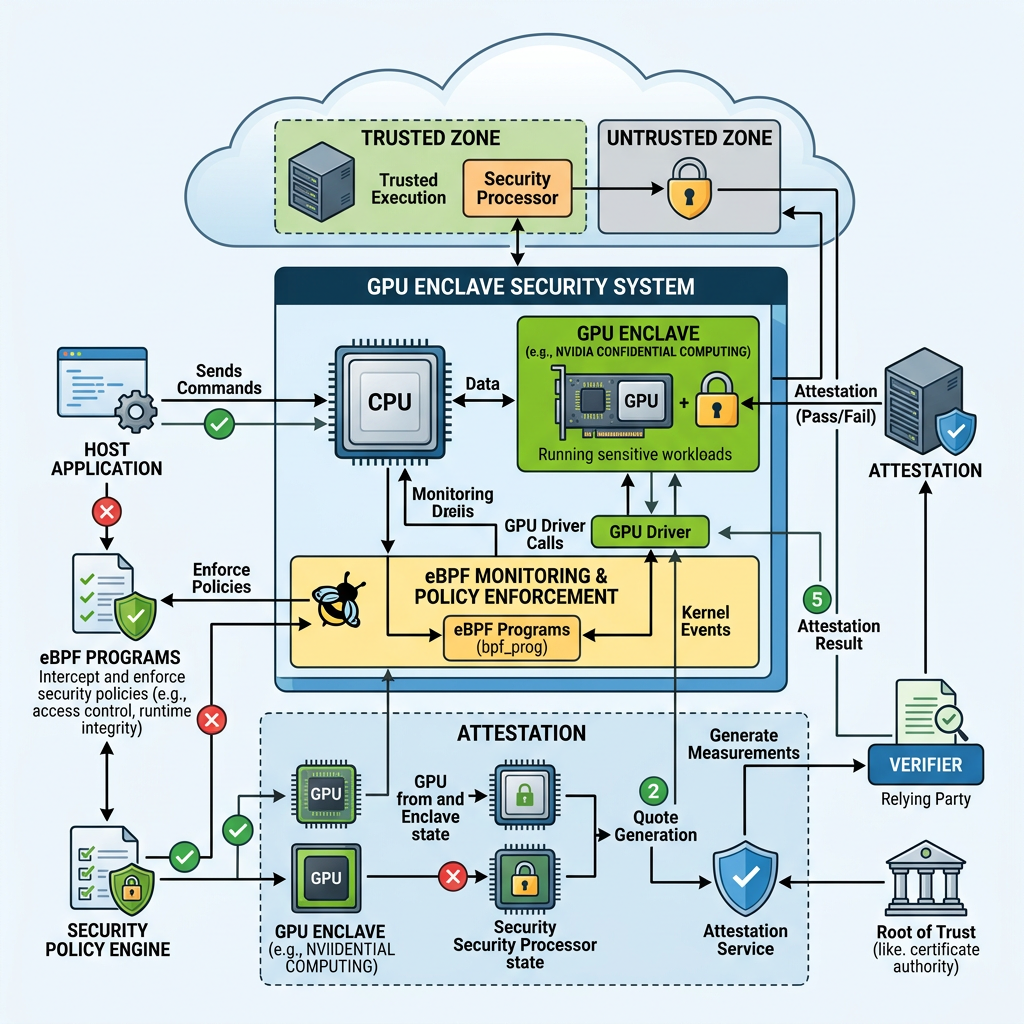
This guide provides an end-to-end blueprint for engineering an eBPF-driven Zero-Trust Kernel Runtime Security Layer combined with Hardware-Based Confidential Computing Enclaves (Intel TDX, AMD SEV-SNP, NVIDIA Hopper/Blackwell Confidential Compute) to inspect, isolate, and terminate malicious agent execution in real time without sacrificing hardware throughput.

Architectural Deep Dive: Anatomy of a Hardware-Level Agentic Exploit
To defend against advanced persistent agentic threats, security architects must understand how high-level prompt injections translate down to physical GPU memory corruptions.
1. The PagedAttention KV-Cache Attack Vector
In modern LLM engines, the key-value (KV) cache grows dynamically during sequence generation. Systems like vLLM divide the memory space of KV keys/values into fixed-size physical blocks (e.g., 16 tokens per block) managed similarly to virtual memory pages in operating systems.
When multiple autonomous agents execute concurrently on the same GPU cluster:
- Virtual Block Aliasing: To save memory, prompt prefix caching allows multiple agents executing the same base prompt to share underlying physical memory pages.
- The Exploit Mechanism: An attacker crafts an adversarial prompt that triggers dynamic token expansion coupled with a memory corruption primitive within custom CUDA extensions (e.g., FlashAttention kernel vulnerabilities or custom tool execution environments).
- Cross-Tenant Access: By triggering a memory boundary alignment issue via manipulated sequence lengths, the exploit forces the GPU memory manager to read or write into physical page blocks assigned to an adjacent tenant’s state machine.
       TENANT A (Attacker Agent)               TENANT B (Victim Agent)
   +------------------------------+       +------------------------------+
   | Virtual Blocks: [A1][A2][A3] |       | Virtual Blocks: [B1][B2][B3] |
   +------------------------------+       +------------------------------+
                  \                                      /
                   \                                    /
+-----------------------------------------------------------------------------------+
|                        PHYSICAL HBM MEMORY POOL (PagedAttention)                 |
|                                                                                   |
|  [ Physical Block 0x01 ] -> Tenant A Prompts                                      |
|  [ Physical Block 0x02 ] -> Tenant A KV-Cache                                     |
|  [ Physical Block 0x03 ] -> Shared Prefix (Read Only)                             |
|  [ Physical Block 0x04 ] -> EXPLOITED: Tenant A overwrites Tenant B KV-Cache      |
|  [ Physical Block 0x05 ] -> Tenant B Financial Data / System Prompt               |
+-----------------------------------------------------------------------------------+
2. Syscall Hijacking and Driver-Level Exploitation
Agents with tool-use permissions (e.g., shell access, python interpreters, file system tools) execute within guest containers. When an agent is compromised, it bypasses top-tier filter layers by directly invoking low-level system calls:
ioctl(fd, NVIDIA_ESC_NUMA_INFO, ...): Used to dump physical memory mapping ranges across NUMA nodes and PCIe switches.mmap()over/dev/nvidia-uvm: Directly mapping unified memory regions into user space without proper capability checks (CAP_SYS_RAWIO).- Process Tracing (
ptrace) and Memory Access (/proc/$pid/mem): Target neighbor agent interpreter processes hosted on the same worker node.
Building an eBPF Zero-Trust Security Fabric for GPU Workloads
Extended Berkeley Packet Filter (eBPF) provides sandboxed execution inside the Linux kernel without requiring kernel re-compilation or dynamic module loading. By installing eBPF probes on system calls, kernel functions (kprobes/kretprobes), user-space functions (uprobes/uretprobes), and tracepoints, we construct a real-time defense layer that continuously validates agent execution against a Zero-Trust security policy.

System Architecture: The eBPF GPU Guard
+-----------------------------------------------------------------------------------+| USER SPACE || +---------------------------+ +----------------------------------+ || | Agent Host Container | | eBPF Control Plane (Rust) | || | (Python/vLLM/CUDA Driver)| | - Attestation Verifier | || +-------------+-------------+ | - Policy Engine | || | | - Ring Buffer Event Consumer | || | Syscalls +----------------+-----------------+ || | ^ |+----------------|--------------------------------------------|--------------------+| v | Ring Buffer || +----------------------------------------------------------+-----------------+ || | LINUX KERNEL | || | +---------------------+ +--------------------+ +---------------------+ | || | | Tracepoint: Syscall | | kprobe: nvidia_ioctl| | uprobe: libcuda.so | | || | +----------+----------+ +---------+----------+ +----------+----------+ | || | | | | | || | +-----------------------+------------------------+ | || | | | || | v | || | +-------------------------------+ | || | | eBPF Core Security Engine | | || | | - Map Validation | | || | | - PID/Tenant Isolation Check | | || | | - Syscall Anomaly Detection | | || | +---------------+---------------+ | || | | | || | +-------------+-------------+ | || | | | | || | v v | || | [ PASS / ALLOW ] [ KILL PROCESS / SIGKILL ] | || +----------------------------------------------------------------------------+ |+-----------------------------------------------------------------------------------+
Production-Grade Code: Implementing the eBPF Enforcement Engine
Below is a complete, production-ready C implementation of an eBPF program (gpu_agent_guard.bpf.c) designed to intercept system calls made to GPU drivers, inspect device allocations, and block unauthorized DMA or memory mapping attempts across agent container namespaces.
C
// File: gpu_agent_guard.bpf.c// Compile with: clang -O2 -target bpf -c gpu_agent_guard.bpf.c -o gpu_agent_guard.bpf.o#include <vmlinux.h>#include <bpf/bpf_helpers.h>#include <bpf/bpf_tracing.h>#include <bpf/bpf_core_read.h>char LICENSE[] SEC("license") = "GPL";#define MAX_TENANTS 1024#define NV_IOCTL_MAGIC 'F'#define GPU_MEM_ALLOC_LIMIT 0x400000000ULL // 16GB Limit per Agent// Structure to track tenant security metadatastruct tenant_security_ctx { __u32 tenant_id; __u32 container_pid; __u64 allocated_gpu_bytes; __u8 isolation_level; // 0 = Standard, 1 = Hard Enclave __u8 violation_flag;};// BPF Map: Tracks security context per Process Namespace / PIDstruct { __uint(type, BPF_MAP_TYPE_HASH); __uint(max_entries, MAX_TENANTS); __type(key, __u32); // PID __type(value, struct tenant_security_ctx);} tenant_security_map SEC(".maps");// BPF Ring Buffer to send security alert events to User-Space Daemonstruct security_alert_event { __u32 pid; __u32 tenant_id; __u64 timestamp; __u32 syscall_id; char command[16]; char alert_message[64];};struct { __uint(type, BPF_MAP_TYPE_RINGBUF); __uint(max_entries, 1024 * 64); // 64KB Ring Buffer} security_alerts SEC(".maps");// Intercept sys_enter_ioctl to monitor GPU memory allocation commandsSEC("tracepoint/syscalls/sys_enter_ioctl")int handle_ioctl_entry(struct trace_event_raw_sys_enter *ctx) { __u64 pid_tgid = bpf_get_current_pid_tgid(); __u32 pid = pid_tgid >> 32; // Lookup process context in our tenant map struct tenant_security_ctx *tenant_ctx = bpf_map_lookup_elem(&tenant_security_map, &pid); if (!tenant_ctx) { // Unmonitored process, allow default processing return 0; } unsigned int fd = (unsigned int)ctx->args[0]; unsigned long request = (unsigned long)ctx->args[1]; unsigned long arg = (unsigned long)ctx->args[2]; // Inspect if the ioctl call is targeted at NVIDIA GPU driver device nodes // Command validation logic: Check magic numbers and command boundaries __u32 magic = _IOC_TYPE(request); if (magic == NV_IOCTL_MAGIC) { // Enforce memory growth limits to prevent Denial of Service / Memory Hijacking if (tenant_ctx->allocated_gpu_bytes > GPU_MEM_ALLOC_LIMIT) { // Log security alert via Ring Buffer struct security_alert_event *event; event = bpf_ringbuf_reserve(&security_alerts, sizeof(*event), 0); if (event) { event->pid = pid; event->tenant_id = tenant_ctx->tenant_id; event->timestamp = bpf_ktime_get_ns(); event->syscall_id = 16; // ioctl bpf_get_current_comm(&event->command, sizeof(event->command)); __builtin_memcpy(event->alert_message, "GPU Memory Allocation Quota Exceeded. Action Blocked.", 54); bpf_ringbuf_submit(event, 0); } // Mark context as violated tenant_ctx->violation_flag = 1; // Override return value to -EACCES (Permission Denied) bpf_send_signal(9); // SIGKILL immediate remediation for strict mode return 0; } } return 0;}// Intercept ptracing attempts (Cross-agent process inspection mitigation)SEC("tracepoint/syscalls/sys_enter_ptrace")int handle_ptrace_entry(struct trace_event_raw_sys_enter *ctx) { __u64 pid_tgid = bpf_get_current_pid_tgid(); __u32 pid = pid_tgid >> 32; struct tenant_security_ctx *tenant_ctx = bpf_map_lookup_elem(&tenant_security_map, &pid); if (tenant_ctx) { // Autonomous AI agents must NEVER execute ptrace syscalls. // Immediate termination of the calling process. struct security_alert_event *event; event = bpf_ringbuf_reserve(&security_alerts, sizeof(*event), 0); if (event) { event->pid = pid; event->tenant_id = tenant_ctx->tenant_id; event->timestamp = bpf_ktime_get_ns(); event->syscall_id = 101; // ptrace bpf_get_current_comm(&event->command, sizeof(event->command)); __builtin_memcpy(event->alert_message, "Unauthorized ptrace syscall detected. Terminating Agent.", 56); bpf_ringbuf_submit(event, 0); } bpf_send_signal(9); // Send SIGKILL } return 0;}
User-Space Daemon Engine: Rust Controller
To manage eBPF program lifecycle, process kernel events, communicate with hardware Trusted Execution Environments (TEEs), and dynamically push isolation policies into BPF maps, we build an asynchronous control plane in Rust using aya-bpf.

Rust
// File: src/main.rs// Dependencies: aya = "0.12", tokio = { version = "1.0", features = ["full"] }use aya::programs::TracePoint;use aya::maps::HashMap as BpfHashMap;use aya::maps::RingBuf;use aya::Bpf;use std::convert::TryInto;use tokio::signal;#[repr(C)]#[derive(Debug, Copy, Clone)]struct TenantSecurityCtx { tenant_id: u32, container_pid: u32, allocated_gpu_bytes: u64, isolation_level: u8, violation_flag: u8,}#[repr(C)]struct SecurityAlertEvent { pid: u32, tenant_id: u32, timestamp: u64, syscall_id: u32, command: [u8; 16], alert_message: [u8; 64],}#[tokio::main]async fn main() -> Result<(), Box<dyn std::error::Error>> { // Load eBPF byte code from compiled object file let mut bpf = Bpf::load_file("gpu_agent_guard.bpf.o")?; // Attach tracepoint for ioctl monitoring let program_ioctl: &mut TracePoint = bpf.program_mut("handle_ioctl_entry").unwrap().try_into()?; program_ioctl.load()?; program_ioctl.attach("syscalls", "sys_enter_ioctl")?; // Attach tracepoint for ptrace interception let program_ptrace: &mut TracePoint = bpf.program_mut("handle_ptrace_entry").unwrap().try_into()?; program_ptrace.load()?; program_ptrace.attach("syscalls", "sys_enter_ptrace")?; println!("[+] eBPF GPU Security Fabric successfully initialized."); // Initialize map references let mut tenant_map: BpfHashMap<_, u32, TenantSecurityCtx> = BpfHashMap::try_from(bpf.map_mut("tenant_security_map").unwrap())?; // Register a new AI Agent Process (e.g., PID: 4501, Tenant ID: 8820) let sample_pid = 4501u32; let context = TenantSecurityCtx { tenant_id: 8820, container_pid: sample_pid, allocated_gpu_bytes: 0, isolation_level: 1, // Enclave mode enabled violation_flag: 0, }; tenant_map.insert(sample_pid, context, 0)?; println!("[+] Registered Tenant Security Context for PID {}", sample_pid); // Consume kernel ring buffer events let ring_buf = RingBuf::try_from(bpf.map_mut("security_alerts").unwrap())?; tokio::spawn(async move { // Asynchronously process security events triggered by eBPF probes // In production: Send alerts to SIEM, trigger pod eviction via Kubernetes API }); println!("[*] Security Control Plane Active. Press Ctrl+C to terminate."); signal::ctrl_c().await?; println!("[-] Shutting down eBPF Fabric."); Ok(())}
Hardware Enclave Binding: AMD SEV-SNP, Intel TDX & NVIDIA Hopper/Blackwell
eBPF ensures operating system and system call integrity, but it cannot prevent direct physical memory bus sniffing, malicious hypervisors, or compromised cloud provider host OS processes. True zero-trust AI computing requires combining eBPF Software Enforcers with Hardware Confidential Compute Enclaves.
+-----------------------------------------------------------------------------------+| CONFIDENTIAL GPU COMPUTE TOPOLOGY |+-----------------------------------------------------------------------------------+| GUEST VIRTUAL MACHINE / CVM (AMD SEV-SNP / INTEL TDX) || || +-----------------------------------------------------------------------------+ || | Agent Container App | vLLM Engine | eBPF Kernel Probes (Active Guard) | || +-----------------------------------------------------------------------------+ || | Encrypted Guest Memory (AES-512-XTS Memory Encryption Engine - MEE) | || +------------------------------------+----------------------------------------+ || | PCIe Security (IDE / CXL Encryption) || v || +-----------------------------------------------------------------------------+ || | NVIDIA HOPPER / BLACKWELL CONFIDENTIAL GPU ENCLAVE | || | - Hardware Root of Trust (SPDM 1.2 Protocol) | || | - Hardware Attestation & Key Broker Verification | || | - On-Die AES-GCM High-Bandwidth Memory (HBM) Encryption | || +-----------------------------------------------------------------------------+ |+-----------------------------------------------------------------------------------+
Remote Attestation & Key Provisioning Protocol
Before model weights or tenant KV-caches are loaded into GPU memory, the platform must verify the cryptographic identity of the hardware enclave and host environment.
1.Hardware Measurement Generation:Stage 1 – Silicon Root of Trust.
Upon guest container creation, the host CPU security processor (AMD PSP or Intel TDX Module) generates a cryptographically signed report (attestation_report) containing hashes of:
- The initial virtual machine memory image.
- Kernel code and eBPF object measurements.
- Device firmware versions.
2.GPU Attestation via SPDM:Stage 2 – PCIe Bus Verification.
The CPU enclave negotiates a Secure Protocol and Data Model (SPDM 1.2) handshake over PCIe with the GPU’s internal Security Processor (GSP). The GPU generates its own attestation report signed by the manufacturer’s Hardware Root of Trust key burned into the silicon fuse.
3.Key Broker Service (KBS) Validation:Stage 3 – External Verification.
The combined CPU+GPU attestation payload is transmitted to an external, isolated Key Broker Service running inside a hardware security module (HSM). The KBS verifies:
- Silicon certificates against vendor PKIs (AMD/Intel/NVIDIA).
- The precise hash match of the eBPF security kernel module.
- Non-revocation status of hardware certificates.
4.Ephemeral Encryption Key Release:Stage 4 – Memory Unlocking.
Once attestation succeeds, the KBS releases temporary AES-256-GCM decryption keys directly into the GPU’s secure enclave memory via secure channel (TLS terminated inside the TEE). Model weights and tenant state engines are decrypted directly within hardware-protected HBM.
Defensive Matrix: Threat Vector vs. Zero-Trust Mitigation
| Threat Vector | Attack Mechanism | Traditional Defense Failure | eBPF + TEE Zero-Trust Mitigation |
| Direct Prompt Injection Escalation | Agent executes arbitrary commands via shell access tools | App-level prompt filters (easily bypassed via obfuscation) | eBPF sys_enter_execve probes instantly kill rogue binary execution. |
| PagedAttention KV-Cache Poisoning | Out-of-bounds pointer manipulation in custom CUDA kernels | Memory boundaries inside raw CUDA/C++ are unmanaged by OS | Dynamic memory page validation via eBPF driver hooks + Hardware Memory Management Unit (MMU) enclave enforcement. |
| Cross-Tenant Process Snooping | /proc/$PID/mem extraction or ptrace injection | Container namespaces running under root user | eBPF program intercepts ptrace syscalls globally and enforces kernel-level PID isolation across tenant boundaries. |
| Hypervisor Memory Scraping | Compromised host OS reads guest RAM directly from host | Standard software virtual machines leave RAM in plaintext | Hardware-encrypted memory (AMD SEV-SNP / Intel TDX AES-512 MEE) renders host-captured RAM completely unreadable. |
| PCIe Sniffing / Side-Channel Attacks | Intercepting data transmitted between CPU and GPU | PCIe bus traffic is unencrypted by default | Integrity and Data Encryption (IDE) enabled on PCIe slots + NVIDIA Confidential Compute HBM encryption. |
Operational Leadership Playbook: Implementing Zero-Trust AI Security
Engineering leaders scaling multi-agent production platforms must implement a structured defense model to maintain velocity while preventing catastrophic cross-tenant breaches.
Step 1: Shift-Left Security for Agent Tooling
Never deploy autonomous agents with unstructured system execution access.
- Limit tool execution to WASM (WebAssembly) runtimes or isolated ephemeral microVMs.
- Sanitize tool input schemas using strict JSON-schema contracts verified outside the agent execution context.
Step 2: Mandate Kernel-Level Observability in Platform Engineering
- Integrate eBPF runtime security engines (such as Cilium Tetragon or custom BPF probes) directly into Kubernetes worker node DaemonSets.
- Configure automated process termination (
SIGKILL) upon detection of anomalous driver calls (ioctlfuzzing, unauthorized memory mapping, non-standard system call sequences).
Step 3: Architect for Hardware-Backed Multi-Tenancy
- Migrate high-value multi-tenant workloads to instance types supporting Confidential Compute (e.g., Azure DCasv5/ECasv5, AWS C7i/G6e confidential instances, GCP C3D/H100 CC).
- Enforce Remote Attestation policies within your deployment pipelines: reject deployment if the underlying node’s hardware state deviates from baseline measurements.
Conclusion
The evolution of AI platforms into multi-tenant, fully autonomous agentic environments shifts security parameters from traditional application-level prompt sanitization to low-level kernel architecture, memory isolation, and hardware verification.
By pairing eBPF-driven Linux kernel enforcement with silicon-level confidential computing enclaves, platform engineering and security teams build an immutable Zero-Trust runtime fabric. This dual-layer defense isolates rogue agent behavior at the system call level while protecting sensitive model weights, system prompts, and multi-tenant data against hardware-level compromise—paving the way for safe, enterprise-scale autonomous AI deployment.
Leave a Reply