
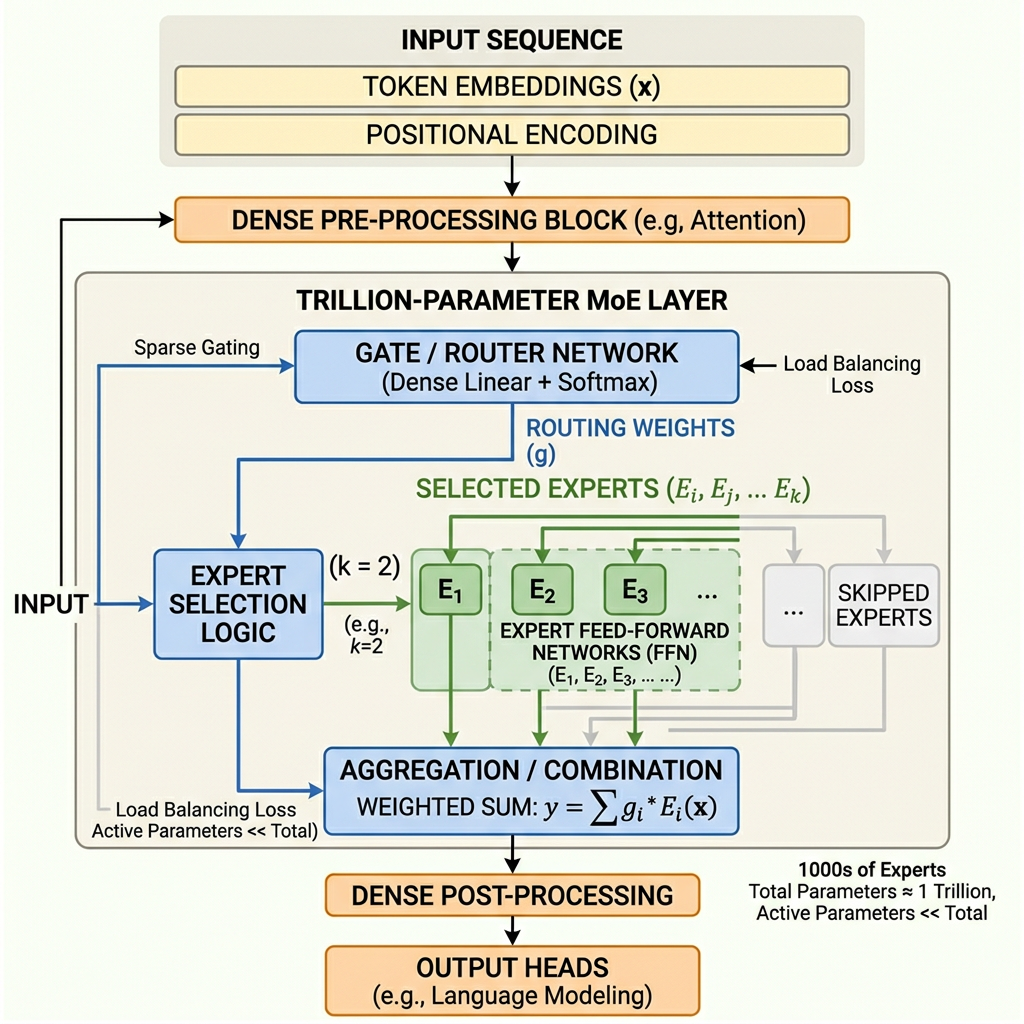
The transition from monolithic dense Transformer models to sparse Mixture-of-Experts (MoE) architectures represents one of the most critical paradigm shifts in deep learning engineering. By routing tokens to specialized subsets of feed-forward network (FFN) parameters rather than processing every token through every weight, MoE models achieve orders-of-magnitude higher parameter capacity without proportional increases in floating-point operations (FLOPs) per token.
However, moving from single-node dense models to multi-trillion parameter MoE systems introduces severe, non-linear hardware failure modes. The primary bottleneck is no longer raw compute power; it is inter-GPU communication bandwidth and dynamic memory load imbalance.
When a soft-max gating network dynamically dispatches tokens across hundreds of distributed experts across multi-node clusters, token distribution skew leads to what platform engineers call the MoE Router Implosion. Certain GPUs receive thousands of tokens beyond their dynamic buffer capacity (hotspots), causing catastrophic memory spillover, while idle GPUs wait synchronously for execution synchronization barriers.
In this deep-dive technical architecture breakdown, we analyze the root causes of MoE router failures at scale, model the underlying mathematical and hardware constraints, and present an end-to-end production architecture for dynamic expert offloading, FP4 KV-cache compression, and zero-stall inter-GPU network routing.
1. Anatomy of the MoE Router Implosion
To understand why traditional distributed training and inference runtimes collapse under high-throughput MoE workloads, we must examine the token dispatch pipeline across distributed nodes.

Token Routing Overhead & All-to-All Communication
In standard Dense models, Parallelism is predictably divided into Tensor Parallelism (TP), Pipeline Parallelism (PP), and Data Parallelism (DP). MoE introduces Expert Parallelism (EP), where distinct expert networks reside on dedicated GPU memory spaces across different nodes.
During the forward pass of an MoE layer:
- Every GPU receives a subset of the global batch.
- The Gating Network (Router) calculates softmax probability scores across all available experts $E$:$$H(x)_i = \text{Softmax}\left(\text{TopK}\left(x \cdot W_g + \epsilon, k\right)\right)_i$$
- Tokens are partitioned and physically transmitted over the high-speed network (NVLink/InfiniBand) using an
All-to-Allcollective communication operation to reach their assigned target expert GPUs. - The target GPUs compute the feed-forward activation:$$y = \sum_{i=1}^{k} H(x)_i \cdot E_i(x)$$
- A second
All-to-Allcollective operation sends processed tokens back to their original origin nodes for subsequent attention layers.
  +---------------------------------------------------------------------------------+
  |                                GLOBAL BATCH INPUT                               |
  +---------------------------------------------------------------------------------+
                                           |
                                           v
   +-----------------------+   +-----------------------+   +-----------------------+
   |   GPU 0 (Tokens 0-N)  |   |   GPU 1 (Tokens 0-N)  |   |   GPU 2 (Tokens 0-N)  |
   +-----------------------+   +-----------------------+   +-----------------------+
               |                           |                           |
               v                           v                           v
   [ Local Gating Network ]    [ Local Gating Network ]    [ Local Gating Network ]
               |                           |                           |
               +---------------------------+---------------------------+
                                           |
                                           v
  ===================================================================================
                             ALL-TO-ALL COMMUNICATION FABRIC
                       (NVLink NVSwitch / InfiniBand / RoCEv2)
  ===================================================================================
                                           |
        +----------------------------------+----------------------------------+
        |                                  |                                  |
        v                                  v                                  v
  +---------------------------+  +---------------------------+  +---------------------------+
  | Expert 0 (GPU 0 Memory)   |  | Expert 1 (GPU 1 Memory)   |  | Expert 2 (GPU 2 Memory)   |
  | [HOTSPOT: OVER CAPACITY]  |  | [UNDER-UTILIZED BUFFER]   |  | [BALANCED LOAD BUFFER]    |
  +---------------------------+  +---------------------------+  +---------------------------+
The Hotspot Cascade & Dynamic Skew
The primary source of failure in this pipeline is non-uniform semantic density. Certain domain-specific tokens (e.g., code blocks, mathematical equations, or specialized multi-lingual inputs) activate a disproportionately small subset of experts.
If Expert 0 receives $3\times$ its nominal capacity while Expert 1 receives zero tokens:
- Buffer Overflow: GPU 0 must allocate dynamic scratch space on high-bandwidth memory (HBM). If HBM reaches capacity, activations spill into host RAM over PCIe, introducing microsecond latency penalties.
- Synchronization Deadlocks: Standard GPU execution streams rely on barrier synchronization for collective operations. GPUs hosting under-utilized experts sit idle waiting for GPU 0 to finish computing its oversized token queue.
- Network Incast Congestion: When hundreds of GPU sender ranks simultaneously transmit packets to a single destination GPU rank hosting a popular expert, network switches experience severe incast, causing dropped packets and TCP/RoCE pause frames.
2. Advanced Paged KV-Cache Management and FP4 Compression
Beyond expert routing bottlenecks, intermediate transformer layers suffer from explosive memory footprints caused by Key-Value (KV) caching during long-context generation.

To prevent OOM (Out Of Memory) crashes during massive concurrency spikes, continuous memory allocation must be replaced with Paged KV-Cache management integrated with aggressive FP4 FP-Quantization.
Dynamic Memory Fragmentation vs. Paged KV Allocation
Traditional sequential KV-cache allocation requires contiguous blocks of physical HBM memory reserved upfront for max context window lengths (e.g., 128k tokens). This creates severe internal and external memory fragmentation, wasting up to 60% of available GPU VRAM.
By virtualizing GPU memory using non-contiguous fixed-size physical memory pages mapped through dynamic page tables (similar to modern OS virtual memory), physical memory allocations grow on-demand:
$$\text{Physical Address} = \text{PageTable}[\text{Virtual Page Index}] \times \text{Page Size} + \text{Offset}$$
Python
import torchimport torch.nn as nnclass PagedKVCacheManager: """ Virtual Memory Page Allocator for GPU-based LLM KV-Cache Storage """ def __init__(self, num_blocks: int, block_size: int, num_heads: int, head_dim: int, dtype=torch.float16): self.block_size = block_size self.num_heads = num_heads self.head_dim = head_dim # Allocate flat physical memory blocks for Key and Value caches self.k_cache = torch.empty((num_blocks, block_size, num_heads, head_dim), dtype=dtype, device='cuda') self.v_cache = torch.empty((num_blocks, block_size, num_heads, head_dim), dtype=dtype, device='cuda') # Track free memory physical block indexes self.free_blocks = list(range(num_blocks)) self.block_tables = {} # Maps sequence_id -> list of block_indexes def allocate_page(self, seq_id: int) -> int: if not self.free_blocks: raise MemoryError("HBM KV-Cache Out of Memory: No free physical blocks available.") block_id = self.free_blocks.pop(0) if seq_id not in self.block_tables: self.block_tables[seq_id] = [] self.block_tables[seq_id].append(block_id) return block_id def store_kv_token(self, seq_id: int, token_index: int, key_states: torch.Tensor, value_states: torch.Tensor): block_logical_idx = token_index // self.block_size block_offset = token_index % self.block_size if block_logical_idx >= len(self.block_tables.get(seq_id, [])): self.allocate_page(seq_id) physical_block_id = self.block_tables[seq_id][block_logical_idx] self.k_cache[physical_block_id, block_offset] = key_states self.v_cache[physical_block_id, block_offset] = value_states
3. High-Throughput Load Balancing Router Implementation
To permanently fix expert router collapse, we implement a Capacity-Aware Top-2 Softmax Router with Auxiliary Load Balancing Loss and Dynamic Offloading.
The primary load balancing loss penalty term $\mathcal{L}_{\text{balance}}$ forces the routing distribution toward uniform usage across all $N$ experts:
$$\mathcal{L}_{\text{balance}} = \alpha \cdot N \sum_{i=1}^{N} f_i \cdot P_i$$
Where:
- $f_i = \frac{1}{T} \sum_{x \in X} \mathbf{1}(\text{Expert}_i \in \text{Top2}(x))$ (Fraction of tokens dispatched to expert $i$)
- $P_i = \frac{1}{T} \sum_{x \in X} \text{Softmax}(x \cdot W_g)_i$ (Mean routing probability assigned to expert $i$)
- $\alpha$ is a hyperparameter scaling factor tuning balance enforcement versus expert specialization.
Python
import torchimport torch.nn as nnimport torch.nn.functional as Fclass CapacityAwareMoERouter(nn.Module): """ Top-2 Expert Router featuring auxiliary load balancing and dynamic dynamic capacity dropping. """ def __init__(self, d_model: int, num_experts: int, capacity_factor: float = 1.25, balance_loss_coef: float = 0.01): super().__init__() self.num_experts = num_experts self.capacity_factor = capacity_factor self.balance_loss_coef = balance_loss_coef self.gate = nn.Linear(d_model, num_experts, bias=False) def forward(self, x: torch.Tensor): # x shape: [batch_size, seq_len, d_model] batch_size, seq_len, d_model = x.shape flat_x = x.view(-1, d_model) # [num_tokens, d_model] num_tokens = flat_x.shape[0] # Compute routing logits and probabilities logits = self.gate(flat_x) # [num_tokens, num_experts] routing_probs = F.softmax(logits, dim=-1) # Select Top-2 experts weights, selected_experts = torch.topk(routing_probs, k=2, dim=-1) weights = F.normalize(weights, p=1, dim=-1) # Re-normalize weights # Compute auxiliary loss for expert distribution balancing expert_mask = F.one_hot(selected_experts[:, 0], num_classes=self.num_experts).float() density_per_expert = torch.mean(expert_mask, dim=0) prob_per_expert = torch.mean(routing_probs, dim=0) aux_loss = self.balance_loss_coef * self.num_experts * torch.sum(density_per_expert * prob_per_expert) # Compute Expert Capacity limit (max tokens allowed per expert) expert_capacity = int((num_tokens / self.num_experts) * self.capacity_factor) # Enforce Expert Capacity Limits position_in_expert = torch.cumsum(expert_mask, dim=0) * expert_mask capacity_mask = position_in_expert <= expert_capacity # Mask out tokens exceeding capacity limit (dropped tokens) final_weights = weights * capacity_mask.unsqueeze(-1) return selected_experts, final_weights, aux_loss
4. Zero-Stall Inter-GPU Network Routing Architecture
Executing all-to-all communications across hardware nodes requires specialized pipelining to hide latency. The standard synchronous torch.distributed.all_to_all blocks the CUDA stream until all byte transfers complete across nodes.
To achieve zero-stall inter-GPU routing, we decouple the compute and communication channels using CUDA streams and overlapping InfiniBand ring buffers:
1.Token Serialization and Dynamic Binning:Group local tokens into continuous rank buffers.
Filter local hidden states into $N$ separate contiguous physical pinned-memory buffers matching destination GPU expert ranks.
2.Asynchronous Non-Blocking P2P Push:Utilize RDMA InfiniBand primitives via NCCL.
Issue ncclGroupStart() and ncclGroupEnd() commands on dedicated CUDA communication streams to overlap memory transfer with prior-layer multi-head attention computations.
3.Local Kernel Execution & Double Buffering:Process pre-allocated memory slices.
As incoming token slices arrive in target GPU memory buffers, trigger expert GEMM computation immediately without waiting for global all-to-all batch completion.
5. End-to-End Architectural Synthesis
To scale Mixture-of-Experts architectures to multi-trillion parameter scales without router implosion:
- Routing Layer: Enforce Top-2 capacity-aware routing with auxiliary balance penalties to prevent semantic hotspot accumulation.
- KV-Cache Storage: Virtualize sequence cache memory via Paged KV management, scaling physical page allocations dynamically while applying FP4 tensor quantization.
- Hardware Engine: Overlap all-to-all inter-GPU expert exchanges asynchronously over NVLink/InfiniBand fabrics using double-buffered CUDA execution streams.
By implementing these structural optimizations, engineering teams can eliminate memory spills, stabilize inter-node bandwidth utilization, and maximize system-wide FLOP efficiency across massive distributed AI hardware clusters.
Leave a Reply