
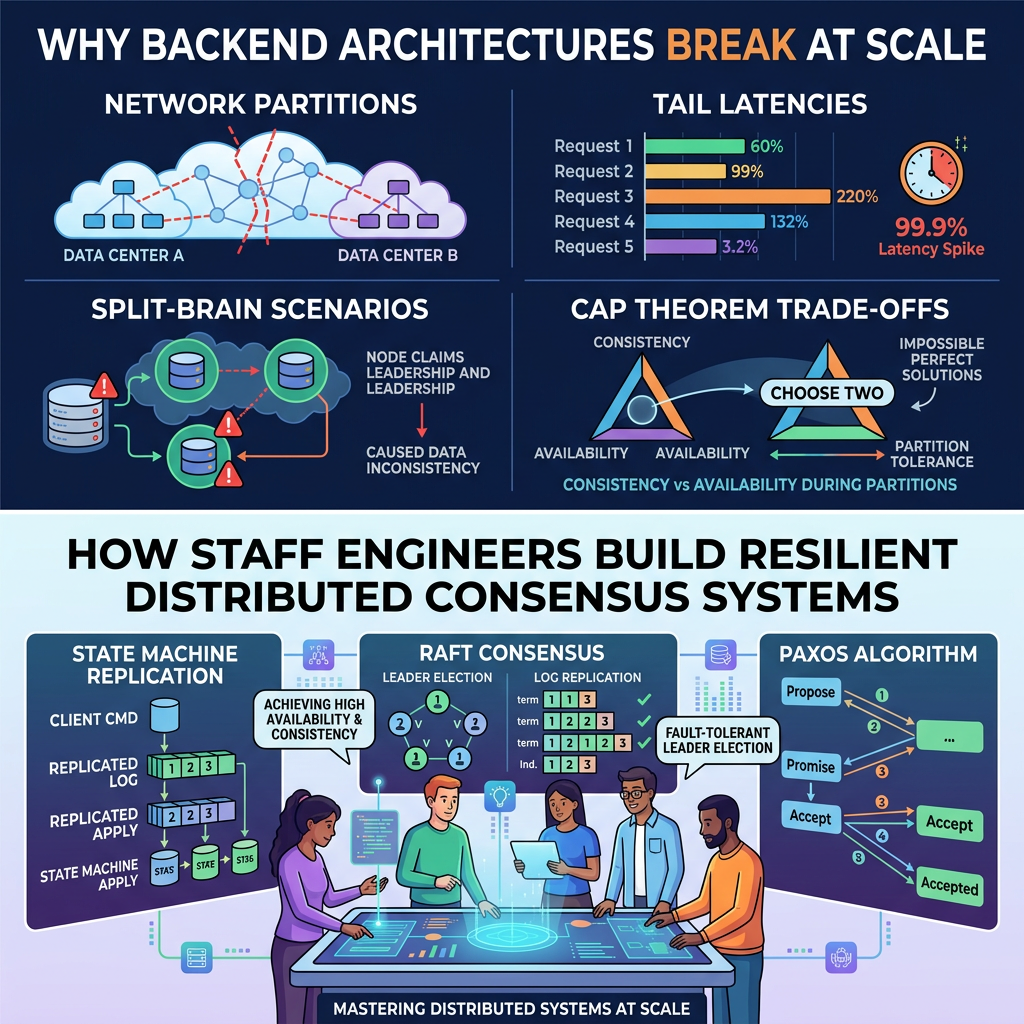
Modern server-side development is undergoing a silent crisis.
For years, backend engineers were told to build stateless microservices. “Keep your application tier stateless,” the industry preached, “and push all state into the database layer.” But in high-scale distributed systems, state never truly disappears—it is merely pushed downstream into distributed state stores, consensus clusters, caching grids, and message brokers.
When your application reaches millions of concurrent requests, network partitions occur, garbage collection pauses spike, and hardware nodes intermittently drop packets. Suddenly, server-side state becomes a high-stakes problem.
When two servers believe they are both the authoritative leader, or when concurrent state writes resolve in out-of-order sequences, your application suffers from silent data corruption, split-brain anomalies, and cascade failures.
In this comprehensive architectural guide, we will unpack the mechanics of server-side state management, dissect why distributed consensus fails under load, examine real-world failure patterns, and explore how elite staff engineers design resilient, partition-tolerant server architectures.
1. The Paradox of Statelessness vs. Stateful Realities
The foundational promise of microservices and serverless architectures is complete statelessness. The stateless application node can die, restart, or scale to zero without losing application context.
+-----------------------------------------------------------------+| Stateless Compute Tier || +------------------+ +------------------+ +---------------+ || | Node A (App API) | | Node B (App API) | | Node C (App) | || +--------+---------+ +--------+---------+ +-------+-------+ |+-----------|---------------------|--------------------|----------+ | | | v v v+-----------------------------------------------------------------+| Stateful Infrastructure || +------------------+ +------------------+ +---------------+ || | Relational DB | | Redis Cluster | | Kafka Brokers | || | (Primary/Replica)| | (Distributed K/V)| | (Event Log) | || +------------------+ +------------------+ +---------------+ |+-----------------------------------------------------------------+
While the compute tier is stateless, the system as a whole is fundamentally stateful. Stateless application nodes simply delegate state coordination to the underlying server infrastructure—such as distributed relational databases, key-value stores, and distributed event streaming platforms.
When server workloads scale:
- Network partitions are inevitable (FLP Impossibility Theorem).
- Clocks across servers are unsynchronized (LNS, clock drift, NTP skew).
- State mutations must reach consensus across physical nodes before acknowledging success to the client.
2. Theoretical Foundations: PACELC, CAP, and FLP Impossibility
To understand why server-side state fails, we must ground our engineering decisions in three core distributed systems theorems.
The CAP Theorem (Brewer’s Theorem)
In a network partition (P), a server-side system must trade off between Consistency (C) (every read receives the most recent write or an error) and Availability (A) (every non-failing node returns a non-error response without guarantee that it contains the most recent write).

The PACELC Theorem
The CAP theorem only applies when a network partition is active. Abadi’s PACELC theorem extends CAP to normal operations:
- If there is a Partition (P), trade off Availability (A) vs Consistency (C).
- Else (E), trade off Latency (L) vs Consistency (C).
                 /--- If Partition (P)  ---> [ Availability (A) vs Consistency (C) ]
PACELC System --|
                 \--- Else (E) ----------> [ Latency (L) vs Consistency (C) ]
When systems operate normally, enforcing strict linearizability requires multi-node synchronization over the network, introducing network round-trip latency.
The FLP Impossibility Result (Fischer, Lynch, Paterson)
In an asynchronous network, no deterministic consensus protocol can guarantee both safety and liveness in the presence of even a single unannounced crash failure.
Server-side consensus engine design is about choosing which trade-offs to make: partial synchronous timeouts (Raft), leader lease mechanisms, or probabilistic guarantees (Dynamo-style quorum models).
3. High Availability Server Topology & Clustering Architecture
To build a enterprise-grade server infrastructure, system architects deploy multi-tiered topology designs with zero single points of failure (N+1 or 2N redundancy).
In an HA cluster, traffic moves through structured layers:
- Border Routing & External Load Balancers: Ingress layer distributing incoming TCP/UDP traffic.
- Internal Routing & Switching Layer: Isolated internal switches routing packets to compute units.
- Application & Stateful Storage Cluster: Dedicated server nodes executing workloads and replicating state across internal high-speed backplanes.
4. Deep Dive: Distributed Consensus Mechanisms (Raft vs. Paxos)
When multiple server nodes must agree on state mutations (e.g., committing a transaction, promoting a new primary node, allocating distributed locks), they rely on Distributed Consensus Algorithms.

The Anatomy of the Raft Consensus Protocol
Raft decomposes distributed consensus into three distinct sub-problems:
- Leader Election: A single leader is chosen by majority vote.
- Log Replication: The leader accepts log entries from clients and replicates them across followers.
- Safety: If any server has applied a log entry to its state machine, no other server can apply a different command for the same log index.

Raft State Transitions
                    [ Follower ]
                       /    ^
       Times out,     /      \  Discovers current leader
    starts election  /        \   or higher term
                    v          \
             [ Candidate ] -----+
                    |
     Receives votes |
    from majority   |
                    v
              [ Leader ]
Raft Log Replication Sequence
 Client             Leader (Node 1)         Follower (Node 2)       Follower (Node 3)
   |                       |                       |                       |
   |--- Write(key=val) --->|                       |                       |
   |                       |-- AppendEntries(Index)|                       |
   |                       |---------------------->|                       |
   |                       |-- AppendEntries(Index)----------------------->|
   |                       |<-- Ack (Success) -----|                       |
   |                       |<-- Ack (Success) -----------------------------|
   |                       |                       |                       |
   |                       | [Commit Entry]        |                       |
   |<-- Write Success -----|                       |                       |
   |                       |-- Apply to State M/C  |                       |
   |                       |-- AppendEntries(Commit)                      |
   |                       |---------------------->|                       |
   |                       |-- AppendEntries(Commit)---------------------->|
- Client Send: The client issues a state change request to the cluster Leader.
- Uncommitted Log Append: The Leader writes the command to its local append-only log.
- RPC Broadcast: The Leader broadcasts an
AppendEntriesRPC to all follower servers. - Quorum Ack: Once a majority of followers acknowledge writing the entry to their local disk logs, the Leader commits the entry.
- State Machine Execution: The Leader applies the committed entry to its local state machine and returns success to the client.
- Follower Notification: Subsequent
AppendEntriesheartbeats notify followers to apply the committed log index to their state machines.
5. Five Disastrous Server-Side Failure Modes & Mitigation Strategies
Even with consensus protocols in place, edge cases in server environments can break data consistency.
1. The Phantom Leader (Split-Brain Anomaly)
- Problem: A network partition isolates the existing Leader (Node A) with a minority of nodes. Node A continues to accept writes because it hasn’t detected the partition yet. Meanwhile, the majority partition elects Node B as the new Leader.
- Impact: Node A accepts writes that will eventually be truncated and lost when the partition heals, corrupting state.
- Mitigation: Implement Leader Leases and Read Index / Pre-Vote Phases. Leaders must verify quorum heartbeats before executing state mutations.
2. Cascading Connection Storms
- Problem: When a primary database server fails, hundreds of stateless application instances attempt to re-establish connection pools to the newly promoted primary simultaneously.
- Impact: Exhaustion of TCP socket backlogs, CPU spikes on the database server, and immediate crashing of the new primary node.
- Mitigation: Implement Exponential Backoff with Full Jitter and circuit breakers at the client/application layer.
Python
import randomimport timedef connect_with_backoff(attempt, base_delay=0.1, max_delay=30.0): # Exponential backoff: base_delay * 2^attempt temp = min(max_delay, base_delay * (2 ** attempt)) # Full jitter: random duration between 0 and temp sleep_duration = random.uniform(0, temp) time.sleep(sleep_duration)
3. Unbounded Log Growth & Disk Exhaustion
- Problem: The write-ahead consensus log grows indefinitely over time, consuming server disk capacity.
- Impact: Disk I/O saturation, node crashes, and prolonged restart recovery times.
- Mitigation: Implement periodic State Machine Snapshottings and log compaction, discarding log entries up to the snapshot index.
4. Garbage Collection (GC) & Process Pauses
- Problem: In managed runtimes (Java, Go, Node.js), a long Garbage Collection Stop-The-World (STW) pause halts server thread execution.
- Impact: The node fails to send heartbeat RPCs. The cluster assumes the node is dead and triggers an election. When the GC pause completes, the node resumes operating with outdated state assumptions.
- Mitigation: Use GC-free memory buffers (off-heap memory) for critical path consensus modules, tune runtime GC flags, or implement fencing tokens.
5. Out-of-Order Execution & Stale Reads
- Problem: Asynchronous replication latencies lead follower nodes to serve historical state while a write is committing on the leader.
- Impact: Users observe backward-moving timestamps or lost updates (e.g., account balance showing pre-transfer values).
- Mitigation: Enforce Read Indexing or Monotonic Read Consistency via vector clocks and session tokens.
6. Engineering Production-Ready Server Architecture: Interactive Strategy Blueprint
Building a reliable server architecture requires systematically choosing trade-offs based on operational requirements.
Use the interactive architectural blueprint below to evaluate server architecture options under varying loads, replication modes, and partition scenarios.
⚙️ Server-Side Architecture Trade-off Simulator
20 ms
7,225 ops/s
99.999%
Low
7. Operational Playbook: Designing Zero-Downtime Stateful Servers
To run high-scale, resilient server infrastructure in production, follow this structural checklist:
1.Establish Quorum Configurations:Deploy odd-numbered cluster nodes (3, 5, or 7).
Ensure your consensus cluster operates with an odd number of dedicated nodes. A 5-node cluster tolerates 2 concurrent node failures while maintaining a majority quorum of 3 nodes ($Q = \lfloor N/2 \rfloor + 1$).
2.Enforce Strict Fencing Tokens:Prevent stale primary writes.
Always attach monotonically increasing fencing tokens (generation counters) to write requests targeting downstream storage resources. Storage engines must reject any write payload carrying an older fencing token than the currently registered max token.
3.Configure Adaptive Heartbeats and Election Timeouts:Prevent unnecessary leader re-elections.
Set election timeouts to be significantly higher than average network round-trip time (RTT) plus broadcast latency (e.g., Heartbeat = 50ms, Election Timeout = 300ms–500ms). This prevents transient network jitter from triggering unnecessary elections.
4.Automate Log Compaction & Storage Snapshots:Control memory and disk usage.
Schedule log snapshotting based on log size thresholds rather than fixed time windows. Retain only the necessary logs required for tailing followers to catch up without re-replicating the entire history.
5.Implement Health Checks & Graceful Degradation:Isolate failing nodes early.
Use two-phase health checking (Liveness vs. Readiness). If a node loses consensus connection to the primary cluster, immediately transition its readiness state to FALSE to detach it from public load balancers.
Summary & Key Takeaways
Server-side engineering at scale requires accepting that networks will fail, clocks will drift, and hardware will fail.
- Stateless compute is a helpful abstraction, but state management is preserved in the underlying infrastructure layer.
- Accept the PACELC trade-offs: Decide early whether your application optimizes for ultra-low write latency or strict linearizable consistency.
- Consensus requires strict quorum engineering: Never run even-numbered consensus clusters without tie-breaking arbitrators.
- Resilience demands proactive safeguards: Protect your server nodes against phantom leaders, connection storms, GC pauses, and uncompacted logs using fencing tokens, exponential backoffs, and automated snapshotting.
By mastering distributed state management, you transition from building standard web applications to engineering resilient enterprise-grade server infrastructure.
Leave a Reply