
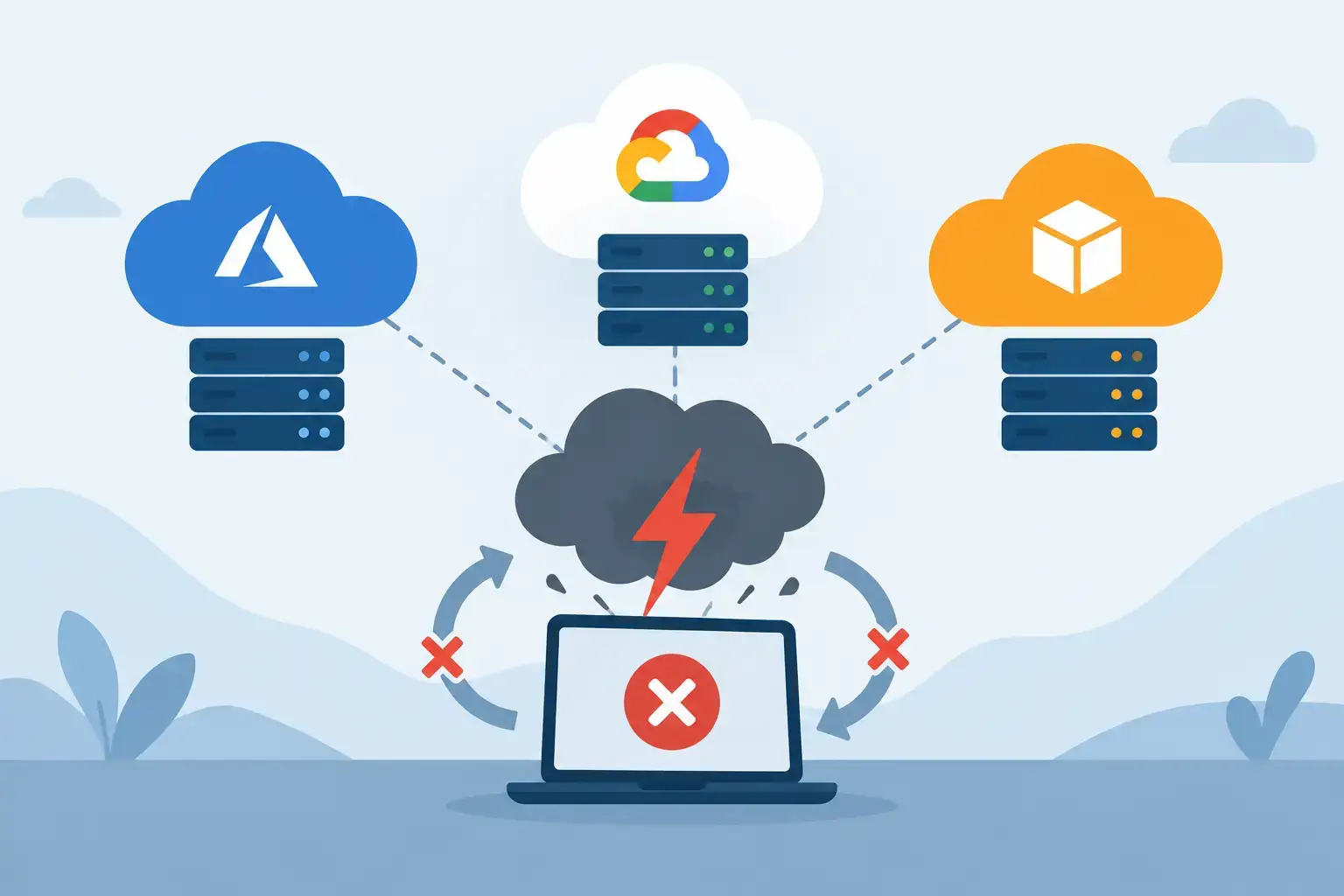
A regional cloud outage is rarely the moment a company discovers it has no backups. It is the moment it discovers that its backups cannot be restored fast enough, its DNS change requires a control plane that is unavailable, its service identities are cloud-local, and its database replication was quietly asynchronous. Multi cloud disaster recovery fails most often at those boundaries, not because the team did not buy enough infrastructure.
Running workloads in two providers is not itself a recovery strategy. It is a commitment to operate two failure domains with different IAM models, network primitives, managed-service semantics, quota systems, and incident procedures. That can reduce correlated provider risk. It can also create a more expensive, less recoverable system if the architecture treats a second cloud as a marketing checkbox.
Start with the failure you are buying protection from
Disaster recovery design becomes vague when the threat model is vague. A multi-cloud design may protect against a provider-wide control-plane failure, a prolonged regional outage, a destructive account compromise, or a commercial event that makes continued operation on one provider unacceptable. Those are distinct scenarios with different mechanisms.
A single-region outage does not automatically justify multi-cloud. Multi-region deployment within one provider can offer materially lower operational complexity and better integration with managed databases, private networking, and identity. Conversely, a provider-level incident can defeat systems that appear geographically redundant but still depend on one global DNS service, one IAM authority, one container registry, or one billing account.
Define recovery point objective and recovery time objective per data class and user-facing capability, not per application. A checkout authorization path may require a five-minute RTO and near-zero RPO. Analytics jobs may tolerate a day of data loss. Treating both as active-active produces needless cost and turns a constrained recovery problem into a distributed-systems project.
The real architecture is data, identity, and traffic
Compute is usually the easy part. Stateless services can be rebuilt from immutable images and declared infrastructure, assuming the images, modules, secrets, and deployment tooling are reachable outside the failed provider. The difficult work is ensuring that the systems around compute can operate independently.
Data replication is a consistency contract
Cross-cloud replication has unavoidable latency. If a primary database commits in Cloud A and replicates asynchronously to Cloud B, a failover can lose acknowledged writes. That may be acceptable for event telemetry. It is usually not acceptable for balances, inventory, entitlements, or idempotency keys that prevent duplicate payment capture.
Do not hide this with a label such as active-active. Ask where the write authority lives. If both clouds accept writes for the same logical records, the application needs a conflict model: single-writer partitioning, version vectors, CRDTs for appropriately commutative data, or a consensus-backed global store. Last-write-wins is not a conflict model for money or permissions. It is a data-loss policy with better branding.
For many SaaS systems, the pragmatic pattern is active-passive writes. Cloud A owns transactional writes. Cloud B maintains a warm replica through database-native replication, log shipping, or an event stream with sequence checkpoints. On disaster declaration, the team promotes Cloud B, fences Cloud A, and accepts a defined replication lag. The key word is fences. Without it, a partial network recovery can create split-brain writers, and the later reconciliation becomes the outage.
Keep an immutable recovery path as well. Replication propagates deletion, corruption, and malicious writes with impressive efficiency. Point-in-time recovery, object-lock retention, and periodically tested exports to an independently controlled storage boundary protect against failures that a hot replica cannot.
Identity must survive the primary cloud
Teams frequently replicate data while leaving their recovery environment unable to authenticate anything. A workload that depends on Cloud A workload identity, a provider-specific KMS key, or a secrets manager available only through Cloud A cannot simply start in Cloud B.
Use an external or independently resilient identity provider for human access, and establish pre-provisioned break-glass roles in each cloud. Workload credentials should be minted through a portable mechanism where possible, such as short-lived certificates or federated OIDC tokens, rather than copied long-lived secrets. The design still needs a degraded-mode answer: if the identity provider is unavailable, which narrowly scoped credentials can operate recovery automation, and how are their uses audited?
Encryption keys deserve the same scrutiny. Cross-cloud copies encrypted with a provider-bound key may be unreadable when the key management service is impaired. Envelope encryption with keys replicated or escrowed under a separately governed recovery process can reduce that dependency. It also increases key-management complexity, so apply it first to data whose recovery value justifies the operational burden.
Traffic failover needs a control plane outside the blast radius
A health check that runs in Cloud A and changes a DNS record through Cloud A cannot initiate recovery when Cloud A is the problem. Place traffic-management authority in a separate failure domain, ideally with independently monitored health checks that validate user-critical transactions rather than a shallow HTTP 200.
DNS is not a precise failover switch. Recursive resolvers can retain records beyond TTL, clients may cache aggressively, and established connections do not migrate. Use low TTLs where the query volume and resolver behavior justify them, but engineer for a transition period in which requests reach both environments. APIs need idempotency keys, queues need deduplication, and session state needs an explicit policy. The cleanest option is usually short-lived, signed, cloud-neutral session tokens rather than server-affine sessions.
Choose an operating model you can afford to test
The right topology is determined less by architecture diagrams than by the recovery behavior the organization can continuously prove.
A pilot-light environment keeps minimal runtime capacity in the secondary cloud and restores or scales services during an event. It minimizes steady-state spend but makes RTO dependent on quota availability, image distribution, database promotion, and infrastructure provisioning. Reserve capacity or obtain explicit quota commitments for the resources that define recovery time. A GPU-based service cannot assume that thousands of accelerators will be available during a broad regional event just because a Terraform plan says so.
A warm standby runs a reduced but functional secondary stack. It offers a more credible RTO because deployment, networking, and core dependencies are already live. The trade-off is sustained cost and configuration drift. Every schema migration, feature flag, secret rotation, and policy change must reach both environments.
Active-active is justified when downtime or regional latency has direct revenue consequences and the workload has a disciplined write-partitioning strategy. It is not justified merely because executives dislike the phrase cold standby. Dual-running complex stateful systems multiplies observability, release coordination, and failure modes. It also means every normal deployment is a cross-cloud compatibility test.
Make recovery an executable system, not a runbook fantasy
A PDF that says promote replica is not a disaster recovery capability. The recovery path should be encoded as versioned automation with explicit preconditions, approvals, and evidence. That includes infrastructure definitions, database promotion commands, traffic shifts, secret activation, queue-draining behavior, and validation probes.
Build an ordered recovery graph. For example, restore network and private DNS, establish identity and KMS access, promote the data authority, start dependent services, expose traffic gradually, then release asynchronous workers. This ordering prevents a common failure: workers consume a replicated queue and write into a database that has not been promoted or fenced.
Validation must test business invariants, not just process liveness. After failover, check that newly created users can authenticate, payment idempotency is preserved, tenant isolation policies still apply, and background jobs do not replay unbounded work. Instrument replication lag, last verified restore point, failover duration, error-budget burn, and the count of writes rejected during fencing. These are operational signals, not compliance decorations.
Test the ugly paths
A quarterly tabletop exercise will expose ownership gaps. It will not prove that recovery works. Run controlled failovers of a noncritical production slice, a staging environment with production-like data volumes, or a deliberately isolated region. Test partial failures: unavailable KMS, broken container registry access, stale DNS, exhausted quotas, and a replica that is technically current but logically corrupted.
Measure the result against the stated RPO and RTO, then record every manual intervention. Manual steps are not automatically bad. A deliberate approval before promoting a financial ledger may be the correct safety control. But any manual action that depends on one absent engineer, an untested credential, or tribal knowledge is a recovery risk that should be made visible.
The useful standard for multi-cloud disaster recovery is not whether two clouds appear on the architecture diagram. It is whether your team can deliberately lose one of them, preserve the required invariants, and restore customer-critical behavior on a clock you have actually measured.
Leave a Reply