
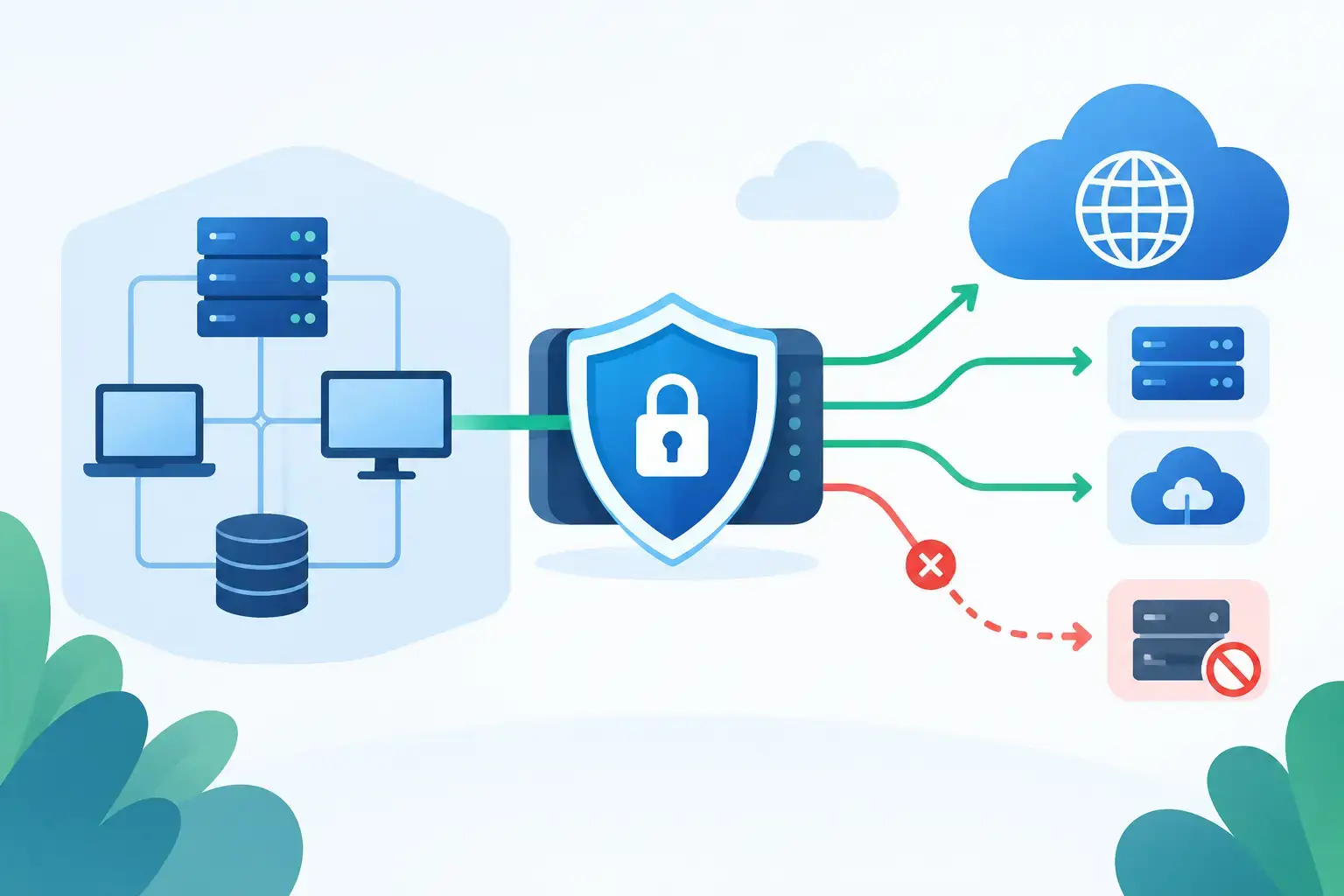
A compromised workload rarely needs inbound reachability to become expensive. Give it unrestricted outbound access and it can exfiltrate customer records, pull a second-stage payload, probe cloud metadata paths, or consume a paid third-party API at line rate. Zero trust egress tools address that failure mode by making outbound connectivity an explicit, identity-bound policy decision rather than an accidental property of being on a private subnet.
For high-scale platforms, this is more than a security-control purchase. Egress is where application architecture, DNS, Kubernetes networking, cloud routing, service identity, and incident response collide. A policy that looks clean in a diagram can break certificate validation, package retrieval, telemetry export, or an LLM provider integration under real deployment conditions. The objective is not to block the internet. It is to establish which process, workload, or service is allowed to contact which external dependency, over which protocol, with enough telemetry to explain a denial at 3 a.m.
Why outbound allowlists fail in production
Traditional egress control often starts and ends with a firewall rule: permit TCP 443 from the workload subnet to the internet, then rely on application-layer controls elsewhere. That is not zero trust. It is a broad network exception that turns every compromised pod, VM, or CI runner into a capable outbound client.
IP-based allowlists improve the situation, but modern dependencies make them brittle. SaaS providers use large and changing address ranges. CDNs terminate many unrelated hostnames on shared IPs. A dependency may redirect across domains during authentication, software updates may fetch signatures from a separate host, and managed cloud APIs may resolve differently by region. If a team responds by widening CIDRs until deployments stop failing, the control has become mostly ceremonial.
The deeper problem is lost identity. An L3/L4 firewall knows source IP, destination IP, port, and sometimes a five-tuple. It does not inherently know that a particular Kubernetes service account, Linux cgroup, or signed workload identity initiated the connection. Nor does it know whether `api.partner.example` is an approved billing provider or a lookalike domain resolved after a DNS compromise.
A useful egress system must join several facts: workload identity, destination identity, protocol semantics, policy intent, and observed behavior. No single product class supplies all of them equally well.
The zero trust egress tools that matter
Zero trust egress tools generally fall into four overlapping control planes. Mature architectures compose them rather than searching for a universal gateway.
Identity-aware proxies and secure web gateways
An identity-aware egress proxy evaluates outbound HTTP, HTTPS, and sometimes generic TCP sessions against a workload or user identity. It can enforce domain policy, inspect HTTP methods and headers, apply data-loss rules, and produce useful audit records. This is often the best place to govern calls to public APIs, SaaS services, artifact repositories, and AI model providers.
The trade-off is protocol coverage and TLS handling. Domain-level policy for encrypted traffic usually requires the proxy to see the TLS Server Name Indication (SNI) or terminate and re-encrypt TLS. SNI is useful but is not a complete application identity signal. TLS interception provides deeper inspection but creates certificate-distribution work, can break certificate pinning, and may be inappropriate for sensitive traffic. Treat decryption as a narrow exception with a documented threat model, not as the default setting.
Kubernetes egress policy and eBPF enforcement
For containerized services, Kubernetes NetworkPolicy is a baseline, not a complete egress design. Its semantics and feature support depend on the CNI. Basic policies can constrain pod-to-CIDR or pod-to-namespace traffic, but FQDN-aware enforcement, DNS lifecycle handling, Layer 7 policy, and workload identity usually require more capable implementations.
eBPF-based dataplanes are compelling because they can enforce policy close to the workload while recording high-cardinality connection context without routing every packet through a centralized appliance. They can associate flows with pod labels, service accounts, cgroups, and process metadata, depending on the platform. That improves both containment and forensics: an alert can identify the deployment and binary initiating a suspicious connection rather than only reporting a node IP.
There is a systems trade-off. Kernel-level enforcement reduces hairpinning and centralized proxy bottlenecks, but policy distribution, map pressure, kernel compatibility, and observability pipelines become operational concerns. At very high connection rates, measure the cost of DNS-aware rule updates and flow logging. A control plane that pushes thousands of updates during an incident must not destabilize the data plane it is protecting.
DNS-layer controls
DNS policy is a high-leverage egress signal because most application dependencies begin with name resolution. It can block known malicious domains, restrict workloads to approved zones, and provide a useful record of attempted destinations. It is also much easier to express a policy around `api.vendor.example` than around a provider’s shifting IP ranges.
DNS alone is not sufficient. A workload can connect directly to an IP address, use encrypted DNS outside the approved resolver path, or exploit an allowed hostname hosted on shared infrastructure. Enforce resolver use at the network layer, log denied queries, and pair DNS policy with connection enforcement. The DNS layer answers, “what did the workload try to resolve?” The transport layer must answer, “what did it actually reach?”
Cloud-native firewall and private endpoint controls
Cloud network firewalls, route tables, NAT gateways, private endpoints, and service endpoint policies remain central for controlling the large blast radius of an account or VPC. Private connectivity to object storage, secret managers, registries, and managed databases removes entire classes of public egress paths. That is often preferable to inspecting traffic after it reaches an internet gateway.
These controls are especially effective for cloud control-plane access. A production workload that needs a specific managed queue or storage service should not require general internet access. Route it privately, limit the endpoint policy to required actions where possible, and use IAM to constrain the API call itself. Network policy without authorization is incomplete containment.
Design the policy around dependencies, not destinations
The hard part of egress is policy discovery. Most organizations do not have a trustworthy inventory of every external dependency used by each service. That is why a sudden default-deny rollout tends to become a rollback.
Start in observe-only mode and build a dependency graph from DNS logs, flow records, proxy telemetry, and application traces. Normalize ephemeral infrastructure noise: health checks, time synchronization, certificate revocation, identity-token exchange, telemetry collectors, container registries, and package mirrors are all common hidden dependencies. Separate runtime egress from build and CI egress. A build runner may need package registries and source control access that a production API should never have.
Then define policies in workload terms. “The payments-api deployment running under this service account may issue HTTPS requests to these domains and private service endpoints” is durable intent. “Allow 10.42.0.0/16 to 0.0.0.0/0 on 443” is an address-based accident waiting to spread.
Use staged enforcement. Deny clearly unnecessary categories first, such as direct access to cloud metadata from untrusted namespaces, outbound SMTP from application workloads, and public internet access from data-plane services with only private dependencies. Move ambiguous dependencies through an approval path with owners and expiration dates. Temporary rules should expire automatically, or they become permanent architecture.
Avoid turning the egress gateway into the outage
Centralized egress gateways concentrate policy, visibility, and failure risk. Capacity planning must include connection churn, TLS handshakes, DNS lookup volume, inspection overhead, and failure behavior. A gateway sized by average bandwidth can still collapse under a burst of short-lived connections from serverless workers or a retry storm.
Run gateways across failure domains, preserve client source identity where practical, and use explicit connection limits. Configure circuit breakers in callers so a denied or unavailable egress path does not trigger synchronized retries across thousands of replicas. If a policy service becomes unreachable, decide deliberately whether the data plane fails closed, uses the last known good policy, or permits narrowly scoped emergency traffic. Each option has a different security and availability consequence.
Logging must be selective enough to remain affordable. Full packet capture for every outbound request is rarely viable. High-value records include workload identity, destination hostname and resolved IP, SNI where available, policy rule ID, bytes transferred, decision, and a trace or request correlation ID when the application can provide one. That is enough to connect an anomalous outbound flow to a deployment, release, and request path.
A practical target architecture
A defensible production design commonly uses private endpoints for cloud services, DNS policy for name governance, eBPF or CNI policy for workload-level enforcement, and an identity-aware proxy for approved public HTTP dependencies. IAM and application credentials constrain what an allowed connection can do after it is established.
Do not force every protocol through an HTTP proxy. Databases, message brokers, Git over SSH, and custom binary protocols may require distinct paths or private connectivity. The correct architecture depends on protocol mix, latency sensitivity, regulatory needs, and how much operational ownership the platform team can sustain.
The operational test is simple: when a newly compromised pod attempts to contact an unfamiliar domain, the platform should deny it by default, identify the pod and owning service, and let responders distinguish a malicious attempt from an undocumented dependency. That is the point where egress stops being a perimeter checkbox and becomes a controllable property of the production system.
Leave a Reply