
A model can pass an offline benchmark on Friday and start corrupting customer workflows on Monday. A provider model update changes tool-call formatting. A revised system prompt pushes requests past a context boundary. A retrieval index silently admits stale documents. Continuous evaluation for LLMs is the control system that detects those changes before they become an incident queue, a security escalation, or an expensive human-review operation.
The common failure is treating LLM evaluation as a release-phase artifact: run a benchmark, record an aggregate score, approve deployment. That model made sense when behavior was mostly determined by application code. In an LLM system, behavior emerges from a moving dependency graph that includes prompts, model snapshots, sampling parameters, retrieval pipelines, tool schemas, guardrails, tenant data, and third-party inference endpoints. Any one of those can move independently.
For production teams, the question is not whether a model is “good.” It is whether a particular system remains within its accepted operating envelope for the requests that matter.
Why Continuous Evaluation for LLMs Is an Operational System
An evaluation program needs the same properties expected from observability or deployment controls: versioning, coverage, traceability, alerting, and a defined response path. A dashboard with a single helpfulness score is not sufficient. Neither is an LLM-as-a-judge pipeline that emits plausible-looking numbers without calibration.
Consider a support agent that retrieves account records and invokes an action API. Its critical properties are not limited to answer fluency. It must identify the correct account, preserve authorization boundaries, select valid tool arguments, avoid making unapproved changes, and return a response that accurately represents tool outcomes. A response can sound excellent while failing every operationally relevant condition.
This is why evaluation should be decomposed into measurable contracts. Some are deterministic: valid JSON, schema conformance, citation presence, prohibited field access, correct tool selection, or a maximum number of tool retries. Others require semantic judgment: factual consistency, policy compliance, completeness, and whether the response actually resolved the user task. Mixing them into one score hides failures that should have different severities.
A malformed payment-refund request should block a release. A small decline in stylistic preference may warrant investigation but not a rollback. Your evaluation system must preserve that distinction.
Build the Evaluation Surface From Production Traces
Static benchmark sets are useful, but they decay quickly. The most valuable test corpus usually begins with production traffic, selected and sanitized under explicit privacy controls. Capture the full execution trace rather than only the final prompt and answer: system prompt version, retrieved chunks, tool definitions, tool calls, model identifiers, token counts, latency, retry behavior, and final output.
Then organize cases by failure class. A mature corpus contains routine traffic, high-value workflows, known historical failures, adversarial inputs, long-context cases, ambiguous requests, and traffic from important customer segments. It should also include negative cases where the correct behavior is refusal, escalation, or a request for clarification.
Do not build a corpus by sampling only high-volume requests. Volume-weighted sampling will overrepresent easy paths and conceal low-frequency failures with disproportionate business cost. A wrong answer in an internal summarization flow is different from an unauthorized action in a healthcare, finance, or enterprise administration workflow.
Each case needs an oracle appropriate to the task. For structured outputs, use AST-based checks, JSON Schema validation, database assertions, and tool-call replay against a controlled environment. For retrieval, judge both answer quality and evidence quality. A response that reaches the correct conclusion from irrelevant or unauthorized context is still a systems failure.
For open-ended outputs, human-labeled rubrics remain the reference standard. LLM judges can reduce labeling cost, but they require calibration against human decisions and periodic revalidation. Judges exhibit positional bias, verbosity bias, and provider-specific preferences. They can also share the same blind spots as the model under test. Use pairwise comparisons where possible, retain disagreement samples for review, and measure judge agreement rather than treating a judge score as ground truth.
Separate Pre-Release Gates From Runtime Detection
Continuous does not mean every request receives an expensive panel of model judges. It means evaluation runs at multiple speeds, with controls matched to risk and cost.
Before release, execute a deterministic regression suite on every change to prompts, retrieval configuration, tool schemas, model versions, and inference parameters. Run the high-risk semantic set with calibrated judges or human review when changes affect money movement, access control, regulated content, or externally visible actions. This suite should produce a diff, not merely a pass/fail result: which cases changed, which contract failed, and whether the regression is concentrated in a segment.
At runtime, sample traces continuously. Some checks can run inline, such as output-schema validation, policy classifiers, PII leakage detection, tool allowlists, and maximum agent-loop limits. Others should run asynchronously, including semantic grading, counterfactual prompt comparisons, and human review queues. Inline controls protect the current request. Asynchronous evaluation detects slow drift without adding user-facing latency.
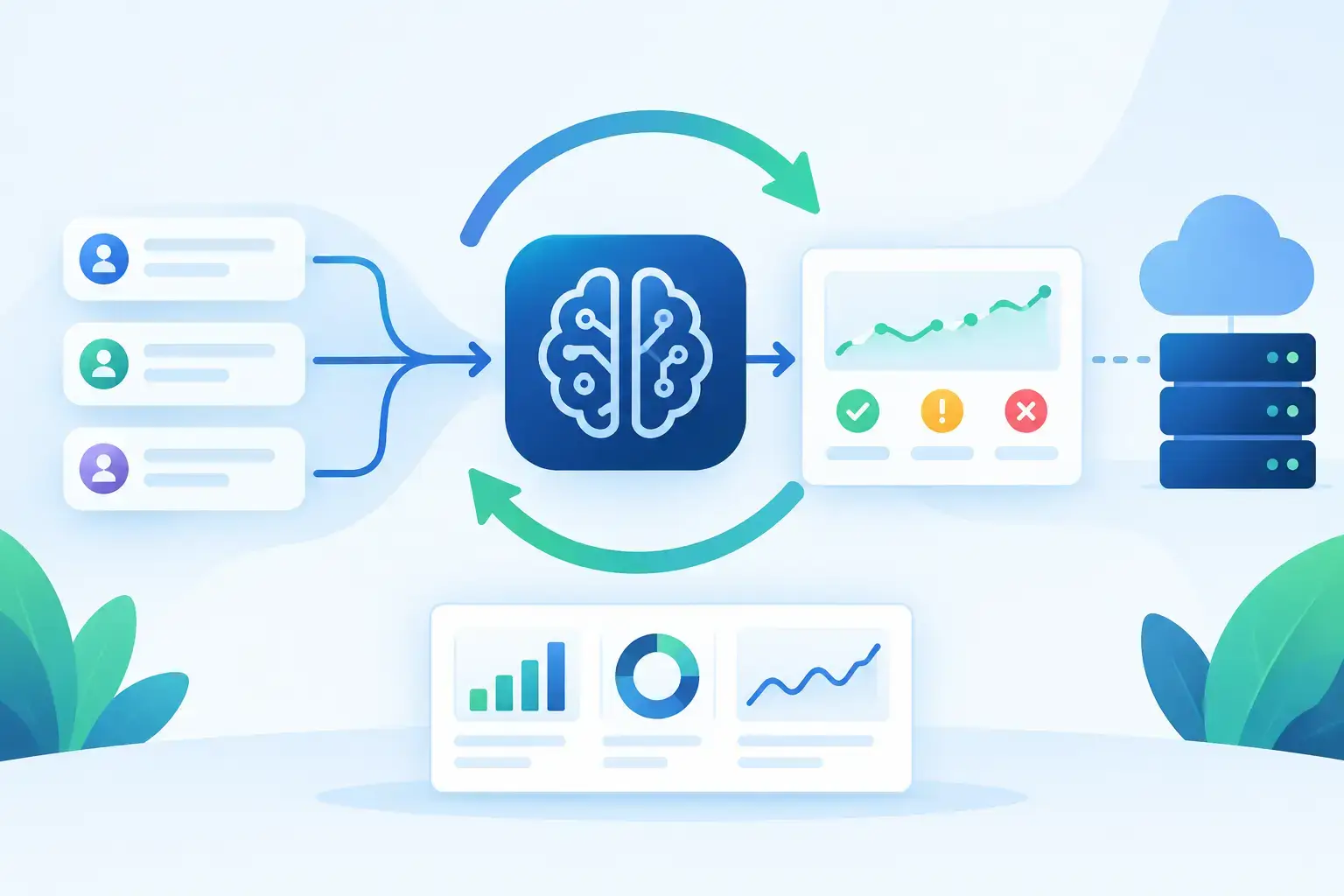
A practical architecture separates the serving path from the evaluation plane. The serving path emits structured events to a durable stream. An evaluator consumes sampled traces, reconstructs the execution context, applies deterministic assertions, and routes selected cases through judge models or annotation workflows. Results land in an immutable evaluation store keyed by trace ID, deployment version, model version, prompt hash, and tenant or cohort attributes.
That joinability matters during an incident. If answer groundedness drops, engineers need to determine whether the cause correlates with a retrieval index build, a new embedding model, a provider region, a prompt revision, or a single large tenant’s documents. Aggregate quality charts without execution metadata are postmortem theater.
Alert on Regressions, Not Noise
LLM outputs are stochastic, so a single failing sample is rarely meaningful. Alerting must account for baseline variance, sample size, and the impact of the failed contract. Track a rolling baseline by workflow and cohort, then use confidence intervals or sequential tests to flag sustained movement. For high-severity deterministic violations, alert immediately. For semantic metrics, require sufficient evidence before paging an engineer.
Segmenting is non-negotiable. A global score can remain stable while multilingual requests, long-context sessions, or a premium tenant workflow deteriorates sharply. Evaluation metrics should be sliced by model route, prompt version, tool, retrieval source, input length, geography where relevant, and customer tier. This is analogous to monitoring p99 latency rather than only average latency: the aggregate can look healthy while the users who matter are absorbing the damage.
Cost also belongs in the scorecard. A model migration that preserves answer quality but doubles tokens per successful task may be a regression. Track cost per completed task, tool-call fanout, cache hit rate, retry rate, and abandonment rate alongside quality metrics. Agent systems are especially prone to hidden cost failures because a slightly weaker tool-selection policy can create retry loops that multiply inference and downstream API spend.
Make Evaluation Results Change Deployment Decisions
The final test of an evaluation program is whether it can stop or reverse a bad change. Define release policies before the incident. For example, block promotion on any authorization or structured-action failure, require manual approval for a statistically significant groundedness decline, and automatically roll back when runtime safety violations exceed a narrow threshold.
Canary releases are particularly effective for LLM systems. Route a controlled percentage of traffic to the candidate configuration, preserve matched cohorts where feasible, and compare outcomes against the control. Shadow evaluation is useful for model replacements: send production inputs to the candidate model without exposing its output, then compare tool plans, structured fields, or judge scores offline. It cannot reveal every interaction effect, but it catches many failures before users do.
Avoid an overgrown metric catalog. Every metric should answer a decision question: should this release proceed, should this workflow be degraded to a safer fallback, should this incident page someone, or should this case enter the regression corpus? If nobody can act on a measurement, it is telemetry debt.
The most effective teams treat failed evaluations as durable engineering assets. A production escape becomes a minimized test case, a labeled failure mode, and often a new deterministic guardrail. Over time, the evaluation corpus becomes a map of the system’s real boundaries – not the boundaries imagined when the first prompt was written.
That is the useful promise of continuous evaluation: not a claim that LLM behavior can be made perfectly predictable, but a disciplined way to make unpredictable behavior observable, bounded, and expensive to ship twice.
Leave a Reply