
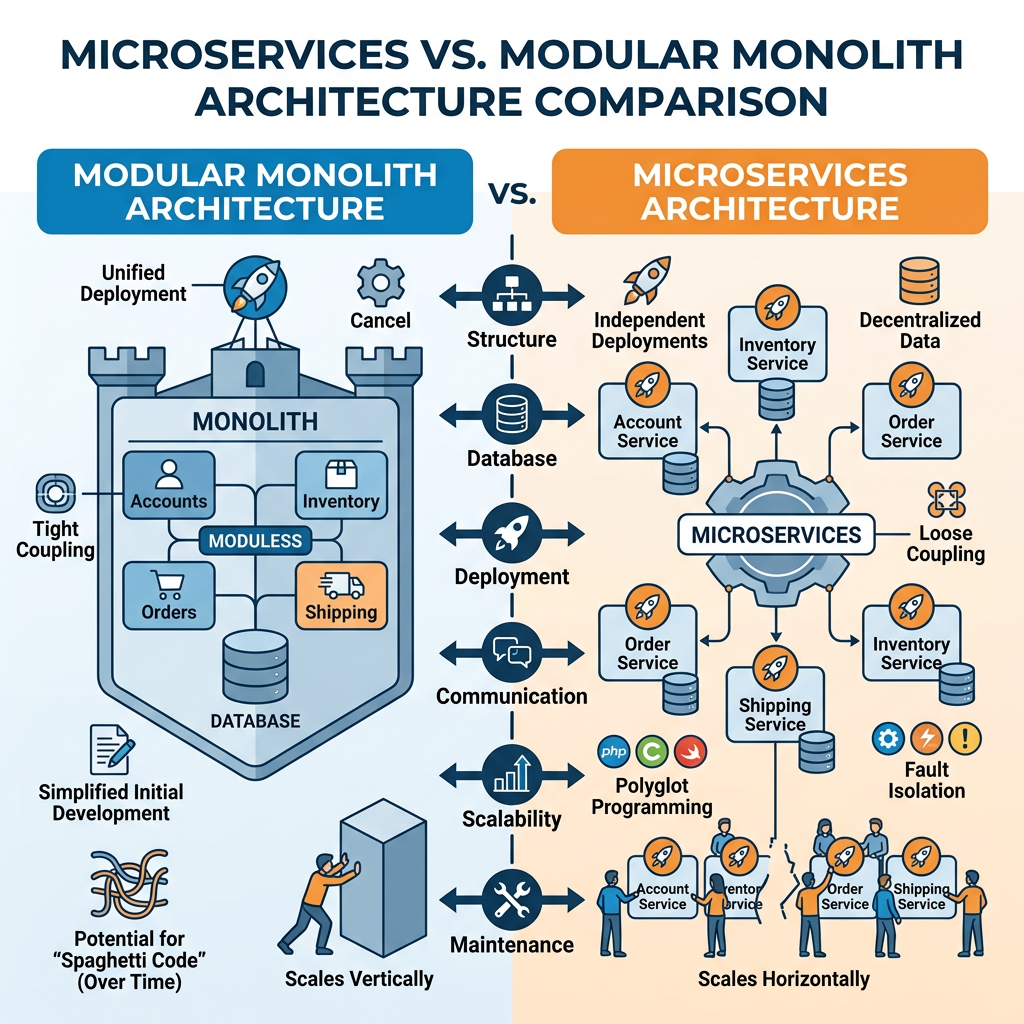
Introduction
For more than a decade, microservices have dominated software architecture conversations.
From conference talks to engineering blogs, they are often portrayed as the inevitable destination for every serious software system.
If your company wants to scale, the narrative goes:
Break the monolith. Build microservices. Scale independently. Deploy faster. Move like Netflix.
It sounds compelling.
And in some cases, it is absolutely the right decision.
But here’s the uncomfortable truth many engineering teams discover too late:
Microservices solve scaling problems by introducing operational complexity.
If your system has not yet reached the scale where those problems exist, adopting microservices prematurely often creates more pain than value.
Many engineering organizations spend years untangling:
- Service sprawl
- Distributed debugging
- Deployment coordination
- Cross-service consistency issues
- Network failures
- Operational overhead
- Team ownership ambiguity
The irony?
Many of these systems could have scaled perfectly well as modular monoliths.
This article explores:
- What modular monoliths really are
- Why teams prematurely choose microservices
- The hidden costs of distributed systems
- How to architect a scalable modular monolith
- When to migrate to microservices
- Practical implementation patterns
The Architecture Evolution Problem
Most software architecture evolves through predictable phases.
Phase 1: Startup Simplicity
Everything lives in one codebase.
Diagram:
+------------------------------------+| Application || || UI + API + Business Logic + DB || |+------------------------------------+
This works because:
- Small team
- Fast iteration
- Easy debugging
- Simple deployment
Phase 2: Growth Pressure
Traffic increases.
Features multiply.
Engineering teams expand.
The monolith begins showing friction:
- Longer build times
- Merge conflicts
- Coupled releases
- Increased regression risk
At this point many teams panic.
They conclude:
“We need microservices.”
Not necessarily.
Phase 3: Premature Distribution
The system gets decomposed.
Diagram:
      +----------+
      | Gateway  |
      +----+-----+
           |
   +-------+--------+
   |       |        |
+--v--+ +--v--+ +---v---+
|User | |Order| |Billing|
|Svc  | |Svc  | |Svc    |
+--+--+ +--+--+ +---+---+
   |       |        |
+--v--+ +--v--+ +---v---+
| DB  | | DB  | | DB    |
+-----+ +-----+ +-------+
Now the team inherits:
- Network complexity
- Distributed tracing
- Service contracts
- Versioning
- Message durability
- Retry logic
- Event consistency
The engineering velocity often slows dramatically.
Why Microservices Became Overhyped
Microservices were popularized by companies like:
- Netflix
- Amazon
- Uber
- Spotify
But these companies operate at extraordinary scale.
They deal with:
- Millions of requests per second
- Thousands of engineers
- Global deployment
- Independent product domains
Their architectural decisions solve their problems.
Not necessarily yours.
This is architectural cargo culting.
Teams copy visible technical choices without understanding the underlying constraints.
What Is a Modular Monolith?
A modular monolith is:
A single deployable application structured as independently bounded internal modules.
It combines:
Monolith Benefits
- Simpler deployment
- Easier debugging
- Strong transactional consistency
- Lower operational complexity
Modular Benefits
- Clear boundaries
- Separation of concerns
- Independent ownership
- Evolutionary architecture
Diagram:
+------------------------------------------------------+| Modular Monolith || || +---------+ +---------+ +----------+ +------------+ || | Users | | Orders | | Billing | | Inventory | || +----+----+ +----+----+ +-----+----+ +------+-----+ || | | | | || +-----------+------------+-------------+ || || Shared Runtime / Process |+------------------------------------------------------+
Each module behaves like a service internally.
But communication happens through in-process calls.
This eliminates distributed systems complexity.
The Real Cost of Microservices
1. Network Complexity
In a monolith:
orderService.process(order);
In microservices:
POST /orders/process
Now you need:
- Timeouts
- Retries
- Circuit breakers
- Load balancing
- Request tracing
- Failure handling
Every network call can fail.
This dramatically changes engineering complexity.
2. Distributed Debugging
Monolith debugging:
Trace stack locally.
Microservices debugging:
Trace across:
- API Gateway
- Auth Service
- User Service
- Order Service
- Inventory Service
- Payment Service
- Event Bus
Diagram:
Client |API Gateway |Auth -> User -> Order -> Inventory -> Payment
Failures become difficult to localize.
3. Data Consistency Challenges
Monolith:
Single transaction.
BEGIN;UPDATE inventory;INSERT order;COMMIT;
Microservices:
Distributed transaction.
Now you need:
- Saga patterns
- Compensation logic
- Event choreography
Diagram:
Order Created | vReserve Inventory | vCharge Payment |Failure? |Compensate
This is vastly more complex.
4. Operational Overhead
Each service requires:
- CI/CD pipeline
- Monitoring
- Logging
- Alerting
- Scaling rules
- Security policies
10 services = manageable
100 services = operational burden
5. Team Coordination Cost
Microservices only shine when team boundaries align.
Poor decomposition creates:
- Cross-team blockers
- Shared ownership confusion
- Contract drift
Designing a Proper Modular Monolith
This is where engineering discipline matters.
A modular monolith is not:
“One giant messy codebase.”
It requires strict boundaries.
Principle 1: Domain-Driven Module Boundaries
Structure around business capabilities.
Bad:
/controllers/services/repositories/models
Good:
/users/orders/payments/inventory
Each contains:
/orders /api /domain /application /infrastructure
This mirrors service architecture internally.
Principle 2: Explicit Interfaces
Modules should communicate via contracts.
Example:
public interface InventoryGateway { boolean reserve(ProductId productId, int quantity);}
Consumers depend on abstractions.
Not implementation.
Principle 3: No Shared Database Access
This is critical.
Bad:
SELECT * FROM inventory
inside Order module.
Good:
inventoryService.checkAvailability()
Modules own their data.
This makes extraction easier later.
Principle 4: Event-Driven Internal Communication
Use internal domain events.
Diagram:
OrderPlaced | +--> Inventory Module | +--> Billing Module | +--> Notification Module
Java example:
publisher.publish(new OrderPlaced(orderId));
This decouples modules.
Later these events can move to Kafka.
Spring Boot Implementation Example
A modular monolith works beautifully in:
Spring Boot
Structure:
src/main/java/com/company/app users/ orders/ payments/ inventory/
Each module:
Public API Layer
public interface OrderFacade { OrderResult placeOrder(OrderRequest request);}
Internal Domain Layer
class OrderAggregate {}
Infrastructure Layer
@Repositoryclass JpaOrderRepository {}
Only expose facade interfaces.
Testing Advantages
Microservices require:
- Contract tests
- Service integration tests
- Network mocks
- Distributed test environments
Modular monoliths allow:
- Fast integration testing
- In-memory execution
- Easier debugging
Example:
@SpringBootTestclass OrderFlowTest
One runtime.
Full flow validation.
Fast feedback.
Performance Benefits
Microservices introduce:
- Serialization cost
- Network latency
- Connection pooling overhead
Modular monolith:
In-memory calls.
Microseconds instead of milliseconds.
At scale, this matters enormously.
When Microservices Actually Make Sense
Microservices are right when you have:
1. Independent Scaling Requirements
Example:
Search traffic 50x order traffic.
Search can scale independently.
2. Distinct Team Ownership
If:
- Team A owns Payments
- Team B owns Inventory
- Team C owns Recommendations
Independent deployment matters.
3. Different Technology Needs
Example:
- Orders → Java
- ML Recommendations → Python
- Analytics → Go
Polyglot architecture becomes useful.
4. Organizational Scale
Conway’s Law matters.
Architecture mirrors communication structure.
Large organizations often need service decomposition.
Migration Strategy: Modular Monolith to Microservices
The best path is evolutionary.
Step 1: Start Modular
Diagram:
+-----------------------+| Modular Monolith |+-----------------------+
Step 2: Strengthen Boundaries
No cross-module leaks.
Step 3: Introduce Async Messaging
Internal events first.
Step 4: Extract Candidate Module
Diagram:
Before:[Monolith]After:[Monolith] <-> [Payment Service]
Step 5: Iterate
Extract only when justified.
Extraction Heuristics
A module is ready when:
- It changes independently
- It scales independently
- It has stable boundaries
- It causes deployment bottlenecks
Without these?
Keep it inside.
Case Study: E-Commerce Platform
Initial Design
Modular monolith:
- Users
- Catalog
- Orders
- Payments
- Inventory
Single deployment.
Growth Phase
Catalog traffic explodes.
Search becomes bottleneck.
Extract:
Catalog Search Service
Everything else remains monolithic.
This hybrid architecture is often ideal.
Common Mistakes
Mistake 1: Service Per Entity
Bad:
- UserService
- ProductService
- CartService
- AddressService
These are often too granular.
Mistake 2: Shared Libraries Everywhere
This recreates coupling.
Mistake 3: Distributed Transactions
Avoid unless absolutely necessary.
Mistake 4: Ignoring Team Topology
Architecture must reflect ownership.
Architecture Decision Framework
Ask:
Question 1
Do we have independent scaling needs?
Question 2
Do teams deploy independently?
Question 3
Can we absorb operational complexity?
Question 4
Do bounded contexts exist?
If most answers are “no”
Choose modular monolith.
The Industry Is Relearning This
Many organizations are quietly moving back.
Not to giant legacy monoliths.
To:
Well-structured modular systems
Because they optimize:
- Developer velocity
- Reliability
- Simplicity
The pendulum is swinging toward pragmatism.
Practical Advice for Engineering Leaders
If you’re leading architecture decisions:
Do not ask:
“Should we use microservices?”
Ask:
“What problem are we solving?”
Architecture is constraint optimization.
Not trend adoption.
Final Thoughts
The best architecture is not the most fashionable.
It is the one that solves today’s problems while preserving tomorrow’s options.
For most teams:
A modular monolith provides:
- Simplicity
- Velocity
- Maintainability
- Evolutionary flexibility
Microservices are not the starting point.
They are an optimization for specific scale conditions.
Build simple.
Design modular.
Extract deliberately.
That’s how resilient systems are built.
Architecture Comparison Diagram
MONOLITH+----------------------+| All Components |+----------------------+MODULAR MONOLITH+----------------------+| Users | Orders | Pay |+----------------------+MICROSERVICES+-----+ +-----+ +-----+|User | |Order| |Pay |+-----+ +-----+ +-----+
Key Takeaways
- Start with modular monoliths
- Enforce boundaries aggressively
- Extract only with evidence
- Optimize for developer velocity
- Architecture should evolve with scale
Leave a Reply