
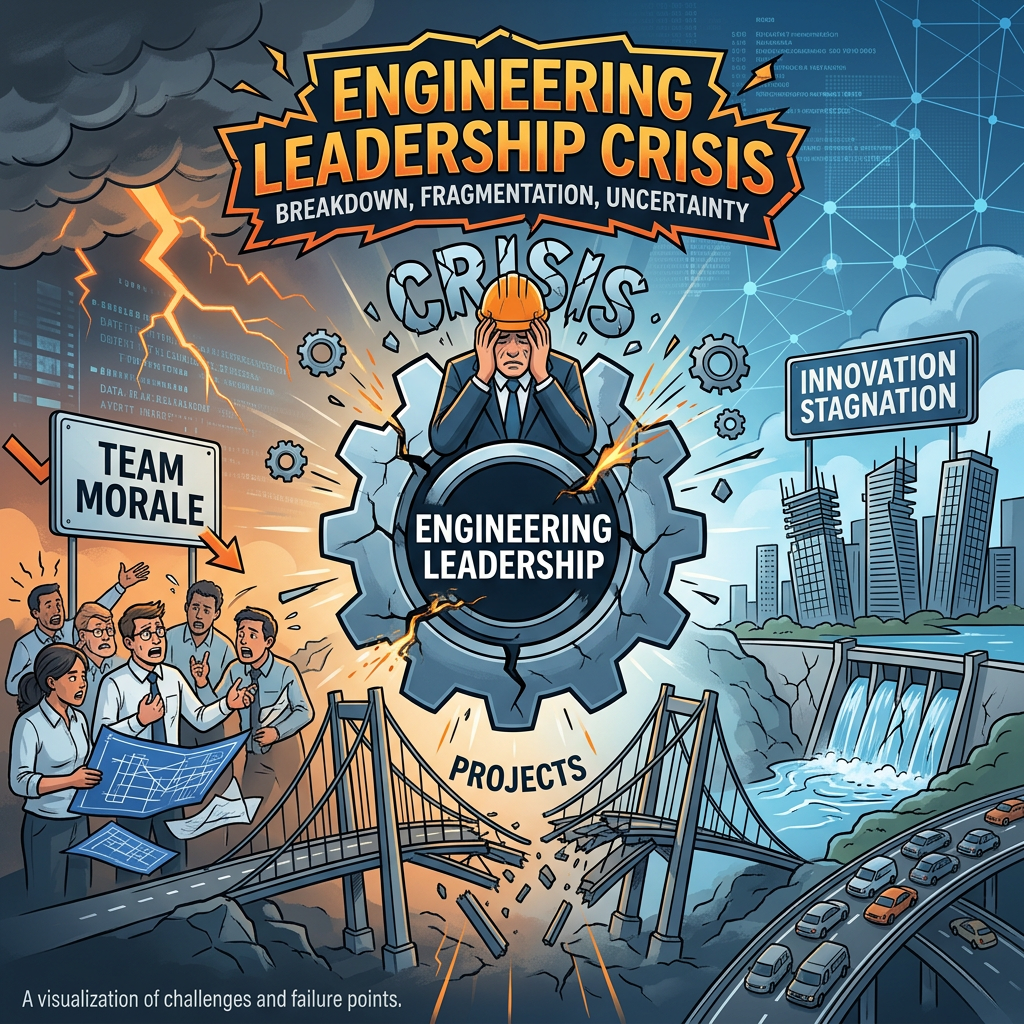
This is where engineering leadership becomes brutally real.
1. The Silent Collapse of Engineering Organizations
Most engineering organizations do not fail dramatically.
They decay slowly.
Symptoms appear gradually:
- Delivery slows
- Teams become defensive
- Deployments become risky
- Incidents increase
- Engineers avoid ownership
- Knowledge silos expand
- Meetings multiply
- Morale drops
- Innovation disappears
The dangerous part:
Leadership often misdiagnoses the problem.
Executives usually blame:
- Engineers
- Velocity
- Communication
- Agile process
- Middle management
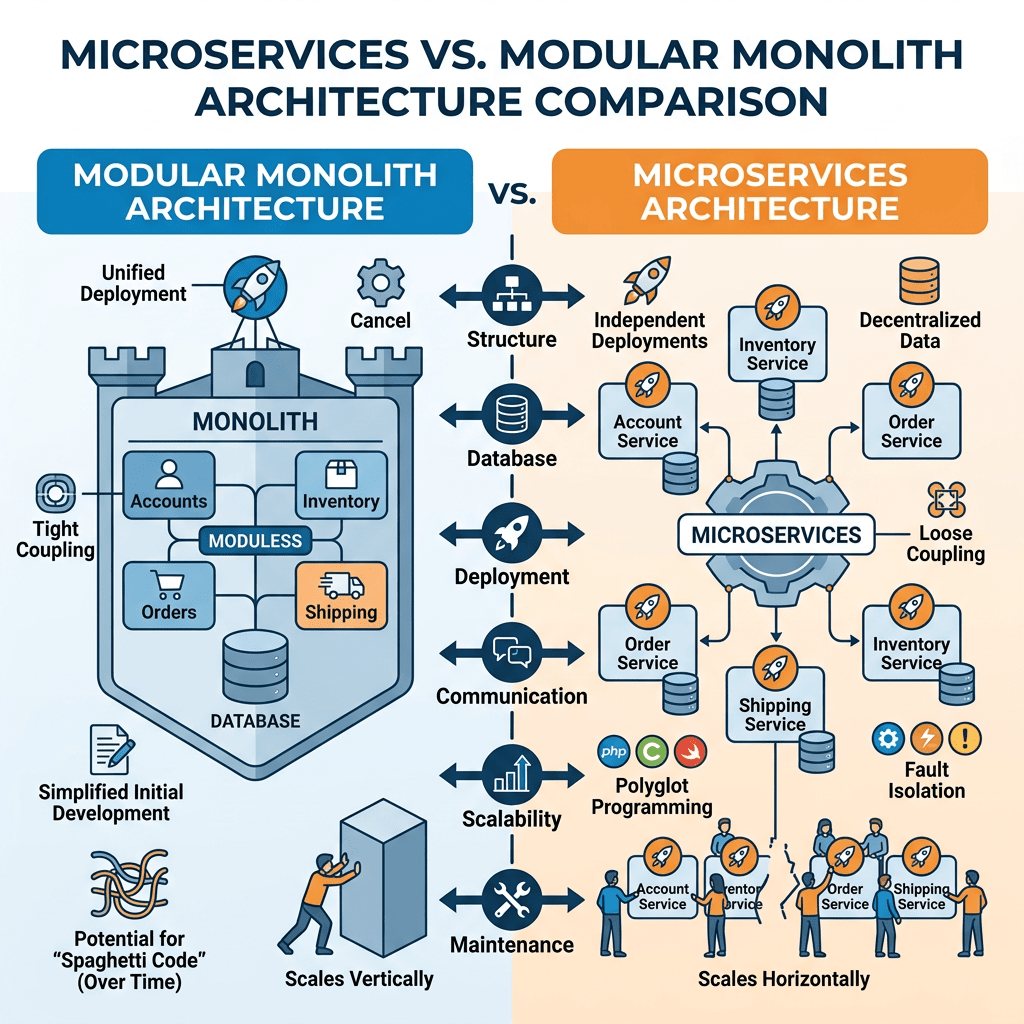
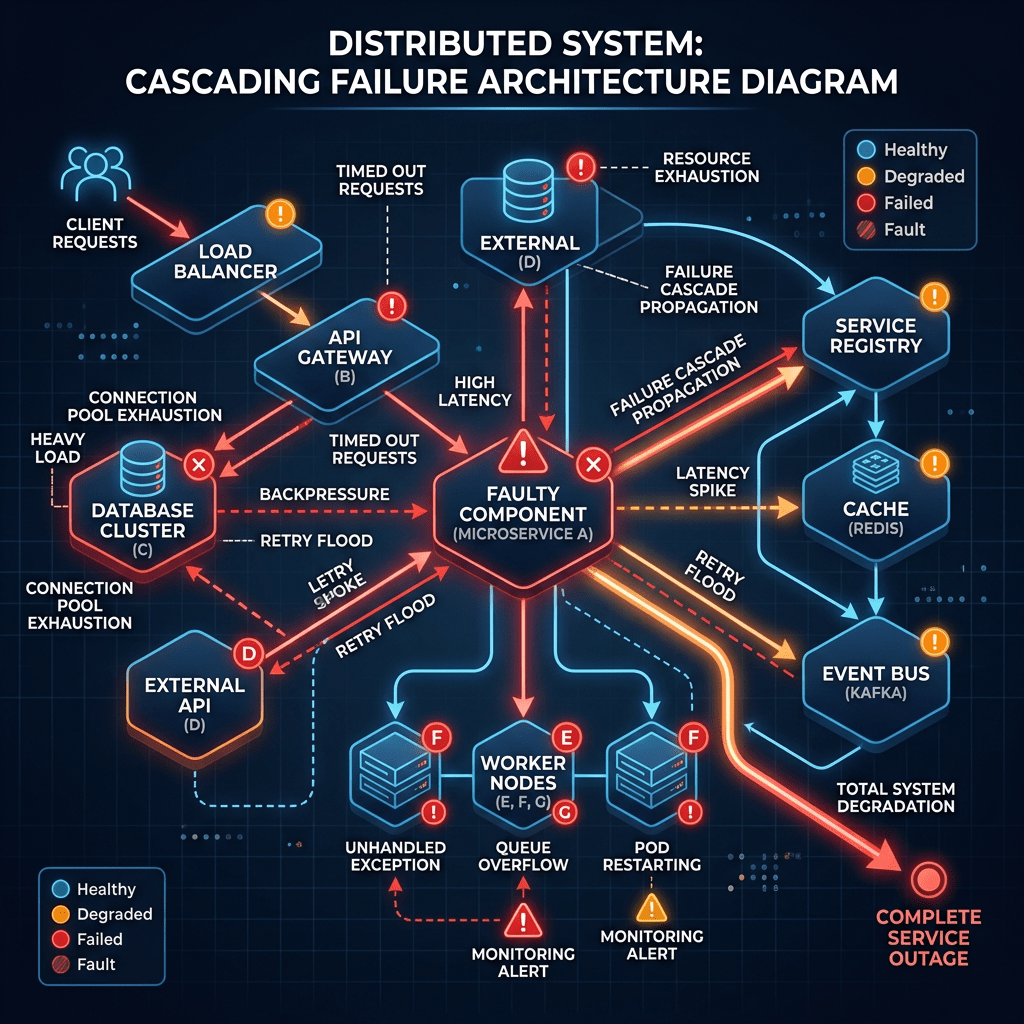
But the root cause is often systemic architectural collapse.
The Architecture-Organization Feedback Loop


As systems scale:
- Architecture complexity increases
- Team dependencies multiply
- Cognitive load explodes
- Decision latency rises
- Release coordination becomes harder
- Reliability weakens
Eventually:
The organization itself becomes the bottleneck.
2. Why Most Platform Rewrites Fail
One of the biggest leadership mistakes:
Assuming technical problems are primarily technical.
They are usually organizational.
Platform rewrites fail because:
- Ownership is unclear
- Business expectations are unrealistic
- Migration strategies are immature
- Teams lose focus
- Old and new systems coexist too long
- Executive patience disappears
The Typical Rewrite Disaster Timeline
Phase 1 — Excitement
Leadership announces:
“We’re modernizing the platform.”
Teams become energized.
Phase 2 — Architectural Idealism
Engineers propose:
- Event-driven architecture
- Service mesh
- Kubernetes everywhere
- Full microservices decomposition
- AI-enabled observability
- Domain-driven design
- Multi-cloud resiliency
The architecture deck looks amazing.
Production reality does not.
Phase 3 — Business Resistance
The business asks:
- Why are features delayed?
- Why is velocity dropping?
- Why are incidents increasing?
- Why are costs rising?
Executive trust weakens.
Phase 4 — Hybrid System Chaos
Now you have:
- Legacy monolith
- Partial microservices
- Duplicate data models
- Multiple deployment systems
- Fragmented ownership
- Operational confusion
This is the most dangerous phase.
Phase 5 — Leadership Panic
Leadership changes direction:
- New priorities
- New org structure
- New platform standards
- New vendor strategy
Teams lose confidence.
The Rewrite Death Spiral


3. The Leadership Trap of “Big Bang Transformation”
Large transformations fail because leaders underestimate operational continuity.
The business cannot stop operating during modernization.
This creates a paradox:
You must rebuild the airplane while flying it.
What Effective Leaders Understand
Strong engineering leaders know:
- Migration matters more than architecture
- Reliability matters more than elegance
- Organizational alignment matters more than tooling
- Incremental progress beats revolutionary change
- Business trust is a technical dependency
This changes how transformations are executed.
4. Technical Debt vs Business Survival
Technical debt discussions are often simplistic.
Not all technical debt is bad.
Some technical debt is strategic.
The real question:
Which technical debt threatens business survivability?
Categories of Technical Debt
| Debt Type | Risk Level | Leadership Response |
|---|---|---|
| Cosmetic code issues | Low | Defer |
| Outdated frameworks | Medium | Plan |
| Scaling bottlenecks | High | Prioritize |
| Security vulnerabilities | Critical | Immediate action |
| Reliability instability | Critical | Executive escalation |
| Knowledge concentration | Severe | Organizational mitigation |
Leadership Mistake: Treating All Debt Equally
High-performing organizations prioritize:
- Reliability debt
- Security debt
- Scalability debt
- Developer productivity debt
- Cosmetic improvements
Weak organizations reverse this order.
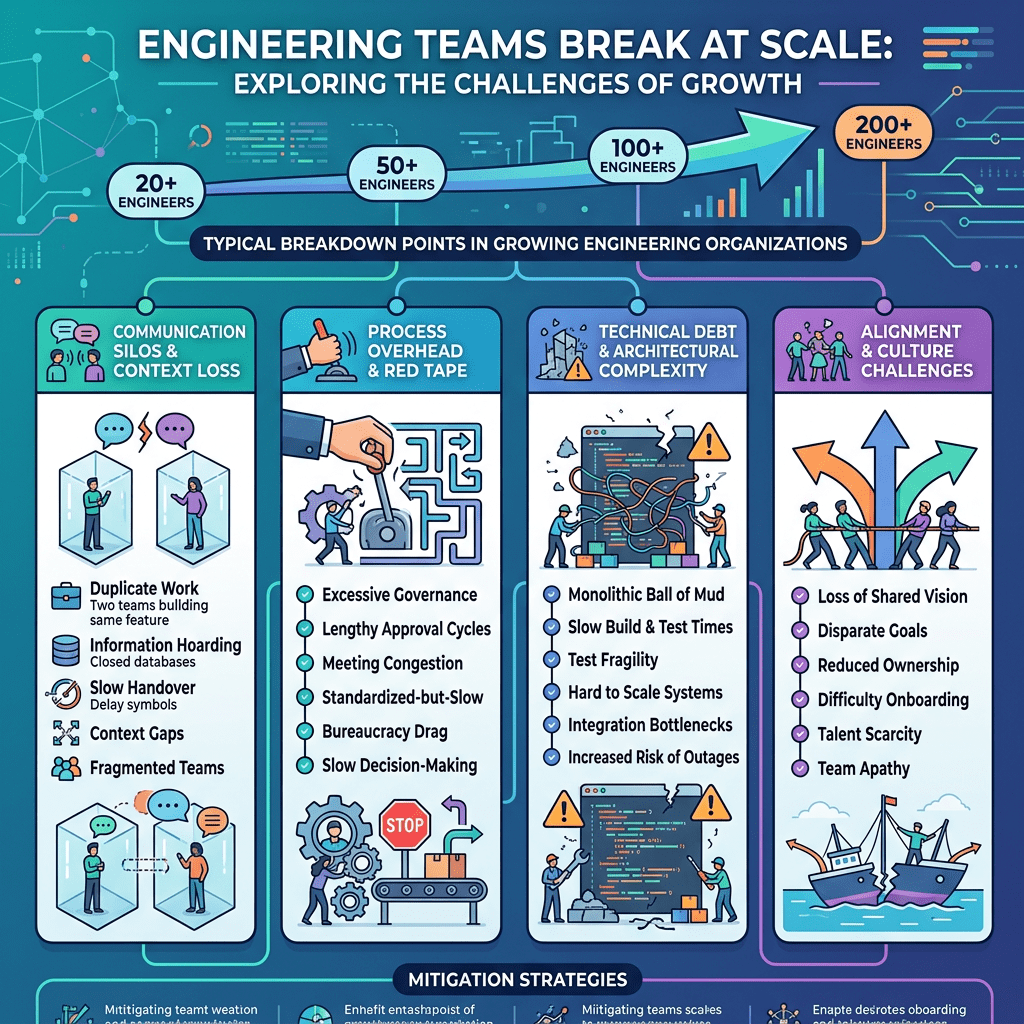
5. Organizational Scaling Failure Modes
As organizations grow:
communication overhead grows exponentially.
This destroys delivery speed.
Team Dependency Explosion


A 5-team organization behaves very differently from a 50-team organization.
Problems include:
- Cross-team blockers
- Architecture inconsistency
- Duplicate systems
- Governance paralysis
- Slow decisions
- Incident confusion
The Hidden Cost of Meetings
At scale:
meetings become distributed system synchronization protocols.
This is not a joke.
Engineering organizations eventually spend enormous energy coordinating rather than building.
6. The Architecture Governance Crisis
Most organizations swing between two extremes:
Extreme 1 — No Governance
Result:
- Technology chaos
- Inconsistent tooling
- Fragmented observability
- Security risks
Extreme 2 — Excessive Governance
Result:
- Innovation paralysis
- Slow delivery
- Bureaucracy
- Engineering frustration
Effective Governance Model
Strong leaders establish:
- Guardrails, not rigid control
- Shared standards
- Clear ownership
- Platform enablement
- Minimal mandatory processes
Governance Architecture Model


7. Platform Teams vs Product Teams
One of the hardest organizational problems:
balancing platform engineering and product delivery.
Common Failure Pattern
Platform teams become:
- Detached from customers
- Focused on internal tooling
- Misaligned with delivery needs
Product teams become:
- Independent technology islands
- Operationally inconsistent
- Difficult to scale
Healthy Operating Model
The best organizations:
- Centralize foundational capabilities
- Decentralize product innovation
- Standardize reliability practices
- Share observability platforms
- Enable self-service infrastructure
Platform Engineering Evolution
Stage 1 — Infrastructure Team
Reactive support model.
Stage 2 — DevOps Team
Automation focus.
Stage 3 — Platform Engineering
Developer experience focus.
Stage 4 — Internal Developer Platform
Self-service engineering ecosystem.
8. Conway’s Law in Real Organizations
Melvin Conway famously stated:
Organizations design systems that mirror their communication structures.
This explains why:
- Broken organizations create broken systems
- Political silos create technical silos
- Confused ownership creates confused architectures
Organizational Design Shapes Software


Leadership Implication
You cannot fix architecture without addressing organizational structure.
This is where many CTOs fail.
9. Leading Through Ambiguity and Political Pressure
Technical leadership becomes hardest when:
- Nobody fully understands the system
- Executives disagree
- Product priorities conflict
- Teams are overloaded
- Incidents are increasing
This is where leadership maturity matters most.
What Weak Leaders Do
Weak leaders:
- Overpromise
- Hide risks
- Avoid conflict
- Shift blame
- Chase trends
- Constantly reorganize
What Strong Leaders Do
Strong leaders:
- Clarify tradeoffs
- Communicate honestly
- Protect focus
- Escalate early
- Reduce chaos
- Build trust under pressure
10. Executive Communication During Technical Crisis
Most executives are not technical.
But they understand:
- Revenue risk
- Customer impact
- Operational instability
- Regulatory exposure
- Reputation damage
Your job:
translate engineering risk into business language.
Weak Technical Communication
“The system has scaling bottlenecks caused by Kafka partition imbalance.”
Executives disconnect instantly.
Strong Technical Communication
“Peak traffic growth could create customer outages during Q4 sales events.”
Now leadership understands urgency.
Executive Risk Translation Framework
| Technical Issue | Business Translation |
|---|---|
| Latency instability | Customer experience degradation |
| Deployment failures | Revenue disruption |
| Security vulnerabilities | Regulatory/legal exposure |
| Observability gaps | Incident recovery delays |
| Single points of failure | Operational outage risk |
11. Building High-Trust Engineering Organizations
Trust is the hidden multiplier in engineering organizations.
Low-trust organizations:
- Escalate constantly
- Over-document everything
- Avoid accountability
- Hide mistakes
- Move slowly
High-trust organizations:
- Collaborate quickly
- Share ownership
- Resolve incidents faster
- Experiment safely
- Innovate continuously
Psychological Safety vs Accountability
A major leadership mistake:
confusing psychological safety with low standards.
Healthy organizations maintain both:
- Safety to speak honestly
- Accountability for execution
High-Trust Engineering Model


12. AI’s Impact on Engineering Leadership
AI is changing engineering organizations faster than most leaders realize.
The impact is not just code generation.
The real disruption is:
- Accelerated delivery expectations
- Increased architectural inconsistency
- Faster technical debt accumulation
- Lower signal-to-noise ratio
- Junior engineer overreliance
- Governance challenges
The New Leadership Problem
AI increases output velocity.
But velocity without architectural discipline creates exponential chaos.
AI-Assisted Engineering Risks
| Risk | Leadership Challenge |
|---|---|
| Inconsistent code generation | Standardization |
| Faster dependency sprawl | Governance |
| Reduced deep understanding | Skill erosion |
| Increased delivery expectations | Burnout risk |
| Shadow AI tooling | Security/compliance |
The Winning Organizations
The best organizations will:
- Combine AI acceleration with strong engineering discipline
- Strengthen architecture governance
- Invest heavily in developer education
- Create AI-enabled review pipelines
- Focus on systems thinking
13. Migration Strategies That Actually Work
The best transformations are incremental.
Not revolutionary.
The Strangler Fig Pattern
Strangler Fig Pattern is one of the most effective modernization strategies.
Concept:
- Gradually replace legacy functionality
- Route traffic incrementally
- Reduce migration risk
- Preserve business continuity
Incremental Migration Architecture


Why Incremental Wins
Incremental migration:
- Preserves revenue stability
- Reduces operational shock
- Improves rollback capability
- Enables continuous learning
- Maintains executive trust
14. Reliability Leadership During Transformation
Transformations often destroy reliability.
Why?
Because organizations prioritize:
- Features
- Migration velocity
- Architecture progress
instead of operational stability.
Reliability Is Leadership
The strongest engineering leaders treat reliability as:
- Product quality
- Customer trust
- Brand protection
- Revenue protection
Not just infrastructure metrics.
Reliability Operating Model
Strong organizations establish:
- SLOs
- Error budgets
- Incident command systems
- Operational ownership
- Observability standards
- Blameless postmortems
Modern Reliability Architecture


15. Engineering Metrics That Matter
One of the most dangerous leadership behaviors:
optimizing vanity metrics.
Bad Metrics
Examples:
- Lines of code
- Number of tickets closed
- Story points completed
- Meeting attendance
- Commit counts
These create distorted incentives.
Valuable Metrics
Strong leaders focus on:
- Deployment frequency
- Change failure rate
- Mean time to recovery
- Reliability
- Customer impact
- Cognitive load
- Developer experience
The DORA Metrics Reality
Google Cloud and the DORA research helped popularize engineering performance measurement.
But metrics without context become dangerous.
A high deployment frequency means nothing if:
- Engineers are burned out
- Systems are unstable
- Customer trust is collapsing
16. Incident Leadership at Scale
Incidents reveal the true health of organizations.
Not architecture diagrams.
Not executive presentations.
Not sprint metrics.
Real operational pressure exposes:
- Organizational clarity
- Ownership maturity
- Leadership quality
- Communication discipline
What Great Incident Leaders Do
Strong leaders:
- Create calm
- Reduce noise
- Clarify ownership
- Prioritize customer impact
- Communicate transparently
- Drive fast learning
Incident Command Structure


17. The Human Side of Technical Leadership
Engineering organizations are human systems.
Ignoring this destroys performance.
Burnout Signals Leaders Miss
Common indicators:
- Increased cynicism
- Defensive behavior
- Reduced curiosity
- Slower code reviews
- Rising attrition
- Incident fatigue
Burnout Is Usually Systemic
Most burnout is not caused by:
- Hard work
- Ambition
- Complexity
It is caused by:
- Chronic chaos
- Unclear priorities
- Lack of autonomy
- Constant interruptions
- Organizational dysfunction
Leadership Responsibility
Strong leaders:
- Reduce chaos
- Protect focus time
- Clarify priorities
- Eliminate unnecessary process
- Build sustainable operating models
18. Operating Models for Modern Engineering Organizations
Modern organizations require different leadership structures than a decade ago.
Old Operating Model
- Centralized decisions
- Top-down architecture
- Infrastructure silos
- Manual operations
- Slow releases
Modern Operating Model
- Platform enablement
- Autonomous teams
- Shared standards
- Continuous delivery
- Observability-first design
- AI-assisted workflows
Modern Engineering Organization Architecture


19. Real-World Transformation Blueprint
Here is a realistic modernization sequence.
Phase 1 — Stabilize
Goals:
- Reduce incidents
- Improve observability
- Clarify ownership
- Create operational discipline
Do NOT start rewriting yet.
Phase 2 — Standardize
Focus:
- CI/CD pipelines
- Infrastructure patterns
- Monitoring standards
- Security baselines
- Platform capabilities
Phase 3 — Incremental Decomposition
Now:
- Extract domains carefully
- Build APIs intentionally
- Remove bottlenecks
- Reduce coupling
Phase 4 — Organizational Evolution
Adjust:
- Team topology
- Ownership models
- Platform structures
- Governance practices
Phase 5 — Optimization
Finally:
- Improve developer experience
- Optimize infrastructure cost
- Scale globally
- Enhance resilience
Transformation Timeline Reality
Real enterprise transformation:
- Usually takes 3–7 years
- Requires executive alignment
- Demands operational patience
- Evolves continuously
Any leader promising:
“Complete modernization in 12 months”
is usually creating future instability.
20. Final Leadership Lessons
Technical leadership is no longer just about technology.
Modern engineering leaders must understand:
- Distributed systems
- Organizational psychology
- Executive communication
- Reliability engineering
- Platform strategy
- AI governance
- Change management
- Economic tradeoffs
The hardest part:
You must balance all of them simultaneously.
The Most Important Leadership Insight
At scale:
engineering problems are rarely isolated technical problems.
They are:
- Organizational problems
- Communication problems
- Incentive problems
- Operational problems
- Trust problems
Technology amplifies leadership quality.
Strong leadership creates resilient systems.
Weak leadership creates fragile organizations.
Closing Thought
The future belongs to engineering leaders who can:
- Scale systems
- Scale organizations
- Scale trust
- Scale operational excellence
- Scale adaptability
while keeping complexity under control.
That is the real challenge of modern engineering leadership.






























Leave a comment