
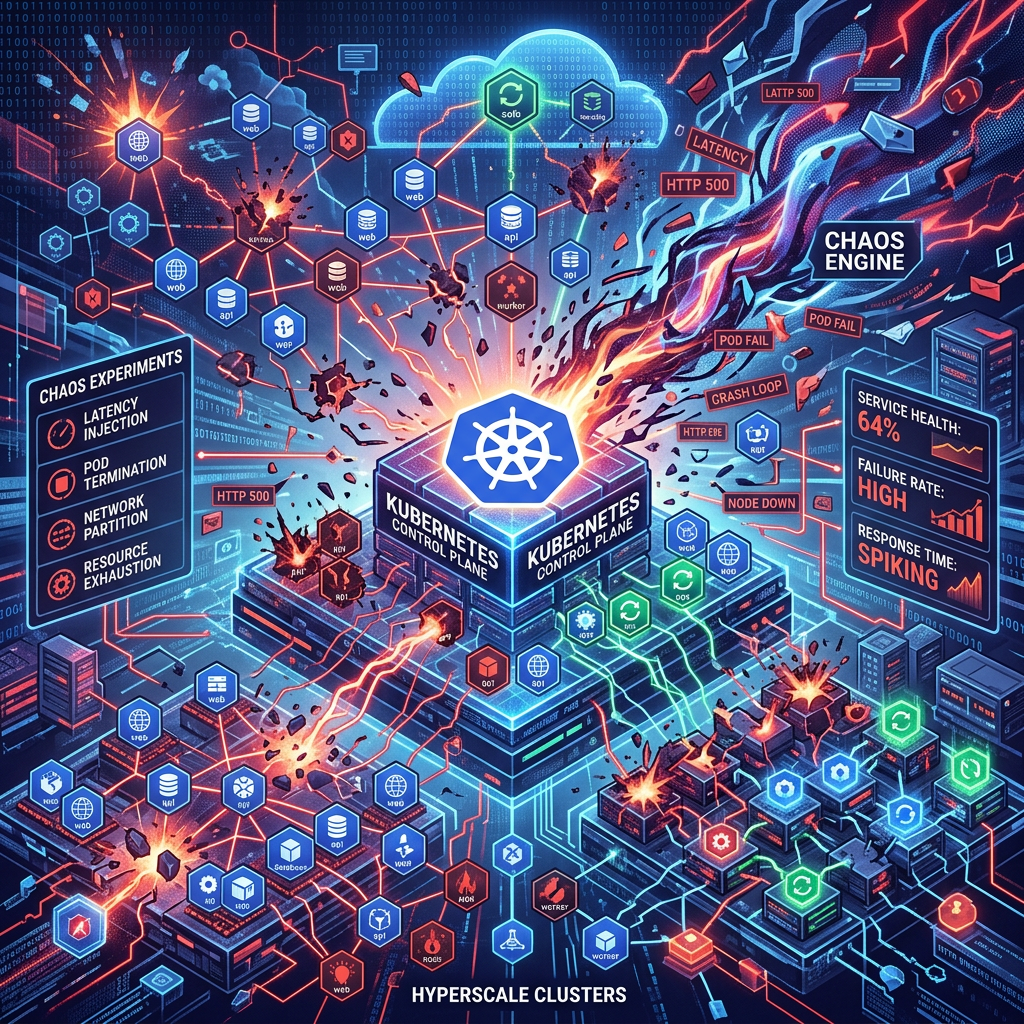
How Large-Scale Kubernetes Environments Fail, Recover, and Evolve at Enterprise Scale


Introduction
Most engineers think Kubernetes problems are about containers.
They are not.
The hardest Kubernetes problems begin when:
- 5,000+ nodes exist across regions
- etcd latency spikes during production traffic
- the scheduler becomes CPU bound
- admission controllers create cascading failures
- service mesh sidecars overwhelm networking stacks
- cluster autoscaling collides with cloud provider APIs
- control plane instability causes a full organizational outage
At small scale, Kubernetes feels elegant.
At enterprise scale, Kubernetes becomes one of the most complex distributed systems platforms ever deployed in modern engineering.
This article explores:
- how the Kubernetes control plane actually works internally
- why large clusters fail
- the scaling limitations most engineers never see
- deep scheduler internals
- etcd consistency tradeoffs
- networking bottlenecks
- platform engineering strategies
- multi-cluster architecture patterns
- production outage scenarios
- advanced resiliency designs used by elite engineering organizations
This is not a beginner tutorial.
This is the reality of operating Kubernetes at scale.
Chapter 1 — Kubernetes Is Actually a Distributed Operating System
Most teams misunderstand Kubernetes because they view it as:
- a container orchestrator
- a deployment tool
- a DevOps platform
In reality, Kubernetes behaves more like:
- a distributed operating system
- a cluster scheduler
- a reconciliation engine
- a control theory platform
- a massive event-driven state machine
The control plane continuously attempts to reconcile:
Desired State → Actual State
That sounds simple.
It becomes extremely difficult when:
- tens of thousands of pods change state simultaneously
- cloud APIs throttle requests
- node heartbeats lag
- DNS propagation delays occur
- storage systems become inconsistent
- controllers conflict with one another
At scale, Kubernetes becomes an endless loop of:
- reconciliation
- scheduling
- state synchronization
- distributed consensus
- event propagation
- failure recovery
Chapter 2 — The Kubernetes Control Plane Deep Dive


The Kubernetes control plane consists primarily of:
| Component | Responsibility |
|---|---|
| kube-apiserver | Central API gateway |
| etcd | Distributed state database |
| kube-scheduler | Pod placement decisions |
| controller-manager | Reconciliation loops |
| cloud-controller-manager | Cloud provider integration |
Every operation in Kubernetes passes through the API server.
Everything.
That includes:
- deployments
- autoscaling
- secrets
- networking
- health checks
- scheduling
- node updates
- RBAC
- ingress updates
- CRDs
- operators
The API server is the heart of Kubernetes.
If it becomes unstable:
the entire cluster destabilizes.
Chapter 3 — etcd: The Most Dangerous Bottleneck in Kubernetes


Most engineers barely think about etcd.
That is a mistake.
etcd is:
- the source of truth
- the persistence layer
- the consistency engine
- the distributed consensus system
Without etcd:
Kubernetes stops functioning.
Why etcd Becomes a Nightmare at Scale
etcd uses the Raft consensus algorithm.
Every write operation requires:
- leader coordination
- quorum agreement
- disk persistence
- replication
At large scale:
- API write amplification becomes massive
- watchers consume enormous memory
- controller churn explodes
- network latency increases quorum delays
Eventually:
etcd becomes the bottleneck for the entire platform.
Real Enterprise Failure Scenario
A large enterprise cluster experienced:
- 12,000 nodes
- 350,000 pods
- 45 million watch events/minute
During a deployment:
- pod churn exploded
- scheduler writes increased
- node status updates spiked
- autoscalers triggered simultaneously
Result:
- etcd latency jumped from 8ms to 2.5 seconds
- API server thread pools saturated
- controllers timed out
- nodes entered NotReady state
- kubelets began eviction loops
Entire platform outage:
41 minutes.
Chapter 4 — Kubernetes Scheduler Internals


The Kubernetes scheduler is deceptively complicated.
Its job:
determine where every pod runs.
That decision involves:
- CPU availability
- memory
- taints/tolerations
- affinity rules
- anti-affinity
- topology spread constraints
- storage locality
- GPU allocation
- NUMA awareness
- pod disruption budgets
- custom plugins
Scheduler Pipeline
The scheduler pipeline:
- Filtering
- Scoring
- Reservation
- Binding
For every pod.
At hyperscale:
this becomes computationally expensive.
The Hidden Scaling Problem
The scheduler complexity often approaches:
O(pods × nodes)
Large clusters can create:
- scheduling latency spikes
- pending pod storms
- cascading deployment delays
At scale:
the scheduler itself becomes a distributed systems bottleneck.
Chapter 5 — The API Server Scaling Crisis
The kube-apiserver handles:
- authentication
- authorization
- admission control
- object validation
- serialization
- persistence coordination
- watch distribution
Large organizations underestimate:
the cost of watch traffic.
Watch Explosions
Every controller watches resources.
Examples:
- deployments
- pods
- services
- nodes
- endpoints
- CRDs
Now multiply this across:
- operators
- service meshes
- observability agents
- security platforms
- GitOps systems
Result:
millions of concurrent watches.
API Server Meltdown Pattern
A common failure chain:
- Deployment storm begins
- Controllers emit excessive updates
- Watch traffic spikes
- API server memory rises
- Serialization threads saturate
- etcd write latency increases
- Retries amplify load
- Entire cluster destabilizes
This is one of the most common large-scale Kubernetes failures.
Chapter 6 — Why Kubernetes Networking Becomes Brutal


Networking is where many Kubernetes dreams collapse.
At small scale:
networking appears invisible.
At enterprise scale:
it dominates everything.
Major Kubernetes Networking Challenges
1. Overlay Network Overhead
Many CNIs use overlays:
- VXLAN
- Geneve
- IP-in-IP
Encapsulation creates:
- MTU issues
- fragmentation
- latency
- CPU overhead
2. East-West Traffic Explosion
Microservices multiply internal traffic.
Example:
- authentication service
- user profile service
- recommendation service
- payment service
- analytics service
One user request can create:
hundreds of internal network calls.
3. Service Mesh Sidecar Tax
Service meshes introduce:
- mTLS
- retries
- observability
- policy enforcement
But sidecars also create:
- CPU overhead
- memory overhead
- startup latency
- packet processing complexity
At scale:
Envoy itself becomes infrastructure.
Chapter 7 — The Multi-Cluster Reality


Most enterprises eventually discover:
one giant Kubernetes cluster is a bad idea.
Why?
Because blast radius becomes catastrophic.
Why Organizations Move to Multi-Cluster
Reasons include:
- fault isolation
- regional resilience
- compliance boundaries
- workload segmentation
- scaling limitations
- security isolation
- cost management
Multi-Cluster Creates New Problems
Now you must solve:
- cross-cluster networking
- identity federation
- traffic routing
- service discovery
- global load balancing
- policy synchronization
- secrets management
- observability aggregation
The operational complexity multiplies dramatically.
Chapter 8 — Kubernetes Operators and the CRD Explosion
Custom Resource Definitions (CRDs) transformed Kubernetes into:
a universal control plane.
Now everything runs through operators:
- databases
- AI infrastructure
- Kafka
- observability stacks
- CI/CD systems
- networking
- security
The Problem With Operators
Every operator:
- watches resources
- reconciles state
- generates API traffic
- consumes memory
- creates retries
Poorly designed operators can destroy cluster stability.
Common Operator Failure Pattern
Operator bug:
- reconciliation loop fails
- retries infinitely
- API requests explode
- etcd saturates
- scheduler slows
- cascading outage begins
This has happened repeatedly across enterprise environments.
Chapter 9 — Kubernetes Autoscaling Is Harder Than Most Think


Autoscaling sounds simple:
increase capacity under load.
Reality:
autoscaling is distributed systems chaos engineering.
Autoscaling Delay Problem
Scaling involves:
- Metrics collection
- Aggregation
- Decision making
- Node provisioning
- Container startup
- Readiness checks
- Traffic routing
This process may take:
30 seconds → several minutes.
Meanwhile:
traffic spikes instantly.
Feedback Loop Instability
Bad autoscaling creates:
- oscillation
- thrashing
- node churn
- resource fragmentation
This resembles unstable control systems in engineering.
Chapter 10 — The Observability Crisis
Modern Kubernetes platforms generate:
- metrics
- traces
- logs
- events
- audit streams
At hyperscale:
observability systems become among the largest workloads.
Cardinality Explosion
Prometheus struggles when:
- labels explode
- pods churn rapidly
- metrics dimensions multiply
Organizations suddenly discover:
their monitoring system consumes enormous compute.
Logging Costs Become Massive
Enterprise logging pipelines often process:
terabytes/day.
Problems include:
- indexing costs
- retention costs
- ingestion bottlenecks
- search latency
Observability itself becomes a platform engineering discipline.
Chapter 11 — Kubernetes Security Complexity


Kubernetes dramatically expands attack surfaces.
Security layers include:
- RBAC
- admission controllers
- network policies
- runtime isolation
- supply chain security
- secrets management
- image signing
- workload identity
Common Security Failure
Organizations frequently:
- overgrant RBAC
- expose dashboards
- misuse service accounts
- leak secrets into configs
- run privileged containers
One compromised workload can laterally move rapidly.
The Supply Chain Problem
Modern Kubernetes deployments rely on:
- public images
- OSS dependencies
- operators
- Helm charts
- CI/CD pipelines
Every dependency expands attack surface.
Chapter 12 — Platform Engineering Emerges
Kubernetes complexity became so large that:
Platform Engineering emerged as a discipline.
The goal:
abstract Kubernetes away from developers.
Platform Teams Build Internal Developer Platforms
These platforms provide:
- golden paths
- templates
- self-service deployments
- policy automation
- infrastructure abstractions
- cost controls
- security guardrails
Developers interact with:
platform APIs
Not raw Kubernetes.
Chapter 13 — The Future of Kubernetes


Kubernetes is evolving toward:
- AI infrastructure orchestration
- GPU scheduling
- serverless execution
- edge computing
- WASM workloads
- autonomous operations
- policy-driven infrastructure
But complexity continues increasing.
Emerging Trend: Platform Consolidation
Many enterprises are discovering:
raw Kubernetes is too difficult for average teams.
The future likely involves:
- opinionated platforms
- managed abstractions
- developer portals
- infrastructure automation layers
Kubernetes may become:
the Linux kernel of cloud infrastructure.
Mostly invisible to application developers.
Chapter 14 — Lessons From Real Enterprise Failures
The most important Kubernetes lessons are operational.
Lesson 1 — Complexity Is the Real Enemy
Most outages are not caused by:
hardware failures.
They are caused by:
unexpected system interactions.
Lesson 2 — Control Planes Must Be Protected
Protect:
- etcd
- API servers
- schedulers
Above everything else.
Lesson 3 — Simplicity Scales Better
Excessive:
- CRDs
- operators
- sidecars
- admission webhooks
- custom schedulers
Eventually create operational fragility.
Lesson 4 — Observability Is Non-Negotiable
You cannot operate:
what you cannot see.
Lesson 5 — Multi-Cluster Is Usually Inevitable
Eventually:
organizations outgrow single-cluster architectures.
Chapter 15 — Designing Kubernetes Platforms That Actually Survive
Elite platform engineering organizations focus on:
- reliability
- isolation
- operational simplicity
- failure containment
- automation
- observability
- policy enforcement
Not feature accumulation.
Common Design Principles
Minimize Blast Radius
Use:
- cluster segmentation
- namespace isolation
- workload partitioning
Reduce Control Plane Load
Avoid:
- unnecessary watches
- excessive CRDs
- noisy controllers
Design for Failure
Assume:
- nodes fail
- APIs throttle
- networks partition
- controllers crash
Standardize Everything
Golden paths reduce:
- entropy
- operational inconsistency
- security drift
Final Thoughts
Kubernetes is one of the most ambitious infrastructure platforms ever created.
It solved:
- workload orchestration
- declarative infrastructure
- container scheduling
- cloud portability
But it also introduced:
enormous distributed systems complexity.
At small scale:
Kubernetes feels magical.
At enterprise scale:
it becomes an operational battlefield requiring:
- distributed systems expertise
- networking expertise
- reliability engineering
- platform engineering
- deep observability
- relentless operational discipline
The organizations that succeed are not the ones with:
the most features.
They are the ones that:
control complexity better than everyone else.
Leave a Reply